Backtesting
Purpose and Scope
This document describes the backtesting functionality in the backtest-kit framework, which simulates trading strategies against historical market data. Backtesting executes a strategy across a predefined timeframe, generating signals and calculating their profit/loss (PnL) without executing real trades.
This page covers the high-level backtest orchestration, execution flow, and memory-efficient streaming architecture. For detailed API reference, see Backtest API. For signal state management, see Signal Lifecycle. For timeframe generation specifics, see Timeframe Generation. For fast-forward simulation mechanics, see Fast-Forward Simulation.
Overview
Backtesting in this framework operates as a memory-efficient async generator that streams closed signals without accumulating results in memory. The system iterates through historical timestamps, evaluates strategy signals at each point, and simulates their outcomes using future candle data.
Key Characteristics
| Characteristic | Description |
|---|---|
| Execution Mode | Synchronous iteration through historical timestamps |
| Memory Model | Streaming generator (yields results incrementally) |
| Data Source | Historical OHLCV candles via ClientExchange |
| Signal Processing | Opens, simulates, and closes signals via ClientStrategy |
| Time Progression | Controlled by ClientFrame timeframe array |
| Early Termination | Consumer can break iteration at any time |
Entry Points
// Public API
import { Backtest } from "backtest-kit";
// Run backtest with async iteration
for await (const result of Backtest.run("BTCUSDT", {
strategyName: "my-strategy",
exchangeName: "binance-historical",
frameName: "1d-2023"
})) {
console.log(result.pnl.pnlPercentage);
}
// Get accumulated report
const report = await Backtest.getReport("my-strategy");
Architecture Components
The backtesting system follows the four-layer architecture with clear separation between orchestration, business logic, and cross-cutting concerns.
Component Diagram

Component Responsibilities
| Component | File Path | Responsibility |
|---|---|---|
BacktestUtils |
src/classes/Backtest.ts | Public API facade with logging |
BacktestLogicPublicService |
src/lib/services/logic/public/BacktestLogicPublicService.ts | Context propagation wrapper |
BacktestLogicPrivateService |
src/lib/services/logic/private/BacktestLogicPrivateService.ts | Async generator orchestration |
BacktestGlobalService |
Service aggregator | Routes to BacktestLogicPublicService |
StrategyGlobalService |
Global service layer | Calls tick() and backtest() on ClientStrategy |
ExchangeGlobalService |
Global service layer | Calls getNextCandles() on ClientExchange |
FrameGlobalService |
Global service layer | Calls getTimeframe() on ClientFrame |
ClientStrategy |
Business logic | Signal generation, validation, simulation |
ClientExchange |
Business logic | Historical candle retrieval |
ClientFrame |
Business logic | Timeframe timestamp array generation |
Execution Flow
Backtesting follows a deterministic execution pattern that processes each timestamp sequentially, opening and simulating signals as they occur.
Sequence Diagram
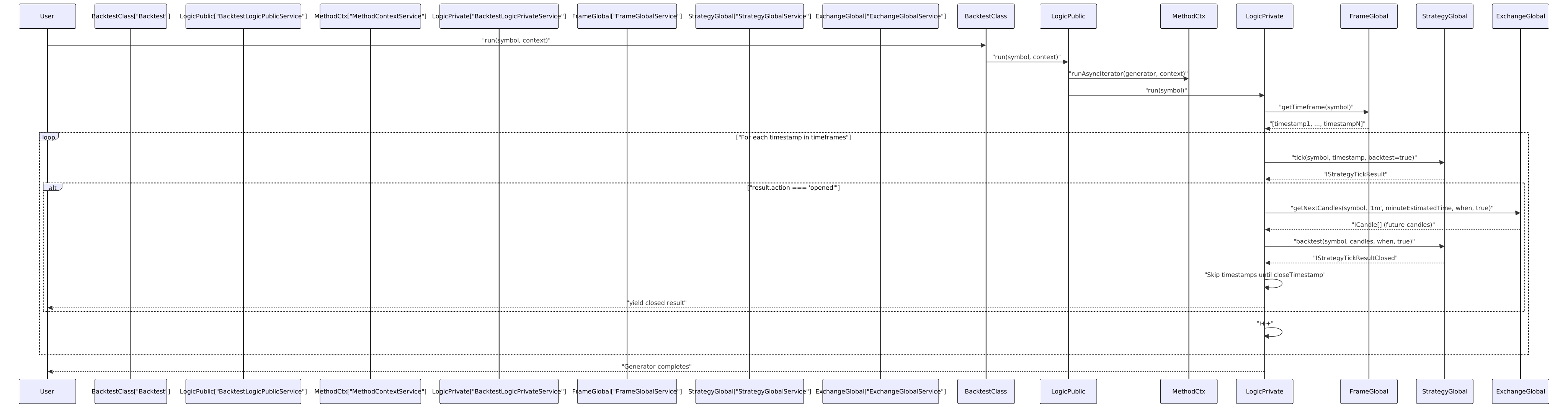
Execution Steps
-
Context Initialization - src/lib/services/logic/public/BacktestLogicPublicService.ts:46-66
BacktestLogicPublicServicewraps the generator withMethodContextService- Context contains
strategyName,exchangeName,frameName - Context is implicitly propagated to all service calls
-
Timeframe Retrieval - src/lib/services/logic/private/BacktestLogicPrivateService.ts:53
FrameGlobalService.getTimeframe()returns array of timestamps- Timestamps represent points in historical time to evaluate strategy
-
Timestamp Iteration - src/lib/services/logic/private/BacktestLogicPrivateService.ts:57-118
- Loop through each timestamp in sequential order
- Index
itracks current position in timeframe array
-
Signal Evaluation - src/lib/services/logic/private/BacktestLogicPrivateService.ts:60
- Call
StrategyGlobalService.tick(symbol, when, backtest=true) - Returns
IStrategyTickResultwith discriminated union type
- Call
-
Signal Opening - src/lib/services/logic/private/BacktestLogicPrivateService.ts:63-79
- When
result.action === "opened", signal requires simulation - Fetch future candles via
getNextCandles()for simulation period signal.minuteEstimatedTimedetermines how many future minutes to fetch
- When
-
Fast-Forward Simulation - src/lib/services/logic/private/BacktestLogicPrivateService.ts:92-97
- Call
StrategyGlobalService.backtest()with future candles - Simulates signal monitoring without iterating every timestamp
- Always returns
IStrategyTickResultClosedwith PnL
- Call
-
Timestamp Skipping - src/lib/services/logic/private/BacktestLogicPrivateService.ts:107-112
- Skip timestamps until
backtestResult.closeTimestamp - Prevents re-evaluating timestamps during active signal period
- Advances index
ito resume after signal closes
- Skip timestamps until
-
Result Streaming - src/lib/services/logic/private/BacktestLogicPrivateService.ts:114
yield backtestResultstreams closed result to consumer- Memory-efficient: no array accumulation
- Consumer can break iteration early
Memory-Efficient Streaming
The backtest system uses async generators to achieve memory efficiency when processing millions of timestamps.
Streaming vs Accumulation

Benefits of Streaming
| Benefit | Description |
|---|---|
| Constant Memory | Results are not accumulated in memory |
| Early Termination | Consumer can break iteration at any point |
| Progressive Processing | Results available immediately as they're generated |
| Large Timeframes | Can process years of data without memory overflow |
Early Termination Example
// Consumer controls iteration lifetime
for await (const result of Backtest.run("BTCUSDT", context)) {
console.log(result.pnl.pnlPercentage);
// Early termination based on condition
if (result.pnl.pnlPercentage < -10) {
console.log("Stop loss threshold reached");
break; // Generator is abandoned
}
}
Context Propagation
Backtesting uses MethodContextService to implicitly pass configuration context through the call stack without explicit parameters.
Context Flow Diagram

Context Structure
The context object passed to Backtest.run() contains three schema names:
interface IMethodContext {
strategyName: string; // Which strategy to execute
exchangeName: string; // Which exchange to fetch data from
frameName: string; // Which timeframe to iterate through
}
Context Propagation Mechanism
| Step | File | Description |
|---|---|---|
| 1. Context Specification | src/classes/Backtest.ts:37-43 | User provides context object |
| 2. Context Forwarding | src/classes/Backtest.ts:49 | BacktestUtils.run() forwards to BacktestGlobalService |
| 3. Context Injection | src/lib/services/logic/public/BacktestLogicPublicService.ts:58-64 | BacktestLogicPublicService wraps generator with MethodContextService.runAsyncIterator() |
| 4. Scope Boundary | src/lib/services/context/MethodContextService.ts:41-45 | di-scoped creates implicit context scope |
| 5. Implicit Retrieval | Service layer | Global/Connection services read context without explicit parameters |
Report Generation
The framework passively accumulates closed signals for reporting via BacktestMarkdownService.
Report Accumulation Flow

Report Usage
// Run backtest (results are accumulated automatically)
for await (const result of Backtest.run("BTCUSDT", {
strategyName: "my-strategy",
exchangeName: "binance-historical",
frameName: "1d-2023"
})) {
// Process results...
}
// Retrieve accumulated report
const markdown = await Backtest.getReport("my-strategy");
console.log(markdown);
// Save report to disk
await Backtest.dump("my-strategy", "./custom/path");
Report Methods
| Method | File | Description |
|---|---|---|
getReport(strategyName) |
src/classes/Backtest.ts:116-121 | Returns markdown string with all closed signals |
dump(strategyName, path?) |
src/classes/Backtest.ts:138-147 | Saves markdown report to filesystem |
For detailed report structure and metrics, see Markdown Report Generation and Performance Metrics.
Background Execution
The background() method consumes backtest results without exposing them to the caller, useful for running backtests purely for side effects.
Background Pattern
// Run backtest in background (no yielded results)
const cancel = await Backtest.background("BTCUSDT", {
strategyName: "my-strategy",
exchangeName: "binance-historical",
frameName: "1d-2023"
});
// Results are not returned, but:
// - BacktestMarkdownService still accumulates
// - Event listeners still fire
// - Logging still occurs
// Optional: cancel early
cancel();
Background Implementation
The background() method internally consumes the async generator without yielding values:
public background = async (symbol: string, context: {...}) => {
const iterator = this.run(symbol, context);
let isStopped = false;
const task = async () => {
while (true) {
const { done } = await iterator.next();
if (done || isStopped) break;
}
}
task();
return () => { isStopped = true; }
}
Integration with Signal Lifecycle
Backtesting integrates with the signal lifecycle state machine. For complete signal state details, see Signal Lifecycle.
State Transitions in Backtest

Signal Result Types
| Result Type | Yielded in Backtest? | Description |
|---|---|---|
IStrategyTickResultIdle |
❌ No | No signal exists |
IStrategyTickResultOpened |
❌ No | Signal opened (internal state) |
IStrategyTickResultActive |
❌ No | Signal monitoring (internal state) |
IStrategyTickResultClosed |
✅ Yes | Signal closed with PnL |
Only closed signals are yielded in backtest mode because opening immediately triggers fast-forward simulation.
Key Design Decisions
Why Async Generators?
| Decision | Rationale |
|---|---|
| Async generators over arrays | Constant memory usage, early termination support |
| Yield only closed signals | Opening triggers immediate simulation, no active state |
| Skip timestamps during signal | Avoid redundant tick evaluations |
| Stream results immediately | Progressive processing without blocking |
Why Fast-Forward Simulation?
Instead of iterating every minute during a signal's lifetime, backtest() simulates the entire signal outcome in a single call using future candles. This provides:
- Performance: O(1) call vs O(N) timestamp iterations
- Accuracy: Uses actual historical OHLCV data for simulation
- Simplicity: Signal lifecycle managed in one method
For fast-forward simulation details, see Fast-Forward Simulation.
Usage Examples
Basic Backtest
import { Backtest } from "backtest-kit";
for await (const result of Backtest.run("BTCUSDT", {
strategyName: "moving-average",
exchangeName: "binance-historical",
frameName: "daily-2023"
})) {
console.log(`Closed at ${result.closeTimestamp}`);
console.log(`PnL: ${result.pnl.pnlPercentage}%`);
console.log(`Reason: ${result.closeReason}`);
}
Conditional Termination
let totalPnl = 0;
for await (const result of Backtest.run("ETHUSDT", context)) {
totalPnl += result.pnl.pnlPercentage;
// Stop if cumulative loss exceeds threshold
if (totalPnl < -20) {
console.log("Drawdown limit reached");
break;
}
}
Report Generation
// Run backtest (accumulates results)
for await (const result of Backtest.run("BTCUSDT", context)) {
// Process results...
}
// Generate report
const report = await Backtest.getReport("moving-average");
console.log(report); // Markdown table with all signals
// Save to disk
await Backtest.dump("moving-average", "./reports");
// Writes to: ./reports/moving-average.md