Backtest API
This page documents the public API for running backtests via the Backtest utility class. The Backtest API provides methods for executing historical strategy simulations and retrieving performance statistics.
For live trading operations, see Live Trading API. For multi-strategy comparison, see Walker API. For event subscription patterns, see Event Listeners.
Overview
The Backtest class is a singleton utility that provides simplified access to backtest execution and report generation. It delegates to BacktestGlobalService for execution and BacktestMarkdownService for statistics and reporting.
Backtest API Service Architecture

Backtest Class Methods
The Backtest class exposes five public methods organized into two categories: execution methods and reporting methods.
| Method | Return Type | Purpose |
|---|---|---|
run(symbol, context) |
AsyncGenerator<IStrategyBacktestResult> |
Execute backtest with manual iteration control |
background(symbol, context) |
() => void |
Execute backtest in background, return cancel function |
getData(strategyName) |
Promise<BacktestStatistics> |
Retrieve statistical data for completed backtest |
getReport(strategyName) |
Promise<string> |
Generate markdown report with all signals |
dump(strategyName, path?) |
Promise<void> |
Save markdown report to disk |
Backtest.run()
The run() method executes a backtest for a symbol and returns an async generator that yields closed signals. This provides fine-grained control over iteration and allows early termination.
public run = (
symbol: string,
context: {
strategyName: string;
exchangeName: string;
frameName: string;
}
) => AsyncGenerator<IStrategyBacktestResult>
Execution Context: The method requires three context parameters:
strategyName- Must reference a strategy registered viaaddStrategy()(see Component Registration)exchangeName- Must reference an exchange registered viaaddExchange()(see Exchange Schemas)frameName- Must reference a frame registered viaaddFrame()(see Frame Schemas)
State Clearing: Before execution, run() clears accumulated state for the strategy:
- Clears
BacktestMarkdownServiceaccumulated signals for the strategy src/classes/Backtest.ts:52 - Clears
ScheduleMarkdownServiceaccumulated scheduled signals src/classes/Backtest.ts:53 - Clears
StrategyGlobalServiceinternal strategy state src/classes/Backtest.ts:57 - Clears
RiskGlobalServiceactive positions if strategy has ariskNamesrc/classes/Backtest.ts:61-63
Yielded Results: Each iteration yields a closed signal of type IStrategyTickResultClosed:
interface IStrategyTickResultClosed {
action: "closed";
strategyName: string;
signal: ISignalRow;
currentPrice: number;
closeTimestamp: number;
closeReason: "take_profit" | "stop_loss" | "max_lifetime";
pnl: IStrategyPnL;
}
Backtest.background()
The background() method executes a backtest in the background without yielding results. It consumes all results internally and emits completion events via doneBacktestSubject.
public background = (
symbol: string,
context: {
strategyName: string;
exchangeName: string;
frameName: string;
}
) => () => void
Cancellation Pattern: The method returns a cancellation function that can be called to stop execution. The cancellation function:
- Calls
strategyGlobalService.stop(strategyName)src/classes/Backtest.ts:119 - Sets
isStoppedflag to break iteration loop src/classes/Backtest.ts:101-106
Completion Event: When iteration completes (normally or via cancellation), the method emits a completion event to doneBacktestSubject src/classes/Backtest.ts:108-113:
await doneBacktestSubject.next({
exchangeName: context.exchangeName,
strategyName: context.strategyName,
backtest: true,
symbol,
});
Error Handling: Errors during background execution are caught and emitted to errorEmitter src/classes/Backtest.ts:115-117.
Backtest.getData()
The getData() method retrieves statistical data for a strategy after backtest execution. It delegates to BacktestMarkdownService.getData().
public getData = async (strategyName: StrategyName) => Promise<BacktestStatistics>
BacktestStatistics Interface: Returns an object with comprehensive performance metrics:
interface BacktestStatistics {
signalList: IStrategyTickResultClosed[];
totalSignals: number;
winCount: number;
lossCount: number;
winRate: number | null; // Percentage (0-100), higher is better
avgPnl: number | null; // Percentage, higher is better
totalPnl: number | null; // Cumulative percentage, higher is better
stdDev: number | null; // Volatility metric, lower is better
sharpeRatio: number | null; // Risk-adjusted return, higher is better
annualizedSharpeRatio: number | null; // Sharpe × √365, higher is better
certaintyRatio: number | null; // avgWin / |avgLoss|, higher is better
expectedYearlyReturns: number | null; // Projected annual return, higher is better
}
Safe Math: All numeric metrics return null if calculation produces NaN or Infinity src/lib/services/markdown/BacktestMarkdownService.ts:33-44.
Backtest.getReport()
The getReport() method generates a markdown-formatted report with all closed signals and statistics.
public getReport = async (strategyName: StrategyName) => Promise<string>
Report Structure: The generated markdown includes:
- Report title with strategy name src/lib/services/markdown/BacktestMarkdownService.ts:299
- Markdown table with columns defined in
columnsarray src/lib/services/markdown/BacktestMarkdownService.ts:104-177:- Signal ID, Symbol, Position, Note
- Open Price, Close Price, Take Profit, Stop Loss
- PNL (net), Close Reason, Duration (minutes)
- Open Time, Close Time
- Statistical summary with all metrics src/lib/services/markdown/BacktestMarkdownService.ts:303-312
Empty State: Returns message "No signals closed yet" if no data src/lib/services/markdown/BacktestMarkdownService.ts:282-286.
Backtest.dump()
The dump() method saves the markdown report to disk in the specified directory.
public dump = async (
strategyName: StrategyName,
path?: string // Default: "./logs/backtest"
) => Promise<void>
File Structure: The method:
- Creates directory recursively if it doesn't exist src/lib/services/markdown/BacktestMarkdownService.ts:330
- Generates filename as
{strategyName}.mdsrc/lib/services/markdown/BacktestMarkdownService.ts:332 - Writes markdown content to file src/lib/services/markdown/BacktestMarkdownService.ts:335
Default Path: If path parameter is omitted, reports are saved to ./logs/backtest/ directory src/lib/services/markdown/BacktestMarkdownService.ts:324.
Statistics Calculation Details
The BacktestMarkdownService calculates statistics using the ReportStorage class which accumulates closed signals.
Statistics Calculation Flow

Metric Calculations
The following formulas are used for statistical calculations:
Basic Metrics:
winRate = (winCount / totalSignals) × 100avgPnl = sum(pnl) / totalSignalstotalPnl = sum(pnl)
Risk Metrics:
variance = sum((pnl - avgPnl)²) / totalSignalsstdDev = sqrt(variance)sharpeRatio = avgPnl / stdDev(assuming risk-free rate = 0)annualizedSharpeRatio = sharpeRatio × sqrt(365)
Win/Loss Analysis:
avgWin = sum(wins) / winCountavgLoss = sum(losses) / lossCountcertaintyRatio = avgWin / |avgLoss|
Projected Returns:
avgDurationDays = avgDurationMs / (1000 × 60 × 60 × 24)tradesPerYear = 365 / avgDurationDaysexpectedYearlyReturns = avgPnl × tradesPerYear
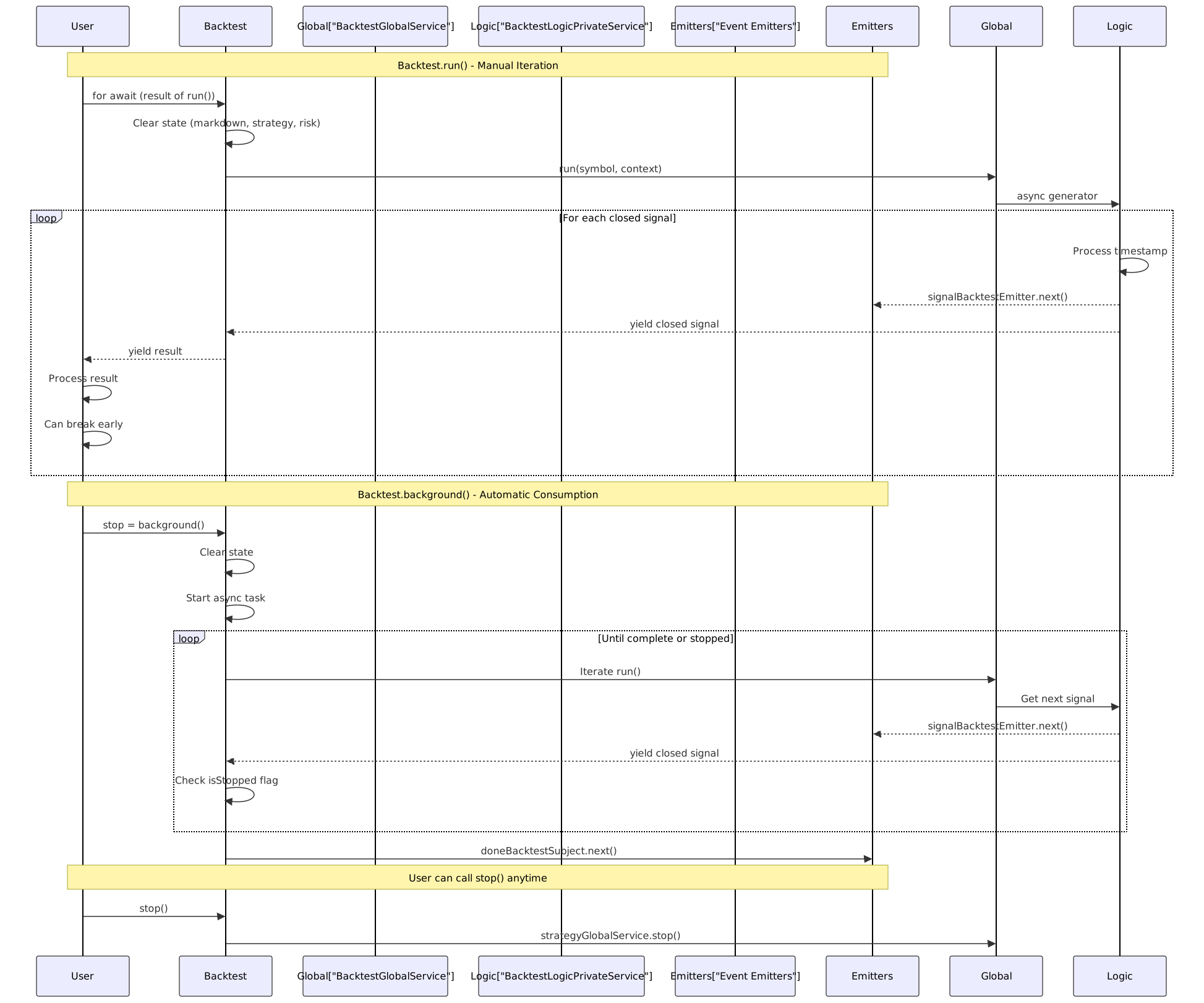
Execution Flow Comparison
The following diagram contrasts the execution patterns of run() and background() methods:
run() vs background() Execution Flow
State Management
The Backtest API clears multiple service states before execution to ensure clean runs:
| Service | Cleared Data | Purpose |
|---|---|---|
BacktestMarkdownService |
_signalList[] per strategy |
Remove accumulated closed signals |
ScheduleMarkdownService |
_eventList[] per strategy |
Remove accumulated scheduled/cancelled events |
StrategyGlobalService |
Strategy internal state | Reset _lastSignalTimestamp, signal cache |
RiskGlobalService |
_activePositions Map |
Clear portfolio position tracking |
Clearing Implementation: The clearing sequence is executed in Backtest.run():
// Clear markdown services
backtest.backtestMarkdownService.clear(context.strategyName);
backtest.scheduleMarkdownService.clear(context.strategyName);
// Clear strategy state
backtest.strategyGlobalService.clear(context.strategyName);
// Clear risk state if strategy has risk profile
const { riskName } = backtest.strategySchemaService.get(context.strategyName);
riskName && backtest.riskGlobalService.clear(riskName);
Event Integration
The Backtest API integrates with the event system through multiple emitters:
Backtest Event Emission Flow

Emitter Initialization: Event emitters are initialized in src/config/emitters.ts:1-80:
signalEmitter- All signal events (live + backtest)signalBacktestEmitter- Backtest-only signal eventsdoneBacktestSubject- Backtest completion eventsprogressEmitter- Progress updates during execution
Usage Examples
Example 1: Manual Iteration with Early Termination
import { Backtest } from "backtest-kit";
for await (const result of Backtest.run("BTCUSDT", {
strategyName: "my-strategy",
exchangeName: "binance",
frameName: "1d-backtest"
})) {
console.log("Signal closed:", result.signal.id);
console.log("PNL:", result.pnl.pnlPercentage);
// Early termination on large loss
if (result.pnl.pnlPercentage < -5) {
console.log("Stopping due to large loss");
break;
}
}
// Get final statistics
const stats = await Backtest.getData("my-strategy");
console.log("Final Sharpe Ratio:", stats.sharpeRatio);
Example 2: Background Execution with Event Listeners
import { Backtest, listenSignalBacktest, listenDoneBacktest } from "backtest-kit";
// Subscribe to events before starting
listenSignalBacktest((event) => {
if (event.action === "closed") {
console.log("PNL:", event.pnl.pnlPercentage);
}
});
listenDoneBacktest((event) => {
console.log("Backtest completed for:", event.symbol);
Backtest.dump(event.strategyName); // Auto-save report
});
// Run in background
const stop = Backtest.background("BTCUSDT", {
strategyName: "my-strategy",
exchangeName: "binance",
frameName: "1d-backtest"
});
// Can cancel anytime
// stop();
Example 3: Multi-Symbol Portfolio Analysis
import { Backtest } from "backtest-kit";
const symbols = ["BTCUSDT", "ETHUSDT", "SOLUSDT"];
for (const symbol of symbols) {
for await (const _ of Backtest.run(symbol, {
strategyName: "my-strategy",
exchangeName: "binance",
frameName: "2024-backtest"
})) {
// Consume results
}
// Generate report per symbol
await Backtest.dump("my-strategy", `./logs/backtest/${symbol}`);
}
// Get aggregated statistics
const stats = await Backtest.getData("my-strategy");
console.log("Portfolio metrics:", {
totalSignals: stats.totalSignals,
winRate: stats.winRate,
sharpeRatio: stats.sharpeRatio
});
Related APIs
For scheduled signals tracking, use the Schedule utility class documented in Schedule API. The Schedule API tracks priceOpen scheduled signals that may be cancelled before activation.
For live trading execution, see Live Trading API. The Live API provides crash-safe persistence and real-time monitoring with a similar interface pattern.
For comparing multiple strategies in parallel, see Walker API. The Walker API internally uses Backtest.run() to execute each strategy and rank results by selected metrics.