Live Trading API
This page documents the public-facing Live Trading API provided by the Live class. This API enables production-ready live trading execution with infinite async generators, crash-safe state persistence, and real-time signal monitoring. The API is designed for production use with automatic state recovery after process crashes.
For backtesting operations, see Backtest API. For detailed implementation of crash recovery mechanisms, see Crash Recovery. For signal persistence internals, see Signal Persistence. For the complete live execution flow including service orchestration, see Live Execution Flow.
Overview
The Live Trading API is implemented as a singleton class LiveUtils exported as Live. It provides four primary methods for live trading operations:
| Method | Return Type | Purpose |
|---|---|---|
run() |
AsyncIterableIterator<IStrategyTickResult> |
Infinite generator yielding signal events |
background() |
Promise<() => void> |
Background execution with cancellation |
getReport() |
Promise<string> |
Generate markdown report |
dump() |
Promise<void> |
Save report to disk |
Unlike the Backtest API which terminates when the timeframe is exhausted, the Live API runs indefinitely until manually stopped or the process crashes. State is persisted atomically before each signal transition, enabling seamless recovery on restart.
Live.run Method
Signature
Live.run(
symbol: string,
context: {
strategyName: string;
exchangeName: string;
}
): AsyncIterableIterator<IStrategyTickResult>
The run() method initiates live trading execution for a trading pair. It returns an infinite async generator that yields signal events in real-time. The generator executes with 1-minute intervals, monitoring active signals and checking for new signal generation opportunities.
Execution Characteristics

Diagram: Live.run Execution Path
The execution flow propagates through dependency injection layers:
Live.run()logs the request and delegates toliveGlobalServiceLiveGlobalServicewraps the call withMethodContextServicefor context propagationLiveLogicPrivateServiceimplements the infinite generator with 1-minute sleep intervals- Each iteration calls
strategyGlobalService.tick()to check signal state - State changes are persisted atomically via
PersistSignalAdapterbefore yielding
Yielded Results
The generator yields only opened and closed results. The idle and active states are filtered out to reduce noise in live mode:
| Result Type | When Yielded | Signal State |
|---|---|---|
IStrategyTickResultOpened |
New signal created and validated | Just opened |
IStrategyTickResultClosed |
Signal hit TP/SL or time expired | Just closed |
IStrategyTickResultIdle |
❌ Not yielded in live mode | No active signal |
IStrategyTickResultActive |
❌ Not yielded in live mode | Monitoring signal |
This filtering is implemented in src/lib/services/logic/private/LiveLogicPrivateService.ts where only opened and closed actions are yielded to the caller.
State Persistence and Recovery
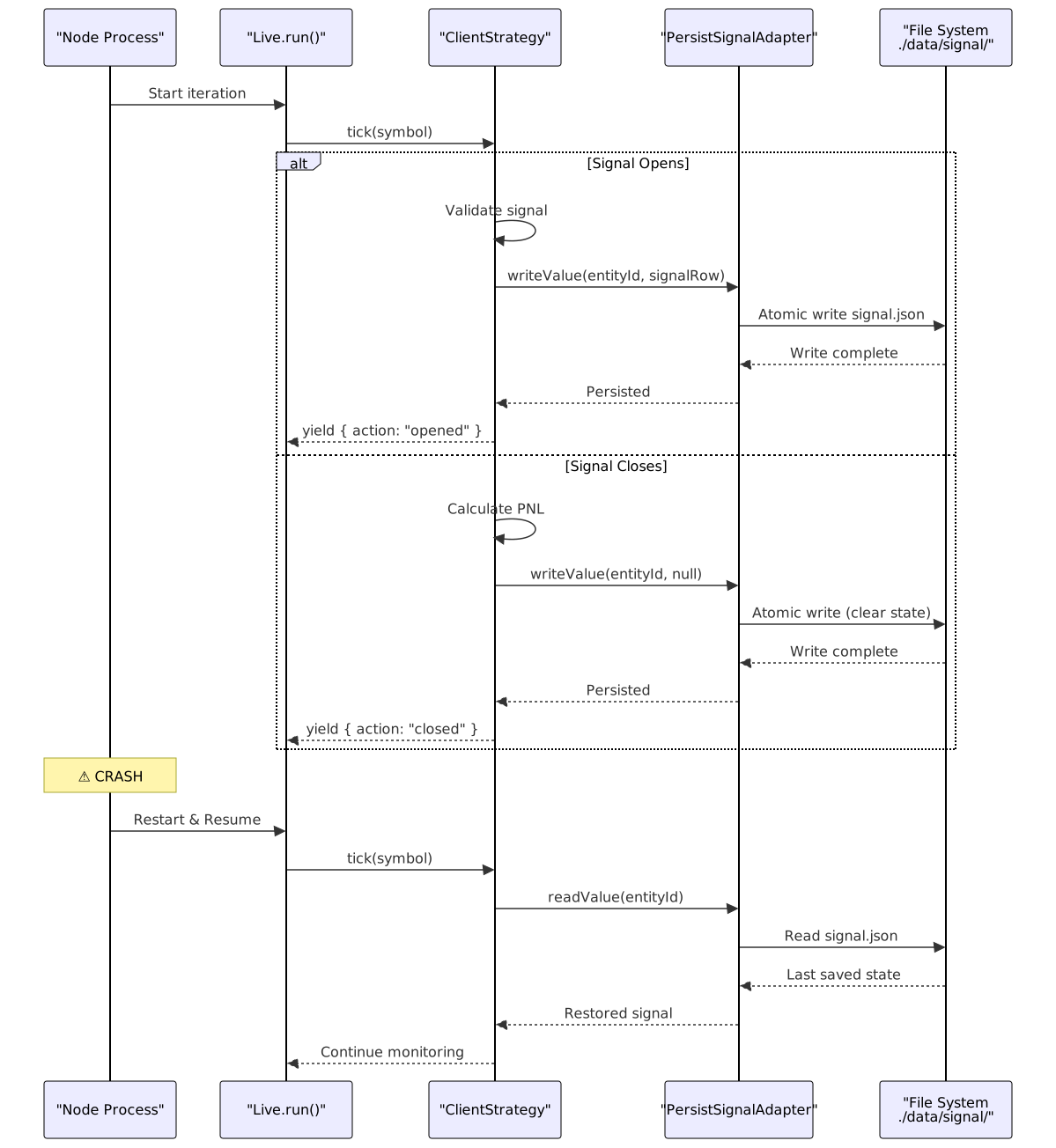
Diagram: Crash Recovery Flow
Every signal state change is persisted atomically before yielding results. This ensures:
- No duplicate signals after restart
- No lost signals during crashes
- Deterministic recovery to last known state
Live.background Method
Signature
Live.background(
symbol: string,
context: {
strategyName: string;
exchangeName: string;
}
): Promise<() => void>
The background() method runs live trading without yielding results to the caller. It internally consumes all generator values, allowing the strategy to execute for side effects only (callbacks, persistence, logging). Returns a cancellation function to stop execution gracefully.
Implementation Details
// Implementation from src/classes/Live.ts:85-117
public background = async (symbol, context) => {
const iterator = this.run(symbol, context);
let isStopped = false;
let lastValue = null;
const task = async () => {
while (true) {
const { value, done } = await iterator.next();
if (value) {
lastValue = value;
}
if (done) break;
if (lastValue?.action === "closed" && isStopped) break;
}
}
task(); // Fire and forget
return () => { isStopped = true; }; // Cancellation closure
}
The method waits for the next closed event before honoring the cancellation flag. This ensures signals are not interrupted mid-lifecycle.
Cancellation Behavior

Diagram: Background Cancellation State Machine
The cancellation mechanism ensures signals are not left in an inconsistent state when stopping live trading.
Reporting Methods
Live.getReport
Live.getReport(strategyName: string): Promise<string>
Generates a markdown-formatted report for the specified strategy. The report includes:
- Total event count (idle, opened, active, closed)
- Closed signals count
- Win rate calculation (percentage, wins/losses)
- Average PNL across all closed signals
- Signal-by-signal table with timestamps, prices, and outcomes
The report is generated by LiveMarkdownService which accumulates events passively via event listeners.
Live.dump
Live.dump(
strategyName: string,
path?: string
): Promise<void>
Saves the markdown report to disk. Default path is ./logs/live/{strategyName}.md. Custom paths can be specified via the optional path parameter.
Report Output Format
| Section | Content |
|---|---|
| Header | Strategy name, total events, closed signals |
| Statistics | Win rate (% and W/L ratio), average PNL |
| Signal Table | Columns: Timestamp, Action, Symbol, Signal ID, Position, Prices (Open/TP/SL), PNL, Close Reason |
Result Type System
The generator yields a discriminated union IStrategyTickResult with the action field as the discriminator:

Diagram: Live Result Type Hierarchy
Type guards enable safe property access:
for await (const result of Live.run("BTCUSDT", context)) {
if (result.action === "opened") {
// TypeScript knows: result is IStrategyTickResultOpened
console.log(result.signal.id);
} else if (result.action === "closed") {
// TypeScript knows: result is IStrategyTickResultClosed
console.log(result.pnl.pnlPercentage);
console.log(result.closeReason);
}
}
Usage Patterns
Basic Live Trading Loop
// Reference: README.md:142-169
import { Live } from "backtest-kit";
for await (const result of Live.run("BTCUSDT", {
strategyName: "my-strategy",
exchangeName: "binance"
})) {
if (result.action === "opened") {
console.log("Signal opened:", result.signal.id);
// State already persisted to disk
}
if (result.action === "closed") {
console.log("Closed:", {
reason: result.closeReason,
pnl: result.pnl.pnlPercentage
});
// Generate report after each close
await Live.dump("my-strategy");
}
}
Background Execution with Event Listeners
// Reference: README.md:387-418
import { Live, listenSignalLive } from "backtest-kit";
// Start background execution
const cancel = await Live.background("BTCUSDT", {
strategyName: "my-strategy",
exchangeName: "binance"
});
// React to events
listenSignalLive((event) => {
if (event.action === "closed") {
console.log("PNL:", event.pnl.pnlPercentage);
}
});
// Stop on condition
setTimeout(() => cancel(), 3600000); // Stop after 1 hour
Multi-Symbol Live Trading
// Reference: README.md:693-715
import { Live } from "backtest-kit";
const symbols = ["BTCUSDT", "ETHUSDT", "SOLUSDT"];
await Promise.all(
symbols.map(async (symbol) => {
for await (const result of Live.run(symbol, {
strategyName: "my-strategy",
exchangeName: "binance"
})) {
console.log(`[${symbol}]`, result.action);
}
})
);
Each symbol maintains independent state persistence in separate files: ./data/signal/binance-my-strategy-BTCUSDT.json, etc.
Comparison with Backtest API
| Feature | Live.run() | Backtest.run() |
|---|---|---|
| Generator Type | Infinite | Finite (exhausts timeframe) |
| Time Progression | Real-time (Date.now()) | Historical (frame timestamps) |
| Sleep Interval | 1 minute + 1ms | No sleep (fast iteration) |
| Yielded Results | opened, closed only |
closed only (after fast-forward) |
| State Persistence | Enabled (crash recovery) | Disabled (stateless) |
| Context Parameter | { strategyName, exchangeName } |
{ strategyName, exchangeName, frameName } |
| Termination | Manual (break/cancel) | Automatic (frame end) |
Service Integration

Diagram: Live API Service Dependencies
The Live API delegates to service layers which handle:
- Context Propagation:
MethodContextServiceandExecutionContextServiceinject implicit context - Strategy Execution:
StrategyGlobalServiceroutes to correctClientStrategyinstance - State Management:
PersistSignalAdapterhandles crash-safe file writes - Reporting:
LiveMarkdownServiceaccumulates events passively
Error Handling
The Live API does not catch exceptions - they bubble up to the caller. This design enables crash recovery:
- Process crashes → State persisted on disk
- Process restarts → State loaded from disk
- Execution resumes → No duplicate signals
For custom error handling, wrap the generator in try-catch:
try {
for await (const result of Live.run("BTCUSDT", context)) {
// Process result
}
} catch (error) {
console.error("Live trading error:", error);
// Log, alert, restart, etc.
}