Fast-Forward Simulation
Purpose and Scope
Fast-forward simulation is an optimization technique used during backtesting to efficiently process historical data without iterating tick-by-tick through every timestamp in the timeframe. Instead of calling strategy.tick() repeatedly, the framework invokes strategy.backtest() once per signal, passing an array of candle data covering the signal's entire lifetime.
This page documents the fast-forward mechanism implemented in ClientStrategy.backtest() and its integration with the backtest execution flow. For the overall backtest orchestration, see Backtest Execution Flow. For timeframe generation, see Timeframe Generation.
Key Benefits:
- Performance: Processes signals 100-1000x faster than tick-by-tick simulation
- Determinism: Uses candle
high/lowfor precise TP/SL detection - Memory Efficiency: Streams results without accumulating intermediate states
- Accuracy: Accounts for intra-candle price movements via VWAP
Fast-Forward vs. Tick-by-Tick Execution
The framework supports two execution modes for strategy evaluation:
| Mode | Method | Use Case | Time Progression | Result Type |
|---|---|---|---|---|
| Tick | strategy.tick() |
Live trading | Real-time (Date.now()) |
IStrategyTickResult (idle/opened/active/closed) |
| Backtest | strategy.backtest(candles) |
Historical simulation | Fast-forward via candle array | IStrategyBacktestResult (closed/cancelled) |
Execution Flow Diagram:

Core Backtest Method
The ClientStrategy.backtest() method implements the fast-forward simulation logic. It receives a candle array and returns a closed or cancelled result.
Method Signature:
backtest: (candles: ICandleData[]) => Promise<IStrategyBacktestResult>
Return Types:
IStrategyTickResultClosed: Signal completed via TP, SL, or time expirationIStrategyTickResultCancelled: Scheduled signal never activated
Processing Logic:

Candle-Based TP/SL Detection
Fast-forward simulation achieves accuracy by checking Take Profit and Stop Loss conditions against candle high/low prices rather than just close prices. This captures intra-candle price movements.
Detection Logic for Long Positions:
// PROCESS_PENDING_SIGNAL_CANDLES_FN logic
if (signal.position === "long") {
if (currentCandle.high >= signal.priceTakeProfit) {
closeReason = "take_profit";
// Use exact TP price, not candle high
} else if (currentCandle.low <= signal.priceStopLoss) {
closeReason = "stop_loss";
// Use exact SL price, not candle low
}
}
Detection Logic for Short Positions:
if (signal.position === "short") {
if (currentCandle.low <= signal.priceTakeProfit) {
closeReason = "take_profit";
} else if (currentCandle.high >= signal.priceStopLoss) {
closeReason = "stop_loss";
}
}
Price Resolution Diagram:

Key Implementation Details:
-
Exact Price Usage: When TP/SL is hit, the result uses the exact
priceTakeProfitorpriceStopLossvalue, not the candle's high/low. This ensures consistent PNL calculations. -
Priority Order: Time expiration is checked first, then TP/SL. If
minuteEstimatedTimeexpires, the signal closes at current VWAP price regardless of TP/SL proximity. -
VWAP Calculation: Average price is calculated using volume-weighted average of recent candles (controlled by
CC_AVG_PRICE_CANDLES_COUNT).
VWAP-Based Average Price Calculation
The framework calculates Volume-Weighted Average Price (VWAP) for each candle to determine current market conditions. This provides more accurate pricing than simple close price.
VWAP Formula:
const GET_AVG_PRICE_FN = (candles: ICandleData[]): number => {
const sumPriceVolume = candles.reduce((acc, c) => {
const typicalPrice = (c.high + c.low + c.close) / 3;
return acc + typicalPrice * c.volume;
}, 0);
const totalVolume = candles.reduce((acc, c) => acc + c.volume, 0);
return totalVolume === 0
? candles.reduce((acc, c) => acc + c.close, 0) / candles.length
: sumPriceVolume / totalVolume;
};
VWAP Calculation Process:

Window Size Configuration:
The number of recent candles used for VWAP calculation is controlled by GLOBAL_CONFIG.CC_AVG_PRICE_CANDLES_COUNT (default: 3).
const candlesCount = GLOBAL_CONFIG.CC_AVG_PRICE_CANDLES_COUNT;
for (let i = candlesCount - 1; i < candles.length; i++) {
const recentCandles = candles.slice(i - (candlesCount - 1), i + 1);
const averagePrice = GET_AVG_PRICE_FN(recentCandles);
// Check TP/SL against averagePrice
}
Scheduled Signal Processing
Scheduled signals require a two-phase fast-forward simulation: first monitoring for price activation (or cancellation), then monitoring TP/SL if activated.
Two-Phase Process Diagram:

Phase 1: Activation Monitoring (PROCESS_SCHEDULED_SIGNAL_CANDLES_FN)
This function iterates through candles looking for:
- Timeout:
candle.timestamp - scheduled.scheduledAt >= CC_SCHEDULE_AWAIT_MINUTES - Stop Loss Hit: Price moves against position before activation
- Price Activation: Price reaches
priceOpen
Priority Logic:
// Timeout checked FIRST
const elapsedTime = candle.timestamp - scheduled.scheduledAt;
if (elapsedTime >= maxTimeToWait) {
return { cancelled: true, result: CancelledResult };
}
// Then check SL (cancel prioritized over activation)
if (scheduled.position === "long") {
if (candle.low <= scheduled.priceStopLoss) {
shouldCancel = true;
} else if (candle.low <= scheduled.priceOpen) {
shouldActivate = true;
}
}
Phase 2: TP/SL Monitoring
If the scheduled signal activates, the function:
- Updates
pendingAtto activation timestamp - Adds signal to risk tracker
- Continues processing remaining candles for TP/SL detection
Candle Fetch Strategy:
For scheduled signals, BacktestLogicPrivateService fetches extra candles to account for activation delay:
// CC_SCHEDULE_AWAIT_MINUTES for activation monitoring
// + minuteEstimatedTime for TP/SL monitoring after activation
// +1 because first candle is inclusive
const candlesNeeded =
GLOBAL_CONFIG.CC_SCHEDULE_AWAIT_MINUTES +
signal.minuteEstimatedTime +
1;
Pending Signal Processing
For immediate signals (no priceOpen specified) or after scheduled signal activation, the framework processes the pending signal by monitoring TP/SL conditions.
Processing Flow (PROCESS_PENDING_SIGNAL_CANDLES_FN):

Critical Timing Detail:
The minuteEstimatedTime countdown starts from signal.pendingAt, not signal.scheduledAt. This distinction is critical for scheduled signals where activation occurs after creation:
// Time expiration check uses pendingAt
const signalTime = signal.pendingAt; // NOT scheduledAt!
const maxTimeToWait = signal.minuteEstimatedTime * 60 * 1000;
const elapsedTime = currentCandleTimestamp - signalTime;
if (elapsedTime >= maxTimeToWait) {
shouldClose = true;
closeReason = "time_expired";
}
Why This Matters:
For a scheduled signal:
scheduledAt: Timestamp when signal was createdpendingAt: Timestamp when price reachedpriceOpenand position activated
If minuteEstimatedTime counted from scheduledAt, the signal would close prematurely, incurring trading fees without adequate time to reach TP.
Integration with Backtest Execution
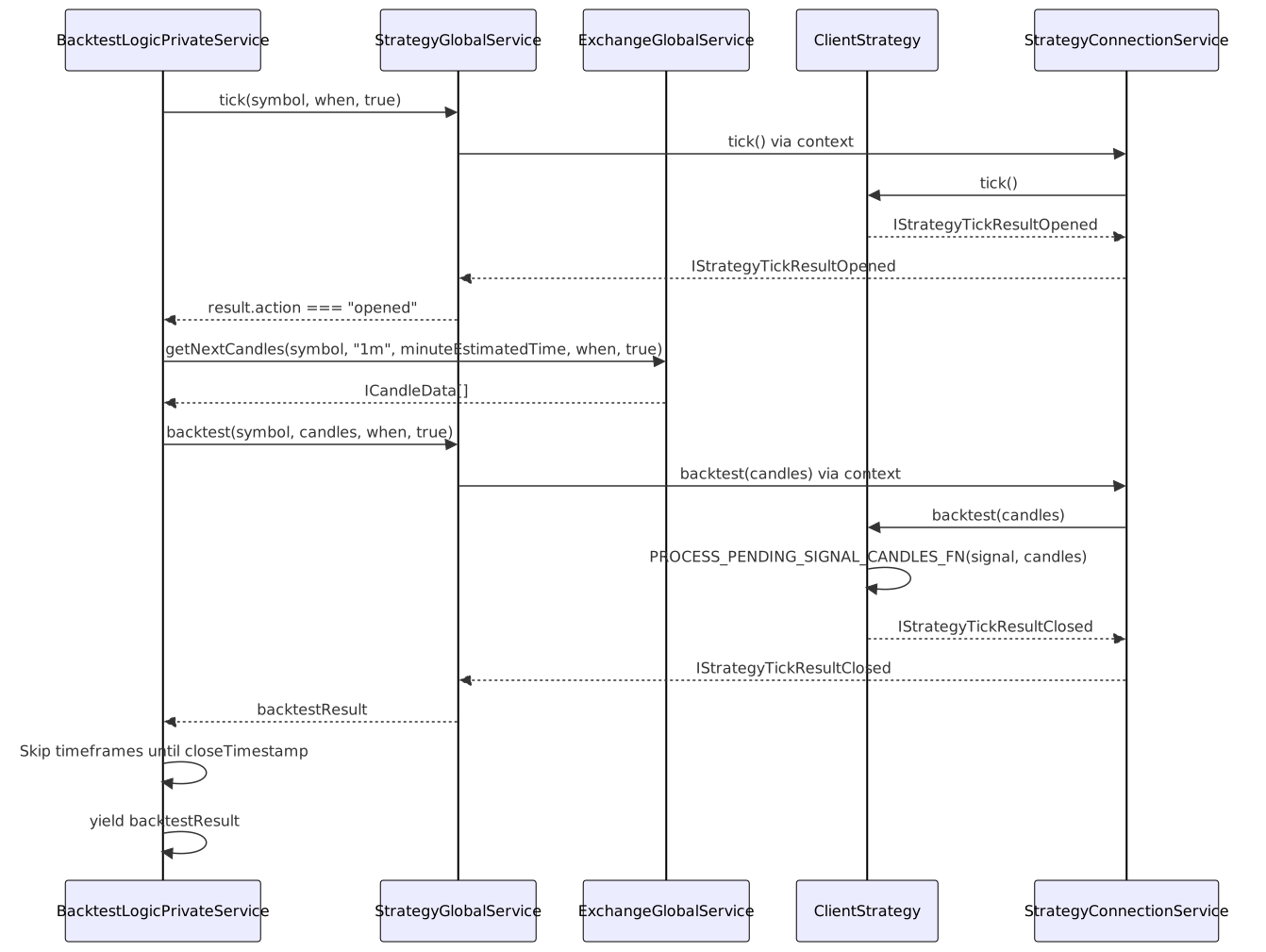
The fast-forward mechanism integrates tightly with BacktestLogicPrivateService, which orchestrates the backtest loop.
Execution Context Flow:
Timeframe Skipping Optimization:
After backtest() returns a closed result, the service skips all timeframes until backtestResult.closeTimestamp:
// Skip timeframes until closeTimestamp
while (
i < timeframes.length &&
timeframes[i].getTime() < backtestResult.closeTimestamp
) {
i++;
}
yield backtestResult;
This prevents redundant tick() calls during periods where a signal is already open and being processed.
Performance Characteristics
Fast-forward simulation provides significant performance advantages over tick-by-tick iteration:
Performance Comparison:
| Aspect | Tick-by-Tick | Fast-Forward | Improvement |
|---|---|---|---|
| Function Calls | O(timeframes) = 1440 calls/day | O(signals) ≈ 10-100 calls/day | 10-100x reduction |
| Candle Fetches | None (uses frame timestamps) | 1 per signal | Batch fetch efficiency |
| State Management | Persist every tick (live) | No persistence (backtest) | No I/O overhead |
| Memory Usage | 1 timestamp at a time | N candles (typically 30-1440) | Minimal impact |
Timing Metrics:
The framework emits performance events via performanceEmitter to track execution times:
// Tracked metric types
"backtest_total" // Total backtest duration
"backtest_timeframe" // Single timeframe processing
"backtest_signal" // Single signal backtest() call
"live_tick" // Single tick() call in live mode
Example Measurements:
For a 30-day backtest with 15-minute signals:
- Tick-by-tick: ~43,200 tick calls (30 days × 24 hours × 60 minutes)
- Fast-forward: ~100 backtest calls (assuming ~3 signals/day)
- Speedup: ~430x fewer function calls
Determinism and Reproducibility
Fast-forward simulation produces deterministic results because:
- Fixed Candle Data: Backtests use historical data from
Frame.getTimeframe(), which returns a static array - Timestamp Progression: Time advances in discrete intervals (frame timestamps), not real-time
- No External State: All state is encapsulated in
ClientStrategyinstance - Exact Price Matching: TP/SL detection uses exact prices, not approximations
Reproducibility Guarantee:
Running the same backtest with identical parameters produces identical results:
// Same inputs
const config = {
strategyName: "my-strategy",
exchangeName: "my-exchange",
frameName: "2024-backtest",
};
// Run 1
const results1 = await Backtest.run("BTCUSDT", config);
// Run 2
const results2 = await Backtest.run("BTCUSDT", config);
// results1 === results2 (deep equality)
// - Same signals generated
// - Same TP/SL/time_expired outcomes
// - Same PNL percentages
// - Same closeTimestamps
This determinism is critical for:
- Strategy Development: Iterative testing without environmental noise
- Walker Optimization: Fair comparison between strategy variants
- Regression Testing: Verify framework changes don't alter outcomes
Code Entity Reference
Primary Classes and Functions:
| Entity | Location | Role |
|---|---|---|
ClientStrategy.backtest() |
src/client/ClientStrategy.ts:1188-1318 | Main fast-forward entry point |
PROCESS_SCHEDULED_SIGNAL_CANDLES_FN |
src/client/ClientStrategy.ts:1048-1134 | Phase 1: Activation monitoring |
PROCESS_PENDING_SIGNAL_CANDLES_FN |
src/client/ClientStrategy.ts:1136-1186 | Phase 2: TP/SL monitoring |
GET_AVG_PRICE_FN |
src/client/ClientStrategy.ts:285-296 | VWAP calculation |
BacktestLogicPrivateService.run() |
src/lib/services/logic/private/BacktestLogicPrivateService.ts:59-300 | Orchestration loop |
StrategyConnectionService.backtest() |
src/lib/services/connection/StrategyConnectionService.ts:132-150 | DI routing layer |
Configuration Parameters:
| Parameter | Default | Purpose |
|---|---|---|
CC_AVG_PRICE_CANDLES_COUNT |
3 | VWAP window size |
CC_SCHEDULE_AWAIT_MINUTES |
120 | Scheduled signal timeout |
CC_MAX_SIGNAL_LIFETIME_MINUTES |
10080 | Maximum signal duration (7 days) |