Performance Metrics
Purpose
This document describes the performance metrics system in backtest-kit, which tracks execution timing and duration analysis for strategy operations. Performance metrics provide timing data for identifying bottlenecks, analyzing execution patterns, and optimizing strategy performance. These metrics are distinct from trading statistics (see 13.3 for PNL calculations and trading performance).
For general reporting capabilities, see 13.1. For event system architecture, see 3.4.
Performance Metric Types
The framework tracks four types of performance metrics, defined by the PerformanceMetricType enum:
| Metric Type | Scope | Description | Execution Mode |
|---|---|---|---|
backtest_total |
Entire backtest | Total duration from start to completion of all timeframes | Backtest only |
backtest_timeframe |
Single timeframe | Duration to process one timestamp (tick + potential signal handling) | Backtest only |
backtest_signal |
Single signal | Duration to process signal lifecycle (from open to close via backtest method) | Backtest only |
live_tick |
Single tick | Duration to execute one tick cycle in live trading | Live only |
Performance Tracking Architecture

Performance Tracking Flow
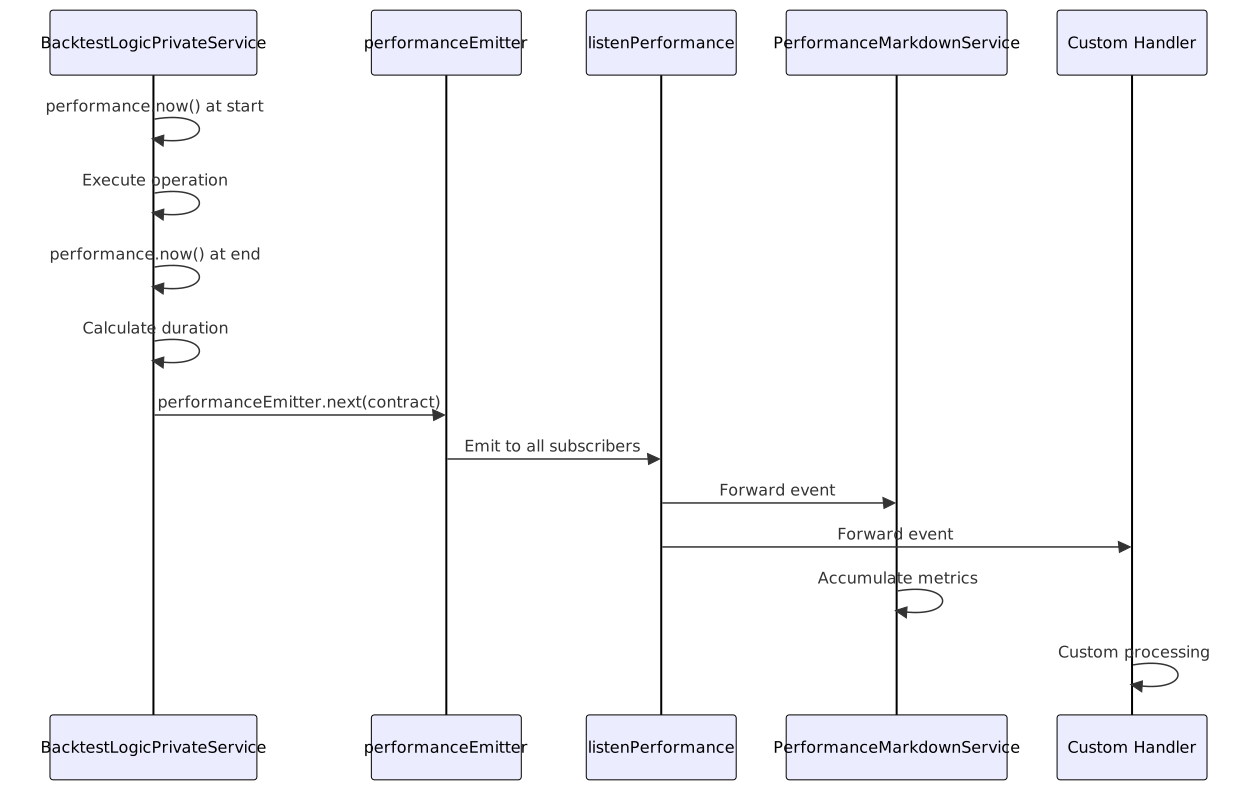
The framework instruments critical operations by recording performance.now() timestamps at operation boundaries, calculating duration, and emitting structured events via performanceEmitter.
Backtest Performance Tracking
Total Backtest Duration
Tracks the complete execution time from the first timeframe to the last:

Timeframe Processing Duration
Tracks the time to process a single timestamp, including tick execution and potential signal handling:

Signal Processing Duration
Tracks the time to execute the fast-forward backtest simulation for a single signal from open to close:

This metric captures the duration of the optimized backtest path, including candle fetching and TP/SL detection via high/low analysis.
Live Trading Performance Tracking
Tick Duration
Tracks the time to execute a complete tick cycle in live trading, including signal generation, risk checks, and TP/SL monitoring:

Performance Contract Structure
The PerformanceContract interface defines the structure of emitted performance events:
| Field | Type | Description |
|---|---|---|
timestamp |
number |
Unix timestamp (milliseconds) when event was emitted |
previousTimestamp |
number | null |
Timestamp of previous performance event for calculating gaps |
metricType |
PerformanceMetricType |
Type of metric: backtest_total, backtest_timeframe, backtest_signal, live_tick |
duration |
number |
Execution duration in milliseconds |
strategyName |
string |
Strategy name being executed |
exchangeName |
string |
Exchange name being used |
symbol |
string |
Trading pair symbol (e.g., "BTCUSDT") |
backtest |
boolean |
true for backtest mode, false for live mode |
Previous Timestamp Tracking
Each service maintains previousEventTimestamp to track the time between successive performance events. This enables analysis of execution gaps and idle time:
// From BacktestLogicPrivateService
let previousEventTimestamp: number | null = null;
// ... later in code
const currentTimestamp = Date.now();
await performanceEmitter.next({
timestamp: currentTimestamp,
previousTimestamp: previousEventTimestamp,
metricType: "backtest_timeframe",
duration: timeframeEndTime - timeframeStartTime,
// ... other fields
});
previousEventTimestamp = currentTimestamp;
Subscribing to Performance Events
Using listenPerformance
The listenPerformance() function subscribes to all performance metric events:
import { listenPerformance } from "backtest-kit";
listenPerformance((event) => {
console.log(`[${event.metricType}] ${event.strategyName} - ${event.duration.toFixed(2)}ms`);
if (event.previousTimestamp !== null) {
const gap = event.timestamp - event.previousTimestamp;
console.log(` Time since last event: ${gap.toFixed(2)}ms`);
}
});
Performance Event Flow
Use Cases and Patterns
Identifying Bottlenecks
Track which operations consume the most time:
import { listenPerformance, PerformanceContract } from "backtest-kit";
const durations: Record<string, number[]> = {
backtest_total: [],
backtest_timeframe: [],
backtest_signal: [],
live_tick: [],
};
listenPerformance((event: PerformanceContract) => {
durations[event.metricType].push(event.duration);
});
// After execution, analyze
Object.entries(durations).forEach(([type, values]) => {
const avg = values.reduce((a, b) => a + b, 0) / values.length;
const max = Math.max(...values);
console.log(`${type}: avg=${avg.toFixed(2)}ms, max=${max.toFixed(2)}ms`);
});
Detecting Performance Degradation
Monitor execution time increases over the course of a backtest:
import { listenPerformance } from "backtest-kit";
const timeframeMetrics: { index: number; duration: number }[] = [];
let frameIndex = 0;
listenPerformance((event) => {
if (event.metricType === "backtest_timeframe") {
timeframeMetrics.push({ index: frameIndex++, duration: event.duration });
// Check if last 100 frames are 2x slower than first 100
if (frameIndex === 200) {
const first100Avg = timeframeMetrics.slice(0, 100)
.reduce((sum, m) => sum + m.duration, 0) / 100;
const last100Avg = timeframeMetrics.slice(100, 200)
.reduce((sum, m) => sum + m.duration, 0) / 100;
if (last100Avg > first100Avg * 2) {
console.warn("Performance degradation detected!");
}
}
}
});
Comparing Strategy Performance
Track execution time across multiple strategies in Walker mode:
import { listenPerformance, Walker } from "backtest-kit";
const strategyTimings: Record<string, number> = {};
listenPerformance((event) => {
if (event.metricType === "backtest_total") {
strategyTimings[event.strategyName] = event.duration;
}
});
// After walker completion
Object.entries(strategyTimings).forEach(([strategy, duration]) => {
console.log(`${strategy}: ${(duration / 1000).toFixed(2)} seconds`);
});
Real-time Performance Monitoring
Track live trading tick performance:
import { listenPerformance } from "backtest-kit";
const recentTicks: number[] = [];
const WINDOW_SIZE = 100;
listenPerformance((event) => {
if (event.metricType === "live_tick") {
recentTicks.push(event.duration);
if (recentTicks.length > WINDOW_SIZE) {
recentTicks.shift();
}
const avg = recentTicks.reduce((a, b) => a + b, 0) / recentTicks.length;
// Alert if tick takes too long
if (event.duration > avg * 3) {
console.warn(`Slow tick detected: ${event.duration.toFixed(2)}ms (avg: ${avg.toFixed(2)}ms)`);
}
}
});
Performance Data Accumulation
The PerformanceMarkdownService subscribes to performance events and accumulates metrics for later analysis. The service maintains a separate storage instance per strategy, allowing isolated performance tracking across multiple concurrent executions.
Timing Precision
The framework uses performance.now() from Node.js for high-resolution timing:
- Resolution: Microsecond precision (typically 0.001ms)
- Monotonic: Not affected by system clock adjustments
- Isolated: Each measurement is self-contained
Example Timing Instrumentation
// From BacktestLogicPrivateService.ts
const backtestStartTime = performance.now();
// ... execute operations ...
const backtestEndTime = performance.now();
const duration = backtestEndTime - backtestStartTime;
await performanceEmitter.next({
timestamp: Date.now(),
previousTimestamp: previousEventTimestamp,
metricType: "backtest_total",
duration,
strategyName: this.methodContextService.context.strategyName,
exchangeName: this.methodContextService.context.exchangeName,
symbol,
backtest: true,
});
Integration with Other Systems
Performance metrics integrate with the broader framework architecture:
| System | Integration Point | Purpose |
|---|---|---|
| Event System | performanceEmitter (Subject) |
Publish-subscribe for metrics distribution |
| Reporting | PerformanceMarkdownService |
Accumulate and format performance reports |
| Context Propagation | MethodContextService |
Inject strategy/exchange names into metrics |
| Execution Modes | BacktestLogicPrivateService, LiveLogicPrivateService |
Instrument operations with timing |