Signal States
Purpose and Scope
This document provides comprehensive documentation of the six discrete states that a trading signal can occupy during its lifecycle in backtest-kit. Each state is represented by a distinct TypeScript interface as part of a discriminated union (IStrategyTickResult), enabling type-safe state handling throughout the system.
For information about the complete signal lifecycle flow and state transitions, see Signal Lifecycle Overview. For details on signal generation and validation, see Signal Generation and Validation. For information on how signals are persisted across crashes in live mode, see Signal Persistence.
State Machine Overview
The signal state machine consists of six mutually exclusive states, represented as a discriminated union with the action field as the discriminator:

Discriminated Union Type
All signal states are unified under the IStrategyTickResult discriminated union type:
type IStrategyTickResult =
| IStrategyTickResultIdle
| IStrategyTickResultScheduled
| IStrategyTickResultOpened
| IStrategyTickResultActive
| IStrategyTickResultClosed
| IStrategyTickResultCancelled;
The action field serves as the discriminator, enabling TypeScript to narrow types in conditional branches:
// Type guard example
if (result.action === "closed") {
// TypeScript knows result is IStrategyTickResultClosed
console.log(result.closeReason); // ✓ Valid
console.log(result.pnl.pnlPercentage); // ✓ Valid
}
State: Idle
Interface: IStrategyTickResultIdle
Purpose: Represents the absence of an active trading position. The strategy is monitoring the market but has no open signal.
Type Definition
interface IStrategyTickResultIdle {
action: "idle";
signal: null;
strategyName: StrategyName;
exchangeName: ExchangeName;
symbol: string;
currentPrice: number;
}
Properties
| Property | Type | Description |
|---|---|---|
action |
"idle" |
Discriminator value for type narrowing |
signal |
null |
Always null in idle state (no active signal) |
strategyName |
StrategyName |
Strategy identifier for tracking |
exchangeName |
ExchangeName |
Exchange identifier for tracking |
symbol |
string |
Trading pair symbol (e.g., "BTCUSDT") |
currentPrice |
number |
Current VWAP price at idle state |
State Transitions
The idle state can transition to:
- scheduled: When
getSignal()returns a signal withpriceOpenspecified - opened: When
getSignal()returns a signal withoutpriceOpen(immediate execution) - idle: Remains idle if
getSignal()returnsnull
Implementation Location
The idle state is returned by ClientStrategy.tick() when:
- No pending signal exists (
this._pendingSignal === null) - No scheduled signal exists (
this._scheduledSignal === null) getSignal()returnsnullor validation fails
State: Scheduled
Interface: IStrategyTickResultScheduled
Purpose: Represents a limit order waiting for price to reach priceOpen before activation. This state models real-world limit orders where the trader specifies an entry price.
Type Definition
interface IStrategyTickResultScheduled {
action: "scheduled";
signal: IScheduledSignalRow;
strategyName: StrategyName;
exchangeName: ExchangeName;
symbol: string;
currentPrice: number;
}
Properties
| Property | Type | Description |
|---|---|---|
action |
"scheduled" |
Discriminator value for type narrowing |
signal |
IScheduledSignalRow |
Scheduled signal with priceOpen specified |
strategyName |
StrategyName |
Strategy identifier |
exchangeName |
ExchangeName |
Exchange identifier |
symbol |
string |
Trading pair symbol |
currentPrice |
number |
Current VWAP price when scheduled signal was created |
Signal Row Structure
The IScheduledSignalRow extends ISignalRow and always has:
priceOpen: Defined (the activation price)_isScheduled:truescheduledAt: Timestamp when signal was createdpendingAt: Initially equalsscheduledAt, updated to actual pending time upon activation
State Transitions
The scheduled state can transition to:
- opened: When
currentPricereachespriceOpen(activation condition met) - cancelled: When
StopLossis hit beforepriceOpenis reached - cancelled: When timeout occurs (exceeds
CC_SCHEDULE_AWAIT_MINUTES, default 120 minutes) - idle: When risk validation fails at activation attempt
Activation Logic

Price Activation Conditions
For LONG positions:
- Activate when:
currentPrice <= priceOpen(price dropped to or below entry point) - Cancel if:
currentPrice <= priceStopLoss(before activation)
For SHORT positions:
- Activate when:
currentPrice >= priceOpen(price rose to or above entry point) - Cancel if:
currentPrice >= priceStopLoss(before activation)
Implementation Location
Scheduled signal handling occurs in:
- Creation: src/client/ClientStrategy.ts:389-443
- Activation check: src/client/ClientStrategy.ts:610-644
- Timeout check: src/client/ClientStrategy.ts:554-608
- Cancellation by StopLoss: src/client/ClientStrategy.ts:646-679
State: Opened
Interface: IStrategyTickResultOpened
Purpose: Represents the first tick immediately after a position is opened. This is a transient state that signals the creation of a new active position.
Type Definition
interface IStrategyTickResultOpened {
action: "opened";
signal: ISignalRow;
strategyName: StrategyName;
exchangeName: ExchangeName;
symbol: string;
currentPrice: number;
}
Properties
| Property | Type | Description |
|---|---|---|
action |
"opened" |
Discriminator value for type narrowing |
signal |
ISignalRow |
Newly created and validated signal with generated ID |
strategyName |
StrategyName |
Strategy identifier |
exchangeName |
ExchangeName |
Exchange identifier |
symbol |
string |
Trading pair symbol |
currentPrice |
number |
Current VWAP price at signal open |
Timestamps
The signal contains two critical timestamps:
scheduledAt: When the signal was first created (for both immediate and scheduled signals)pendingAt: When the position became active- For immediate signals:
pendingAt === scheduledAt - For scheduled signals:
pendingAtis updated upon activation
- For immediate signals:
State Transitions
The opened state immediately transitions to:
- active: On the next tick (monitoring begins)
The opened state is ephemeral and exists only for one tick to trigger onOpen callbacks.
Callbacks Triggered
When entering the opened state:
IStrategyCallbacks.onOpenis invoked src/client/ClientStrategy.ts:747-754Risk.addSignal()is called to register the position src/client/ClientStrategy.ts:742-745- Signal is persisted to disk (in live mode) src/client/ClientStrategy.ts:157-175
Implementation Location
The opened state is emitted by:
- Immediate signal opening: src/client/ClientStrategy.ts:803-860
- Scheduled signal activation: src/client/ClientStrategy.ts:681-774
State: Active
Interface: IStrategyTickResultActive
Purpose: Represents an open position being continuously monitored for take profit, stop loss, or time expiration conditions.
Type Definition
interface IStrategyTickResultActive {
action: "active";
signal: ISignalRow;
currentPrice: number;
strategyName: StrategyName;
exchangeName: ExchangeName;
symbol: string;
percentTp: number;
percentSl: number;
}
Properties
| Property | Type | Description |
|---|---|---|
action |
"active" |
Discriminator value for type narrowing |
signal |
ISignalRow |
Currently monitored signal |
currentPrice |
number |
Current VWAP price for monitoring |
strategyName |
StrategyName |
Strategy identifier |
exchangeName |
ExchangeName |
Exchange identifier |
symbol |
string |
Trading pair symbol |
percentTp |
number |
Percentage progress towards take profit (0-100%, 0 if moving towards SL) |
percentSl |
number |
Percentage progress towards stop loss (0-100%, 0 if moving towards TP) |
Progress Calculation
The percentTp and percentSl fields indicate how close the current price is to hitting the respective target:
// For LONG position
const distanceToTp = priceTakeProfit - priceOpen;
const currentProgress = currentPrice - priceOpen;
percentTp = (currentProgress / distanceToTp) * 100;
// For SHORT position
const distanceToTp = priceOpen - priceTakeProfit;
const currentProgress = priceOpen - currentPrice;
percentTp = (currentProgress / distanceToTp) * 100;
Only one of percentTp or percentSl is non-zero at any given time, depending on which direction the price is moving.
Exit Conditions Monitoring

Partial Profit/Loss Tracking
During the active state, ClientPartial monitors for milestone levels:
- Profit levels: 10%, 20%, 30%, ..., 100% (when
revenuePercent > 0) - Loss levels: -10%, -20%, -30%, ..., -100% (when
revenuePercent < 0)
Events are emitted only once per level via Set-based deduplication src/client/ClientPartial.ts:1-300.
State Transitions
The active state can transition to:
- closed: When any exit condition is met (TP, SL, or time expiration)
Implementation Location
Active state monitoring occurs in:
- Main monitoring loop: src/client/ClientStrategy.ts:862-1085
- Progress calculation: src/client/ClientStrategy.ts:920-1000
- Exit condition checks: src/client/ClientStrategy.ts:1000-1085
State: Closed
Interface: IStrategyTickResultClosed
Purpose: Represents the final state of a completed signal with calculated profit/loss. This is a terminal state that marks the end of a signal's lifecycle.
Type Definition
interface IStrategyTickResultClosed {
action: "closed";
signal: ISignalRow;
currentPrice: number;
closeReason: StrategyCloseReason;
closeTimestamp: number;
pnl: IStrategyPnL;
strategyName: StrategyName;
exchangeName: ExchangeName;
symbol: string;
}
Properties
| Property | Type | Description |
|---|---|---|
action |
"closed" |
Discriminator value for type narrowing |
signal |
ISignalRow |
Completed signal with original parameters |
currentPrice |
number |
Final VWAP price at close |
closeReason |
StrategyCloseReason |
Why signal closed: "take_profit", "stop_loss", or "time_expired" |
closeTimestamp |
number |
Unix timestamp in milliseconds when signal closed |
pnl |
IStrategyPnL |
Profit/loss calculation with fees and slippage |
strategyName |
StrategyName |
Strategy identifier |
exchangeName |
ExchangeName |
Exchange identifier |
symbol |
string |
Trading pair symbol |
Close Reasons
type StrategyCloseReason = "time_expired" | "take_profit" | "stop_loss";
| Reason | Description |
|---|---|
"take_profit" |
Price reached priceTakeProfit target |
"stop_loss" |
Price reached priceStopLoss limit |
"time_expired" |
minuteEstimatedTime elapsed without hitting TP/SL |
PnL Calculation
The IStrategyPnL structure includes:
interface IStrategyPnL {
pnlPercentage: number; // e.g., 1.5 for +1.5%, -2.3 for -2.3%
priceOpen: number; // Entry price adjusted with slippage and fees
priceClose: number; // Exit price adjusted with slippage and fees
}
Fee and Slippage Application:
- Entry fee: 0.1% (default
CC_PERCENT_FEE) - Exit fee: 0.1%
- Entry slippage: 0.1% (default
CC_PERCENT_SLIPPAGE) - Exit slippage: 0.1%
- Total cost: ~0.4% round-trip
The calculation is performed by toProfitLossDto() helper src/helpers/toProfitLossDto.ts:1-100.
State Transitions
The closed state transitions to:
- idle: Signal is complete and removed from tracking
Cleanup Actions
When entering the closed state:
Risk.removeSignal()is called to release risk limits src/client/ClientStrategy.ts:1147-1150ClientPartial.clear()removes partial tracking state src/client/ClientStrategy.ts:1151-1154IStrategyCallbacks.onCloseis invoked src/client/ClientStrategy.ts:1139-1146- Signal is removed from persistence (in live mode) src/client/ClientStrategy.ts:157-175
Implementation Location
Closed state creation occurs in:
- Take profit closure: src/client/ClientStrategy.ts:1000-1050
- Stop loss closure: src/client/ClientStrategy.ts:1050-1100
- Time expiration closure: src/client/ClientStrategy.ts:1100-1150
State: Cancelled
Interface: IStrategyTickResultCancelled
Purpose: Represents a scheduled signal that was discarded without ever opening a position. This occurs when a limit order's conditions are never met or are invalidated before activation.
Type Definition
interface IStrategyTickResultCancelled {
action: "cancelled";
signal: IScheduledSignalRow;
currentPrice: number;
closeTimestamp: number;
strategyName: StrategyName;
exchangeName: ExchangeName;
symbol: string;
}
Properties
| Property | Type | Description |
|---|---|---|
action |
"cancelled" |
Discriminator value for type narrowing |
signal |
IScheduledSignalRow |
Cancelled scheduled signal (never activated) |
currentPrice |
number |
Final VWAP price at cancellation |
closeTimestamp |
number |
Unix timestamp in milliseconds when signal cancelled |
strategyName |
StrategyName |
Strategy identifier |
exchangeName |
ExchangeName |
Exchange identifier |
symbol |
string |
Trading pair symbol |
Cancellation Scenarios
A scheduled signal is cancelled in two scenarios:
1. Pre-Activation Stop Loss Hit
For LONG scheduled signals:
if (currentPrice <= signal.priceStopLoss && currentPrice > signal.priceOpen) {
// Price dropped past SL before reaching priceOpen
// Cancel to prevent opening a position that would immediately lose
}
For SHORT scheduled signals:
if (currentPrice >= signal.priceStopLoss && currentPrice < signal.priceOpen) {
// Price rose past SL before reaching priceOpen
// Cancel to prevent opening a position that would immediately lose
}
Rationale: Prevents opening positions that would trigger immediate stop loss, saving fees and slippage costs.
2. Timeout Exceeded
const elapsedTime = currentTime - signal.scheduledAt;
const maxTimeToWait = CC_SCHEDULE_AWAIT_MINUTES * 60 * 1000; // Default: 120 minutes
if (elapsedTime >= maxTimeToWait) {
// Scheduled signal waited too long
// Cancel to free up risk limits
}
Rationale: Prevents "zombie" scheduled signals from blocking risk limits indefinitely.
State Transitions
The cancelled state transitions to:
- idle: Scheduled signal is removed without ever activating
No PnL Impact
Unlike the closed state, cancelled signals have no PnL impact because:
- No position was ever opened
- No entry fees were incurred
- No slippage was applied
- Risk limits are released immediately
Callbacks Triggered
When entering the cancelled state:
IStrategyCallbacks.onCancelis invoked src/client/ClientStrategy.ts:580-587- Scheduled signal is removed from persistence (in live mode) src/classes/Persist.ts:1-500
Implementation Location
Cancelled state creation occurs in:
- Timeout cancellation: src/client/ClientStrategy.ts:554-608
- Pre-activation SL cancellation: src/client/ClientStrategy.ts:646-679
State Properties Comparison Table
| Property | idle |
scheduled |
opened |
active |
closed |
cancelled |
|---|---|---|---|---|---|---|
action |
"idle" |
"scheduled" |
"opened" |
"active" |
"closed" |
"cancelled" |
signal |
null |
IScheduledSignalRow |
ISignalRow |
ISignalRow |
ISignalRow |
IScheduledSignalRow |
currentPrice |
✓ | ✓ | ✓ | ✓ | ✓ | ✓ |
strategyName |
✓ | ✓ | ✓ | ✓ | ✓ | ✓ |
exchangeName |
✓ | ✓ | ✓ | ✓ | ✓ | ✓ |
symbol |
✓ | ✓ | ✓ | ✓ | ✓ | ✓ |
percentTp |
✗ | ✗ | ✗ | ✓ | ✗ | ✗ |
percentSl |
✗ | ✗ | ✗ | ✓ | ✗ | ✗ |
closeReason |
✗ | ✗ | ✗ | ✗ | ✓ | ✗ |
closeTimestamp |
✗ | ✗ | ✗ | ✗ | ✓ | ✓ |
pnl |
✗ | ✗ | ✗ | ✗ | ✓ | ✗ |
Code-Level Implementation Mapping
The following diagram maps signal states to their implementation in ClientStrategy:

Validation Rules Enforced at State Transitions
The VALIDATE_SIGNAL_FN enforces the following rules when signals are created or activated:
Price Validation
| Position | Rule | Error Message Pattern |
|---|---|---|
| LONG | priceTakeProfit > priceOpen |
"priceTakeProfit must be > priceOpen" |
| LONG | priceStopLoss < priceOpen |
"priceStopLoss must be < priceOpen" |
| SHORT | priceTakeProfit < priceOpen |
"priceTakeProfit must be < priceOpen" |
| SHORT | priceStopLoss > priceOpen |
"priceStopLoss must be > priceOpen" |
Distance Validation
| Parameter | Minimum | Maximum | Configuration |
|---|---|---|---|
| Take Profit | CC_MIN_TAKEPROFIT_DISTANCE_PERCENT |
N/A | Default: 0.5% |
| Stop Loss | CC_MIN_STOPLOSS_DISTANCE_PERCENT |
CC_MAX_STOPLOSS_DISTANCE_PERCENT |
Default: 0.1% - 10% |
Time Validation
| Parameter | Minimum | Maximum | Configuration |
|---|---|---|---|
minuteEstimatedTime |
> 0 | CC_MAX_SIGNAL_LIFETIME_MINUTES |
Default: 10080 min (7 days) |
Immediate Closure Prevention
For immediate signals (without priceOpen):
// LONG: currentPrice must be BETWEEN SL and TP
if (currentPrice <= priceStopLoss || currentPrice >= priceTakeProfit) {
throw new Error("Signal would be immediately closed");
}
// SHORT: currentPrice must be BETWEEN TP and SL
if (currentPrice <= priceTakeProfit || currentPrice >= priceStopLoss) {
throw new Error("Signal would be immediately closed");
}
For scheduled signals (with priceOpen):
// LONG: priceOpen must be BETWEEN SL and TP
if (priceOpen <= priceStopLoss || priceOpen >= priceTakeProfit) {
throw new Error("Signal would close immediately on activation");
}
// SHORT: priceOpen must be BETWEEN TP and SL
if (priceOpen <= priceTakeProfit || priceOpen >= priceStopLoss) {
throw new Error("Signal would close immediately on activation");
}
Rationale: Prevents signals that would incur fees/slippage without any opportunity for profit.
Event Emission Per State
The following table shows which RxJS subjects emit events for each state:
| State | signalEmitter |
signalBacktestEmitter |
signalLiveEmitter |
Additional Events |
|---|---|---|---|---|
idle |
✓ | ✓ (if backtest) | ✓ (if live) | None |
scheduled |
✓ | ✓ (if backtest) | ✓ (if live) | None |
opened |
✓ | ✓ (if backtest) | ✓ (if live) | Risk.addSignal() called |
active |
✓ | ✓ (if backtest) | ✓ (if live) | partialProfitSubject / partialLossSubject |
closed |
✓ | ✓ (if backtest) | ✓ (if live) | Risk.removeSignal() called |
cancelled |
✓ | ✓ (if backtest) | ✓ (if live) | None |
All states emit to:
- Global
signalEmittersrc/config/emitters.ts:19 - Mode-specific emitters based on
execution.context.backtestflag src/client/ClientStrategy.ts:1200-1229
State Persistence in Live Mode
In live trading mode (when execution.context.backtest === false), signal states are persisted to disk for crash recovery:
| State | Persisted? | Adapter | File Path |
|---|---|---|---|
idle |
No | N/A | N/A |
scheduled |
Yes | PersistScheduleAdapter |
./dump/data/schedule/{strategy}/{symbol}.json |
opened |
Yes | PersistSignalAdapter |
./dump/data/signal/{strategy}/{symbol}.json |
active |
Yes | PersistSignalAdapter |
./dump/data/signal/{strategy}/{symbol}.json |
closed |
No (deleted) | PersistSignalAdapter |
Removed from disk |
cancelled |
No (deleted) | PersistScheduleAdapter |
Removed from disk |
Persistence Workflow
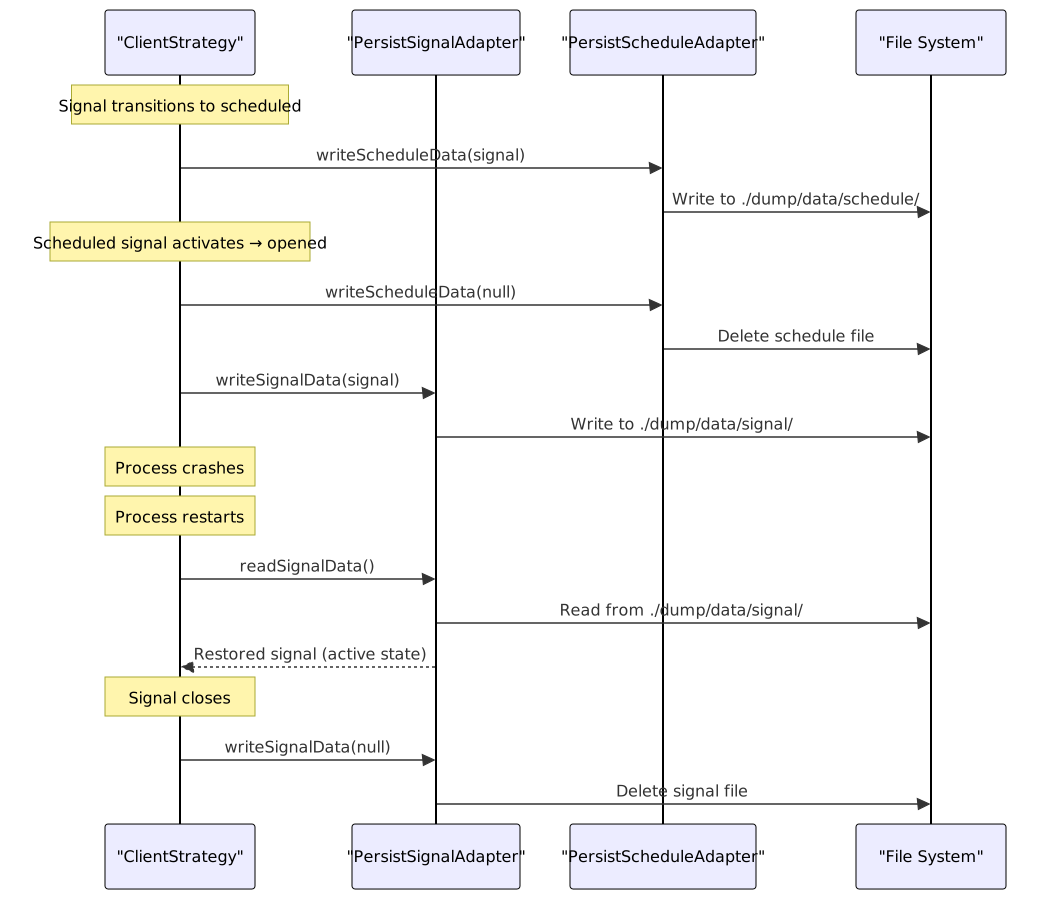
For detailed information on persistence mechanics, see Signal Persistence and Crash Recovery.