Signal Lifecycle Overview
Purpose and Scope
This document provides a high-level overview of how trading signals progress through their lifecycle states in the backtest-kit framework. It covers the state machine model, signal types, state transitions, validation rules, and monitoring logic.
For detailed information about:
- Execution mode differences (backtest vs live), see Execution Modes
- Component registration and schema definitions, see Component Registration
- Deep dive into each signal state, see Signal States
- Signal persistence and crash recovery, see Signal Persistence
Signal State Machine
The framework implements a type-safe state machine using discriminated unions. Every signal passes through well-defined states from creation to closure. The action field serves as the discriminator for type safety.

Key States:
idle: No active signal, strategy waiting to generate new signalscheduled: Limit order awaiting price activation atpriceOpenopened: Signal just created and validated, transitioning to active monitoringactive: Position monitoring TP/SL conditionsclosed: Signal completed with PNL calculationcancelled: Scheduled signal cancelled before activation
Signal Types
The framework uses two primary signal types with a clear transformation flow:

ISignalDto
The data transfer object returned by the strategy's getSignal function:
| Field | Type | Description |
|---|---|---|
position |
"long" | "short" |
Trade direction |
priceOpen |
number? |
Optional entry price (if specified → scheduled) |
priceTakeProfit |
number |
TP target price |
priceStopLoss |
number |
SL exit price |
minuteEstimatedTime |
number |
Max duration in minutes |
note |
string? |
Optional description |
ISignalRow
Augmented signal with auto-generated metadata:
| Field | Type | Description |
|---|---|---|
id |
string |
UUID v4 auto-generated |
priceOpen |
number |
Entry price (current VWAP if not specified) |
symbol |
string |
Trading pair (e.g., "BTCUSDT") |
exchangeName |
string |
Exchange identifier |
strategyName |
string |
Strategy identifier |
scheduledAt |
number |
Creation timestamp (ms) |
pendingAt |
number |
Activation timestamp (ms) |
_isScheduled |
boolean |
Internal runtime marker |
IScheduledSignalRow
Extends ISignalRow for signals awaiting price activation. The pendingAt field is initially set to scheduledAt and updated upon activation.
State Transitions
Idle → Scheduled/Opened
The transition from idle begins when getSignal returns a non-null signal. The framework performs interval throttling based on the strategy's configured interval field.

Interval Throttling Logic:
The _lastSignalTimestamp field tracks the last getSignal call. The interval check prevents signal spam:
// From ClientStrategy.ts:340-352
const currentTime = self.params.execution.context.when.getTime();
const intervalMinutes = INTERVAL_MINUTES[self.params.interval];
const intervalMs = intervalMinutes * 60 * 1000;
if (
self._lastSignalTimestamp !== null &&
currentTime - self._lastSignalTimestamp < intervalMs
) {
return null; // Skip this tick
}
self._lastSignalTimestamp = currentTime;
Price Activation Check:
For signals with priceOpen, immediate activation occurs if the price has already reached the entry threshold:
// From ClientStrategy.ts:393-420
const shouldActivateImmediately =
(signal.position === "long" && currentPrice <= signal.priceOpen) ||
(signal.position === "short" && currentPrice >= signal.priceOpen);
if (shouldActivateImmediately) {
// Create ISignalRow directly (skip scheduled phase)
const signalRow: ISignalRow = {
id: randomString(),
priceOpen: signal.priceOpen,
// ... other fields
_isScheduled: false,
};
return signalRow;
}
Scheduled → Opened/Cancelled
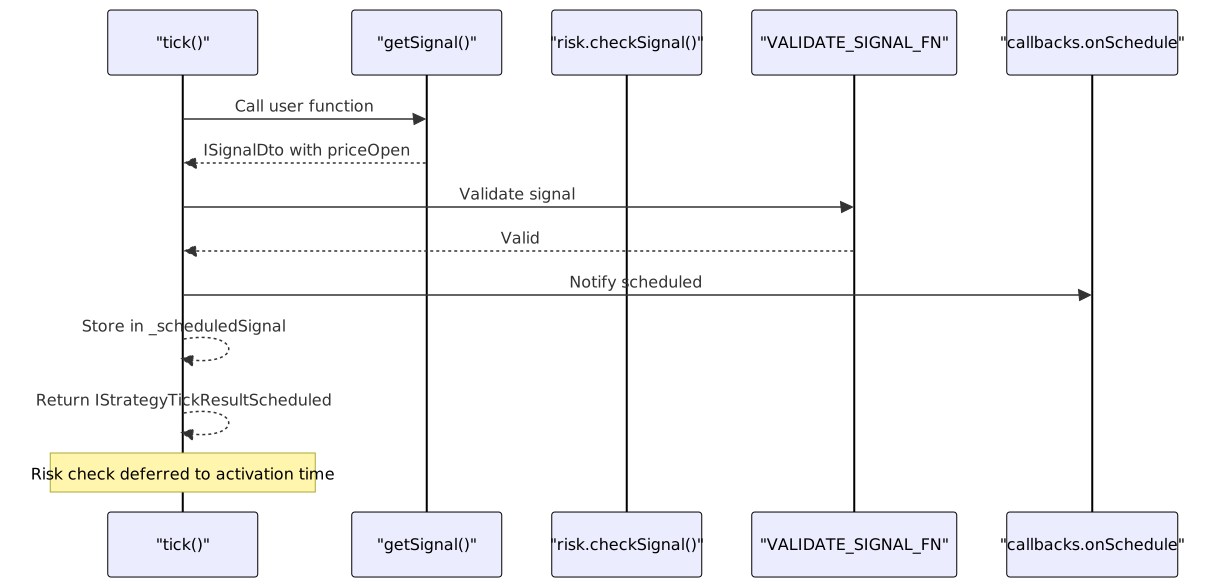
Scheduled signals monitor three conditions on each tick: price activation, StopLoss hit, and timeout expiration.
Priority Order:
Cancellation checks occur before activation checks to prevent race conditions where a price gaps through both StopLoss and activation levels on the same candle:
// From ClientStrategy.ts:610-644
if (scheduled.position === "long") {
// Check StopLoss FIRST (cancellation priority)
if (currentPrice <= scheduled.priceStopLoss) {
shouldCancel = true;
}
// Only check activation if NOT cancelled
else if (currentPrice <= scheduled.priceOpen) {
shouldActivate = true;
}
}
Timeout Calculation:
The timeout is measured from scheduledAt, not pendingAt:
// From ClientStrategy.ts:554-566
const currentTime = self.params.execution.context.when.getTime();
const signalTime = scheduled.scheduledAt; // Important: from scheduledAt
const maxTimeToWait = GLOBAL_CONFIG.CC_SCHEDULE_AWAIT_MINUTES * 60 * 1000;
const elapsedTime = currentTime - signalTime;
if (elapsedTime >= maxTimeToWait) {
// Cancel due to timeout
}
Opened → Active
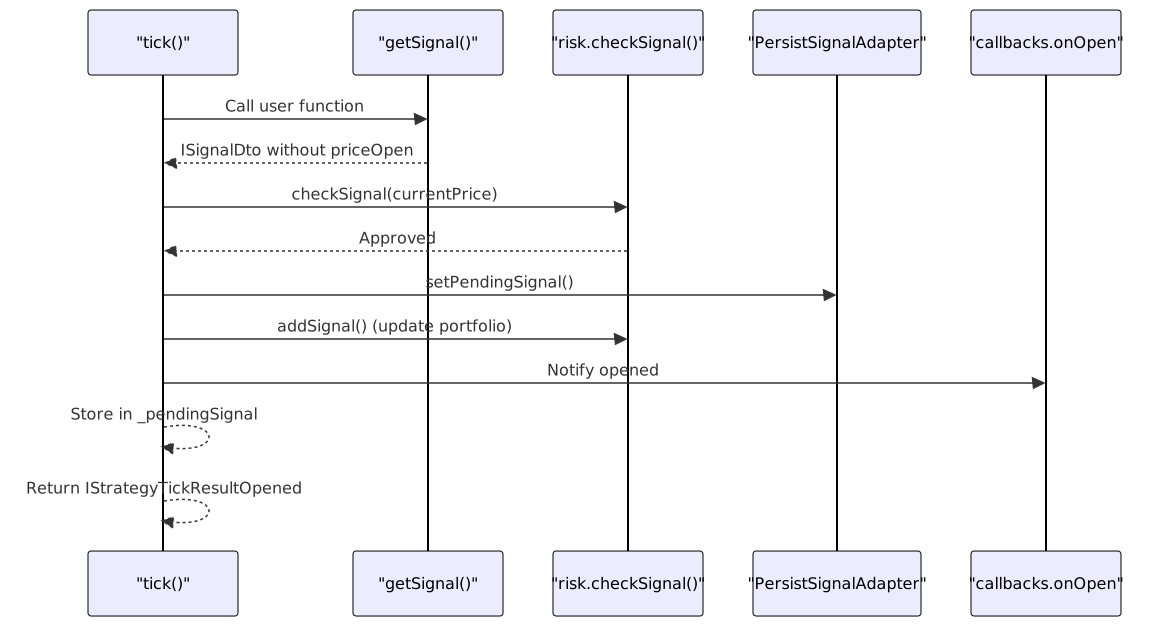
The opened state is transient. After signal validation, the framework persists the signal (in live mode) and transitions to active monitoring:
Validation Rules:
The VALIDATE_SIGNAL_FN performs extensive validation to prevent invalid signals:
| Validation | Long Position | Short Position |
|---|---|---|
| Price order | SL < Open < TP |
TP < Open < SL |
| Positive prices | All prices > 0 | All prices > 0 |
| Finite values | No NaN/Infinity | No NaN/Infinity |
| Min TP distance | CC_MIN_TAKEPROFIT_DISTANCE_PERCENT |
CC_MIN_TAKEPROFIT_DISTANCE_PERCENT |
| Min SL distance | CC_MIN_STOPLOSS_DISTANCE_PERCENT |
CC_MIN_STOPLOSS_DISTANCE_PERCENT |
| Max SL distance | CC_MAX_STOPLOSS_DISTANCE_PERCENT |
CC_MAX_STOPLOSS_DISTANCE_PERCENT |
| Max lifetime | CC_MAX_SIGNAL_LIFETIME_MINUTES |
CC_MAX_SIGNAL_LIFETIME_MINUTES |
| Instant closure check | SL < current < TP |
TP < current < SL |
Immediate Closure Prevention:
For market orders (non-scheduled), the framework verifies the current price doesn't trigger immediate TP/SL:
// From ClientStrategy.ts:125-141 (long example)
if (!isScheduled && isFinite(currentPrice)) {
// For long: current price must be BETWEEN SL and TP
if (currentPrice <= signal.priceStopLoss) {
errors.push(
`Long immediate: currentPrice (${currentPrice}) <= priceStopLoss (${signal.priceStopLoss}). ` +
`Signal would be immediately closed by stop loss.`
);
}
if (currentPrice >= signal.priceTakeProfit) {
errors.push(
`Long immediate: currentPrice (${currentPrice}) >= priceTakeProfit (${signal.priceTakeProfit}). ` +
`Signal would be immediately closed by take profit.`
);
}
}
Active → Closed
Active signals monitor three completion conditions on each tick: TakeProfit hit, StopLoss hit, or time expiration.

Time Calculation:
The elapsed time is measured from pendingAt, not scheduledAt. This ensures scheduled signals only count time after activation:
// From ClientStrategy.ts:901-919
const currentTime = self.params.execution.context.when.getTime();
const signalTime = signal.pendingAt; // CRITICAL: from pendingAt, not scheduledAt
const maxTimeToWait = signal.minuteEstimatedTime * 60 * 1000;
const elapsedTime = currentTime - signalTime;
if (elapsedTime >= maxTimeToWait) {
return await CLOSE_PENDING_SIGNAL_FN(
self,
signal,
averagePrice,
"time_expired"
);
}
PNL Calculation:
The framework applies realistic fees (0.1%) and slippage (0.1%) to both entry and exit prices:
| Fee Type | Long Position | Short Position |
|---|---|---|
| Entry slippage | priceOpen * 1.001 |
priceOpen * 0.999 |
| Entry fee | priceOpen * 1.001 |
priceOpen * 0.999 |
| Exit slippage | priceClose * 0.999 |
priceClose * 1.001 |
| Exit fee | priceClose * 0.999 |
priceClose * 1.001 |
Partial Progress Tracking:
The framework calculates percentage progress toward TP or SL to trigger milestone callbacks:
// From ClientStrategy.ts:1034-1053
if (signal.position === "long") {
const currentDistance = currentPrice - signal.priceOpen;
if (currentDistance > 0) {
// Moving towards TP
const tpDistance = signal.priceTakeProfit - signal.priceOpen;
const progressPercent = (currentDistance / tpDistance) * 100;
percentTp = Math.min(progressPercent, 100);
await self.params.partial.profit(
symbol,
signal,
currentPrice,
percentTp,
backtest,
when
);
}
}
Execution Mode Differences
The lifecycle behaves differently in backtest and live modes:
| Aspect | Backtest Mode | Live Mode |
|---|---|---|
| Signal generation | Per historical candle | Per tick interval (1 minute) |
| VWAP calculation | From candle OHLCV data | From last 5 1-minute candles |
| TP/SL checking | Check candle high/low | Check VWAP at intervals |
| Fast-forward | Skip candles after opening | No fast-forward, continuous monitoring |
| Persistence | In-memory only | Atomic file writes via PersistSignalAdapter |
| Crash recovery | Not applicable | Restore from disk on restart |
| Scheduled activation | Check exact candle timestamp | Check at polling intervals |
Backtest Fast-Forward
After a signal opens, backtest mode calls ClientStrategy.backtest() which iterates through candles checking TP/SL conditions without calling getSignal again:
// From BacktestLogicPrivateService (conceptual flow)
for (const timeframe of timeframes) {
const result = await tick(symbol, strategyName);
if (result.action === "opened") {
// Fast-forward: fetch candles and run backtest
const candles = await getCandles(...);
const closeResult = await backtest(symbol, strategyName, candles);
yield closeResult;
// Skip timeframes until signal closes
continue;
}
}
Live Continuous Monitoring
Live mode continuously polls at TICK_TTL intervals (default 60 seconds), checking VWAP against TP/SL on every tick:
// From LiveLogicPrivateService (conceptual flow)
while (true) {
const when = new Date();
const result = await tick(symbol, strategyName);
yield result;
await sleep(GLOBAL_CONFIG.TICK_TTL);
}
Code Entity Mapping
The following table maps high-level concepts to concrete code entities:
| Concept | Code Entity | Location |
|---|---|---|
| Signal states | IStrategyTickResult union |
src/interfaces/Strategy.interface.ts:299-305 |
| Idle state | IStrategyTickResultIdle |
src/interfaces/Strategy.interface.ts:173-186 |
| Scheduled state | IStrategyTickResultScheduled |
src/interfaces/Strategy.interface.ts:192-205 |
| Opened state | IStrategyTickResultOpened |
src/interfaces/Strategy.interface.ts:211-224 |
| Active state | IStrategyTickResultActive |
src/interfaces/Strategy.interface.ts:230-247 |
| Closed state | IStrategyTickResultClosed |
src/interfaces/Strategy.interface.ts:253-272 |
| Cancelled state | IStrategyTickResultCancelled |
src/interfaces/Strategy.interface.ts:278-293 |
| Signal types | ISignalDto, ISignalRow, IScheduledSignalRow |
src/interfaces/Strategy.interface.ts:24-73 |
| Lifecycle orchestration | ClientStrategy class |
src/client/ClientStrategy.ts:1-1500 |
| Signal generation | GET_SIGNAL_FN |
src/client/ClientStrategy.ts:332-476 |
| Signal validation | VALIDATE_SIGNAL_FN |
src/client/ClientStrategy.ts:45-330 |
| Scheduled monitoring | CHECK_SCHEDULED_SIGNAL_* functions |
src/client/ClientStrategy.ts:554-846 |
| Active monitoring | CHECK_PENDING_SIGNAL_COMPLETION_FN |
src/client/ClientStrategy.ts:901-960 |
| Signal closure | CLOSE_PENDING_SIGNAL_FN |
src/client/ClientStrategy.ts:962-1023 |
| Persistence | PersistSignalAdapter |
src/classes/Persist.ts |
| Routing | StrategyConnectionService |
src/lib/services/connection/StrategyConnectionService.ts:52-240 |
| Event emission | signalEmitter, signalBacktestEmitter, signalLiveEmitter |
src/config/emitters.ts |
| Callbacks | IStrategyCallbacks interface |
src/interfaces/Strategy.interface.ts:100-126 |
Key Takeaways
-
Type-safe state machine: Discriminated unions (
actionfield) enable exhaustive type checking at compile time. -
Two entry modes: Scheduled signals (limit orders with
priceOpen) vs immediate signals (market orders withoutpriceOpen). -
Validation is comprehensive: The framework prevents invalid signals before they enter active monitoring through price logic, distance checks, and instant closure detection.
-
Time tracking distinction: Scheduled signals use
scheduledAtfor timeout calculation, active signals usependingAtfor duration calculation. -
Cancellation priority: StopLoss checks occur before activation checks in scheduled signals to handle price gaps correctly.
-
Mode-specific optimizations: Backtest uses fast-forward simulation, live uses continuous VWAP monitoring with persistence for crash recovery.
-
Event-driven architecture: Every state transition emits typed events via
signalEmitter,signalBacktestEmitter, andsignalLiveEmitterfor external consumption.