ClientStrategy
Purpose and Scope
ClientStrategy is the core business logic component responsible for managing the complete lifecycle of trading signals. It implements signal generation, validation, state transitions, TP/SL monitoring, crash-safe persistence, and PNL calculation. This class operates in both backtest and live trading modes without dependency injection, making it a pure, testable implementation.
For information about how ClientStrategy is orchestrated within the execution flow, see Backtest Execution Flow and Live Execution Flow. For details on the persistence mechanism, see Signal Persistence. For PNL calculation specifics, see PnL Calculation.
Role in System Architecture
ClientStrategy sits in the Business Logic Layer and is the highest-importance component in the codebase (importance score 54.04). It is instantiated and managed by StrategyConnectionService and invoked by BacktestLogicPrivateService and LiveLogicPrivateService.
System Integration Diagram

Class Structure and Constructor
The ClientStrategy class implements the IStrategy interface and manages two primary pieces of internal state:
| Field | Type | Purpose |
|---|---|---|
_pendingSignal |
ISignalRow | null |
Currently active signal being monitored |
_lastSignalTimestamp |
number | null |
Last time getSignal() was called (for throttling) |
params |
IStrategyParams |
Injected dependencies and configuration |
Constructor Parameters

Signal Lifecycle State Machine
ClientStrategy manages signals through four distinct states, represented by discriminated union types IStrategyTickResult.

Signal Generation and Validation
Throttling with Interval
Signal generation is throttled at the strategy level to prevent spam. The GET_SIGNAL_FN helper enforces minimum intervals between getSignal() calls:
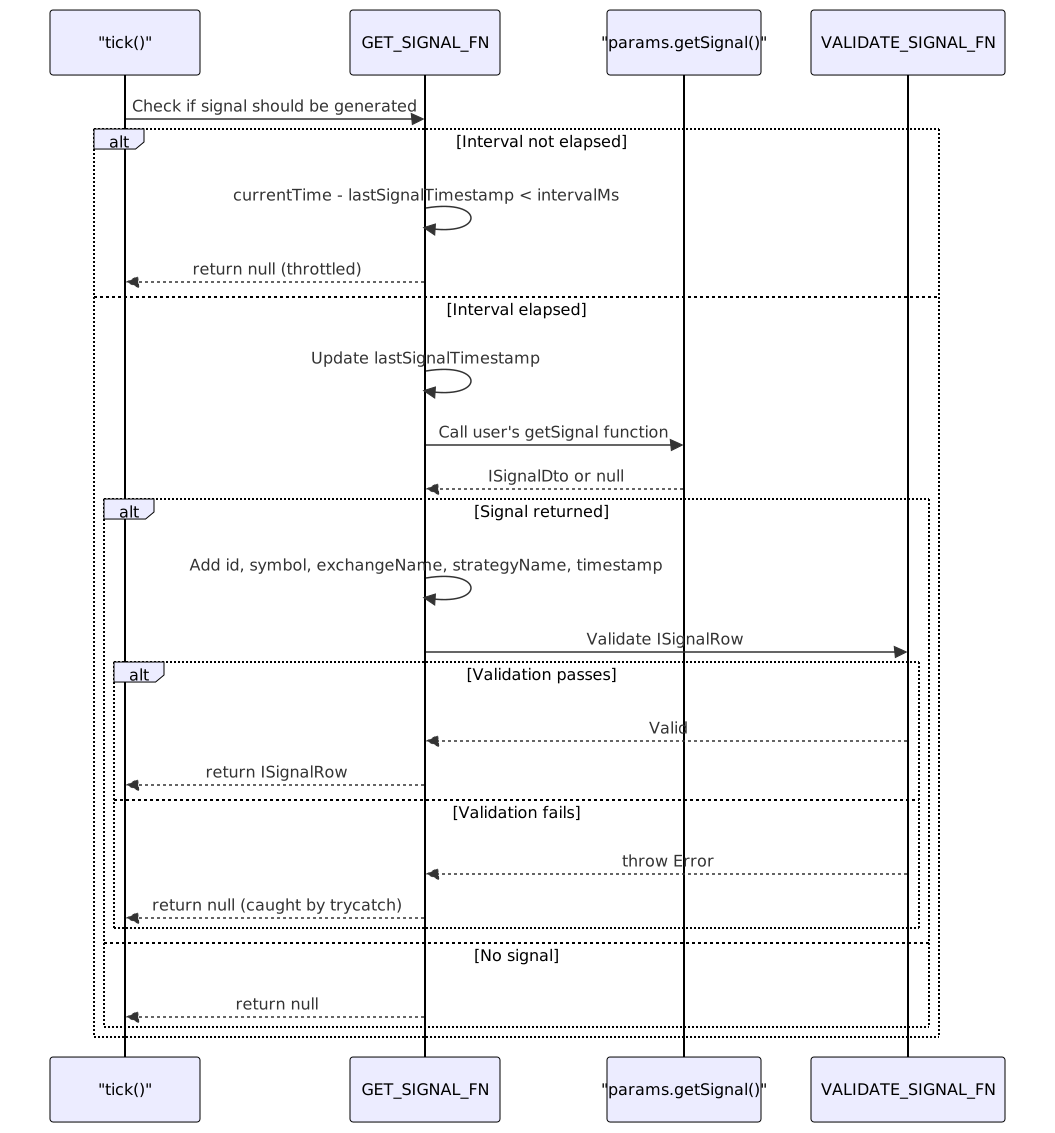
Interval Constants:
| Interval | Minutes | Milliseconds |
|---|---|---|
"1m" |
1 | 60,000 |
"3m" |
3 | 180,000 |
"5m" |
5 | 300,000 |
"15m" |
15 | 900,000 |
"30m" |
30 | 1,800,000 |
"1h" |
60 | 3,600,000 |
Validation Rules
The VALIDATE_SIGNAL_FN helper performs comprehensive validation before a signal is accepted:
Price Validation
priceOpen > 0priceTakeProfit > 0priceStopLoss > 0
Long Position Logic
priceTakeProfit > priceOpen(profit is up)priceStopLoss < priceOpen(loss is down)
Short Position Logic
priceTakeProfit < priceOpen(profit is down)priceStopLoss > priceOpen(loss is up)
Time Validation
minuteEstimatedTime > 0timestamp > 0
Error Format:
Invalid signal for long position:
Long: priceTakeProfit (49000) must be > priceOpen (50000)
Long: priceStopLoss (51000) must be < priceOpen (50000)
Live Trading: tick() Method
The tick() method performs a single iteration of strategy execution. It is called repeatedly by LiveLogicPrivateService (every 1 minute + 1ms) or BacktestLogicPrivateService (for each timestamp in the timeframe).
tick() Execution Flow

TP/SL Check Logic
The method checks TP/SL conditions based on position type:
Long Position:
// Take profit: price goes up
if (averagePrice >= signal.priceTakeProfit) {
closeReason = "take_profit";
}
// Stop loss: price goes down
else if (averagePrice <= signal.priceStopLoss) {
closeReason = "stop_loss";
}
Short Position:
// Take profit: price goes down
if (averagePrice <= signal.priceTakeProfit) {
closeReason = "take_profit";
}
// Stop loss: price goes up
else if (averagePrice >= signal.priceStopLoss) {
closeReason = "stop_loss";
}
Backtesting: backtest() Method
The backtest() method performs fast-forward simulation using an array of future candles. Instead of iterating timestamp-by-timestamp, it processes candles directly to find when TP/SL is hit.
backtest() Execution Flow

VWAP Calculation with 5-Candle Window
The method uses a sliding 5-candle window to calculate VWAP at each step. Starting from index 4 ensures sufficient candles for accurate VWAP:
// Iterate starting from 5th candle (index 4)
for (let i = 4; i < candles.length; i++) {
// Get last 5 candles: [i-4, i-3, i-2, i-1, i]
const recentCandles = candles.slice(i - 4, i + 1);
const averagePrice = GET_AVG_PRICE_FN(recentCandles);
// Check TP/SL...
}
Why 5 candles? This matches the live trading behavior where ClientExchange.getAveragePrice() uses the last 5 1-minute candles for VWAP calculation, ensuring consistency between backtest and live modes.
Persistence Integration
ClientStrategy uses PersistSignalAdapter for crash-safe state management. All signal state changes are persisted atomically before yielding results.
Persistence Flow
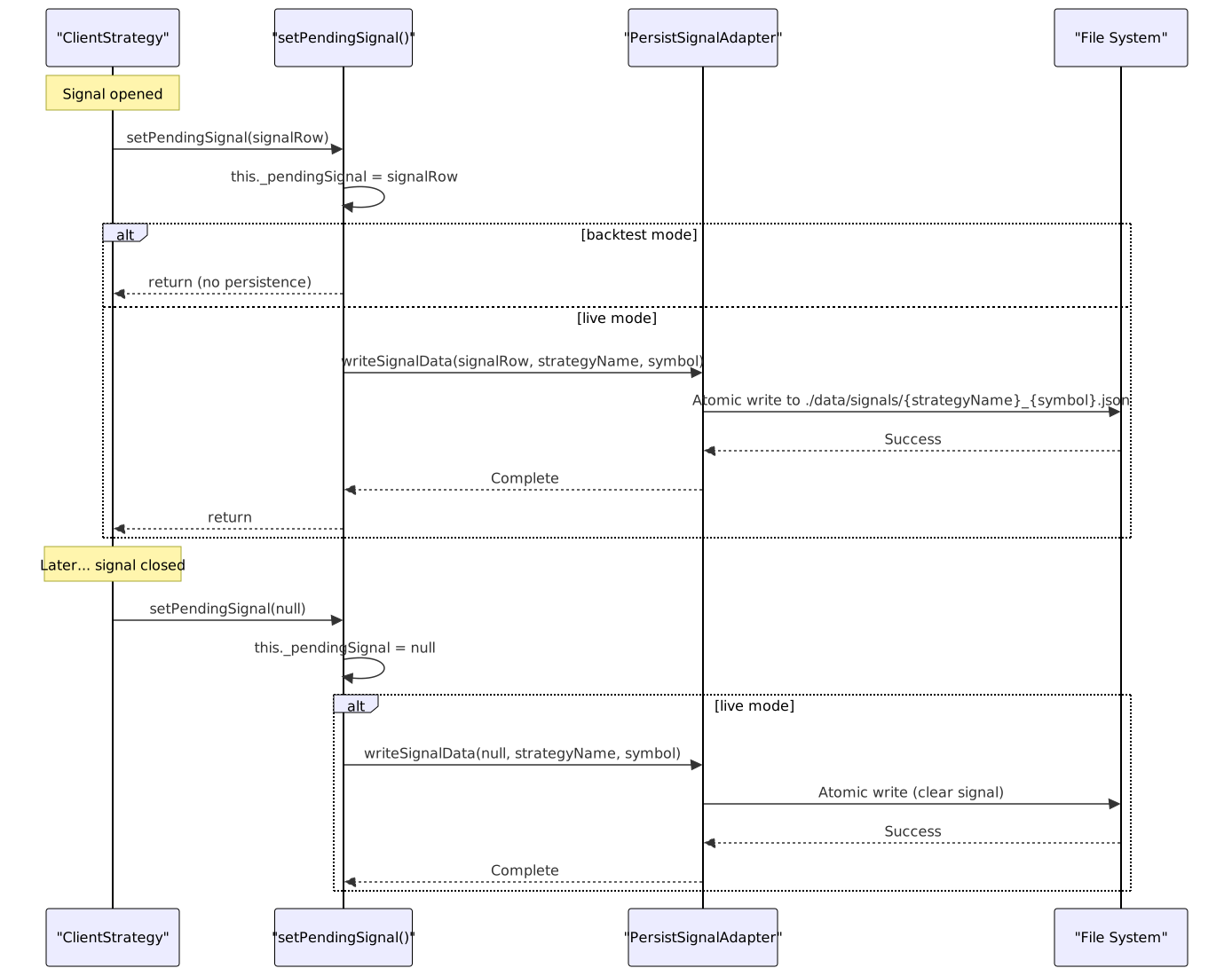
Initialization with State Recovery
The waitForInit() method loads persisted state on startup:

Key Features:
- Uses
singleshotpattern to ensure initialization happens exactly once - Validates that persisted signal matches current exchange/strategy context
- Skips persistence entirely in backtest mode for performance
Callback System
ClientStrategy supports five optional lifecycle callbacks for observability and custom logic injection:
| Callback | Trigger | Parameters | Use Case |
|---|---|---|---|
onTick |
Every tick result | (symbol, result, backtest) |
Universal event tracking |
onOpen |
Signal opened | (symbol, signal, currentPrice, backtest) |
Notification on new signal |
onActive |
Signal monitored | (symbol, signal, currentPrice, backtest) |
Real-time position tracking |
onIdle |
No signal | (symbol, currentPrice, backtest) |
Market monitoring when idle |
onClose |
Signal closed | (symbol, signal, priceClose, backtest) |
PNL recording, alerts |
Callback Invocation Pattern
All callbacks are invoked synchronously within the tick execution:
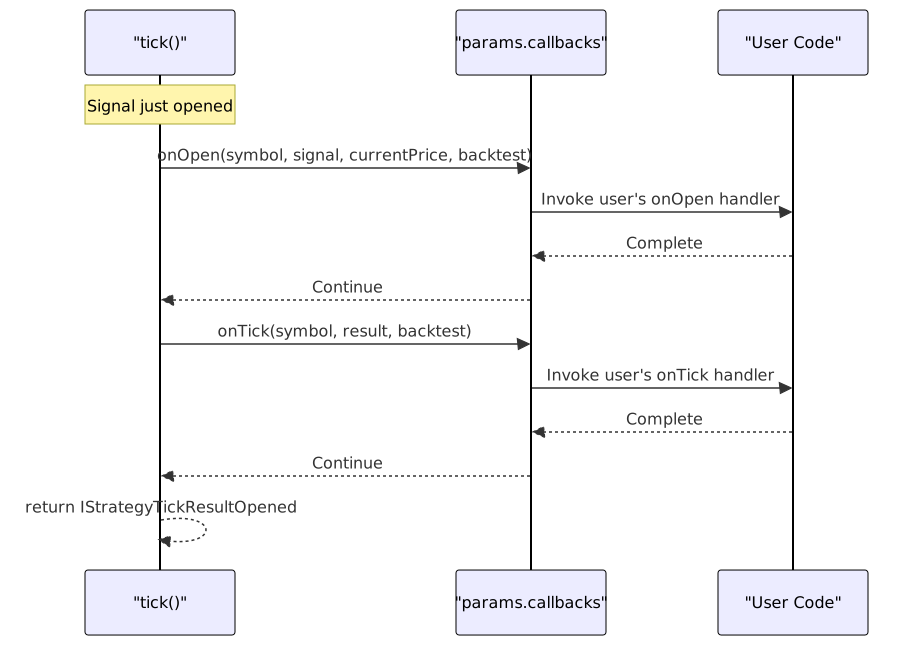
Important: All callbacks are invoked even if they return promises, but the execution does not await them. This ensures callbacks don't block the main execution flow.
VWAP Calculation
The GET_AVG_PRICE_FN helper calculates Volume-Weighted Average Price using the typical price (high + low + close) / 3:
VWAP Formula
typicalPrice = (high + low + close) / 3
sumPriceVolume = Σ(typicalPrice × volume) for all candles
totalVolume = Σ(volume) for all candles
VWAP = sumPriceVolume / totalVolume
If totalVolume == 0:
VWAP = average close price
Implementation

This calculation is used in:
backtest()method - calculates VWAP from 5-candle sliding window- Indirectly via
ClientExchange.getAveragePrice()duringtick()method
Performance Considerations
ClientStrategy implements several optimizations for memory efficiency and execution speed:
Memory Optimization Techniques
| Technique | Implementation | Benefit |
|---|---|---|
| Prototype Methods | All methods defined on prototype | Shared across instances, not duplicated |
| Memoized Initialization | waitForInit = singleshot(async () => ...) |
Init happens exactly once per instance |
| Minimal State | Only _pendingSignal and _lastSignalTimestamp |
~100 bytes per instance |
| Streaming Architecture | Results yielded immediately | No result accumulation in memory |
| Instance Reuse | StrategyConnectionService memoizes instances |
One instance per strategyName |
Backtest Performance
The backtest() method achieves fast simulation through:
- Direct Candle Processing: Iterates through candle array instead of calling
tick()repeatedly - Early Termination: Stops at first TP/SL hit, doesn't process remaining candles
- No Network Calls: Uses pre-fetched candle data, no API requests per candle
- VWAP Caching: Calculates VWAP only when needed, not stored
Example: Backtesting a 60-minute signal requires:
tick()approach: 60 calls totick(), 60 VWAP calculations, 60 persistence writesbacktest()approach: 1 call tobacktest(), ~5-60 VWAP calculations (stops early), 1 persistence write
Code Entity Reference
Primary Classes and Functions
| Entity | Type | Location | Purpose |
|---|---|---|---|
ClientStrategy |
class | src/client/ClientStrategy.ts:194 | Main strategy implementation |
tick() |
method | src/client/ClientStrategy.ts:258 | Single iteration of strategy execution |
backtest() |
method | src/client/ClientStrategy.ts:485 | Fast-forward signal simulation |
waitForInit() |
method | src/client/ClientStrategy.ts:209 | Load persisted state on startup |
setPendingSignal() |
method | src/client/ClientStrategy.ts:220 | Update and persist signal state |
GET_SIGNAL_FN |
function | src/client/ClientStrategy.ts:90 | Throttled signal generation wrapper |
VALIDATE_SIGNAL_FN |
function | src/client/ClientStrategy.ts:28 | Signal validation with error messages |
GET_AVG_PRICE_FN |
function | src/client/ClientStrategy.ts:133 | VWAP calculation from candles |
WAIT_FOR_INIT_FN |
function | src/client/ClientStrategy.ts:146 | State recovery logic |
INTERVAL_MINUTES |
constant | src/client/ClientStrategy.ts:19 | Interval to minutes mapping |
Key Interfaces
| Interface | Location | Purpose |
|---|---|---|
IStrategy |
src/interfaces/Strategy.interface.ts:219 | Strategy contract with tick() and backtest() |
IStrategyParams |
src/interfaces/Strategy.interface.ts:60 | Constructor parameters |
ISignalRow |
src/interfaces/Strategy.interface.ts:43 | Complete signal with auto-generated ID |
ISignalDto |
src/interfaces/Strategy.interface.ts:22 | User-provided signal data |
IStrategyTickResult |
src/interfaces/Strategy.interface.ts:204 | Discriminated union of tick results |
IStrategyTickResultClosed |
src/interfaces/Strategy.interface.ts:181 | Closed signal with PNL |
IStrategyCallbacks |
src/interfaces/Strategy.interface.ts:75 | Lifecycle event handlers |