Signal Generation and Validation
This page documents the signal generation process and the multi-layer validation pipeline that ensures all trading signals meet safety and logical requirements before execution. Signal generation occurs in the getSignal function defined in IStrategySchema, and validation is performed by VALIDATE_SIGNAL_FN within ClientStrategy.
Scope: This page covers the mechanics of signal creation from getSignal() through validation. For information about signal state transitions after validation, see Signal States. For the actual risk checking integration, see Risk Management. For signal persistence after validation, see Signal Persistence.
Signal Generation Overview
Signal generation is the entry point for all trading decisions. The getSignal function is called by ClientStrategy at intervals specified by the strategy's interval parameter, respecting throttling limits to prevent excessive signal generation.
Signal Generation Flow Diagram

Signal Data Transfer Object (ISignalDto)
The getSignal function returns an ISignalDto object containing the signal parameters. This DTO is then validated and augmented with metadata to create an ISignalRow.
ISignalDto Structure
| Field | Type | Required | Description |
|---|---|---|---|
id |
string |
No | Optional signal ID (UUID v4 auto-generated if omitted) |
position |
"long" | "short" |
Yes | Trade direction: "long" for buy, "short" for sell |
note |
string |
No | Human-readable description of signal reason |
priceOpen |
number |
No | Entry price for limit order. If omitted, opens immediately at current VWAP |
priceTakeProfit |
number |
Yes | Target exit price for profit |
priceStopLoss |
number |
Yes | Exit price for loss protection |
minuteEstimatedTime |
number |
Yes | Expected duration in minutes before time expiration |
Augmented Signal Row (ISignalRow)
After validation, ISignalDto is augmented with system metadata to create ISignalRow:
| Additional Field | Type | Description |
|---|---|---|
id |
string |
Guaranteed non-empty (generated if missing) |
priceOpen |
number |
Guaranteed defined (set to currentPrice if omitted) |
exchangeName |
ExchangeName |
Exchange identifier from strategy context |
strategyName |
StrategyName |
Strategy identifier from strategy context |
symbol |
string |
Trading pair symbol (e.g., "BTCUSDT") |
scheduledAt |
number |
Signal creation timestamp (milliseconds) |
pendingAt |
number |
Position activation timestamp (milliseconds) |
_isScheduled |
boolean |
Internal marker for scheduled signals |
Validation Pipeline (VALIDATE_SIGNAL_FN)
The validation function VALIDATE_SIGNAL_FN performs comprehensive safety checks before a signal is allowed to proceed. This function throws an error if any validation fails, preventing invalid signals from being executed.
Validation Layers

Layer 1: Type Validation
Type validation ensures all required fields are present and have valid types. This prevents runtime errors from missing or malformed data.
Required Field Checks
// Example validation checks (pseudocode from VALIDATE_SIGNAL_FN)
if (signal.id === undefined || signal.id === null || signal.id === '') {
errors.push('id is required and must be a non-empty string');
}
if (signal.position !== "long" && signal.position !== "short") {
errors.push(`position must be "long" or "short", got "${signal.position}"`);
}
Validation Rules:
id: Must be non-empty string (auto-generated if missing in DTO, but required in ISignalRow)exchangeName: Must be defined and non-emptystrategyName: Must be defined and non-emptysymbol: Must be defined and non-empty string_isScheduled: Must be booleanposition: Must be exactly"long"or"short"(no other values allowed)
Layer 2: Price Validation (NaN/Infinity Protection)
Price validation protects against NaN and Infinity values that could cause financial losses or system crashes. All price fields must be finite positive numbers.
Price Safety Checks
| Check | Purpose | Example Error |
|---|---|---|
isFinite(currentPrice) |
Prevent NaN/Infinity in current market price | "currentPrice must be a finite number, got NaN" |
currentPrice > 0 |
Prevent negative or zero prices | "currentPrice must be positive, got -42000" |
isFinite(priceOpen) |
Prevent NaN/Infinity in entry price | "priceOpen must be a finite number, got Infinity" |
priceOpen > 0 |
Prevent negative or zero entry | "priceOpen must be positive, got 0" |
isFinite(priceTakeProfit) |
Prevent NaN/Infinity in TP | "priceTakeProfit must be a finite number" |
priceTakeProfit > 0 |
Prevent negative or zero TP | "priceTakeProfit must be positive" |
isFinite(priceStopLoss) |
Prevent NaN/Infinity in SL | "priceStopLoss must be a finite number" |
priceStopLoss > 0 |
Prevent negative or zero SL | "priceStopLoss must be positive" |
Critical Protection: These checks prevent catastrophic scenarios:
- Zero StopLoss: Would allow unlimited losses in flash crashes
- NaN prices: Would cause position to never close (TP/SL comparisons always false)
- Infinity prices: Would cause position to never trigger TP or SL
Layer 3: Logic Validation (Position-Specific Rules)
Logic validation enforces the mathematical relationships between prices based on position direction. LONG and SHORT positions have opposite requirements.
LONG Position Rules

LONG Position Requirements:
- Basic:
priceStopLoss < priceOpen < priceTakeProfit- Buy low, sell higher for profit
- Exit low to cut losses
- Immediate Entry:
priceStopLoss < currentPrice < priceTakeProfit- Current price must be between SL and TP
- Prevents opening positions that would close immediately
- Scheduled Entry:
priceStopLoss < priceOpen < priceTakeProfit- Entry price must be between SL and TP
- Prevents limit orders that would activate and close immediately
Example Error Messages:
Long: priceTakeProfit (42000) must be > priceOpen (43000)
Long immediate: currentPrice (41000) <= priceStopLoss (41500).
Signal would be immediately closed by stop loss.
Long scheduled: priceOpen (40000) <= priceStopLoss (40500).
Signal would be immediately cancelled on activation.
SHORT Position Rules

SHORT Position Requirements:
- Basic:
priceTakeProfit < priceOpen < priceStopLoss- Sell high, buy back lower for profit
- Exit high to cut losses
- Immediate Entry:
priceTakeProfit < currentPrice < priceStopLoss- Current price must be between TP and SL
- Prevents opening positions that would close immediately
- Scheduled Entry:
priceTakeProfit < priceOpen < priceStopLoss- Entry price must be between TP and SL
- Prevents limit orders that would activate and close immediately
Example Error Messages:
Short: priceTakeProfit (44000) must be < priceOpen (43000)
Short immediate: currentPrice (45000) >= priceStopLoss (44500).
Signal would be immediately closed by stop loss.
Short scheduled: priceOpen (46000) >= priceStopLoss (45500).
Signal would be immediately cancelled on activation.
Layer 4: Distance Validation (Global Config)
Distance validation enforces minimum and maximum distances between prices to prevent unprofitable or overly risky trades. These thresholds are configured globally via setConfig().
Distance Validation Rules
| Validation | Config Parameter | Purpose |
|---|---|---|
| Minimum TP Distance | CC_MIN_TAKEPROFIT_DISTANCE_PERCENT |
Ensures TP is far enough to cover fees + slippage (default: no minimum) |
| Minimum SL Distance | CC_MIN_STOPLOSS_DISTANCE_PERCENT |
Prevents micro-SL that triggers on normal volatility (default: no minimum) |
| Maximum SL Distance | CC_MAX_STOPLOSS_DISTANCE_PERCENT |
Caps maximum loss per trade to protect capital (default: no maximum) |
Minimum TakeProfit Distance
Calculation (LONG):
const tpDistancePercent = ((priceTakeProfit - priceOpen) / priceOpen) * 100;
// Example: ((43000 - 42000) / 42000) * 100 = 2.38%
Calculation (SHORT):
const tpDistancePercent = ((priceOpen - priceTakeProfit) / priceOpen) * 100;
// Example: ((43000 - 42000) / 43000) * 100 = 2.33%
Protection: With fees (0.1%) + slippage (0.1%) = 0.2% total overhead, a minimum TP distance (e.g., 0.5%) ensures trades can be profitable after costs.
Minimum StopLoss Distance
Purpose: Prevents "micro-stoploss" that triggers on normal market volatility before the trade has a chance to succeed.
Example: If CC_MIN_STOPLOSS_DISTANCE_PERCENT = 0.3, then:
- LONG at 42000 requires SL ≤ 41874 (0.3% away)
- SHORT at 43000 requires SL ≥ 43129 (0.3% away)
Error Example:
Long: StopLoss too close to priceOpen (0.120%).
Minimum distance: 0.300% to avoid instant stop out on market volatility.
Current: SL=41950, Open=42000
Maximum StopLoss Distance
Purpose: Caps the maximum loss per trade to prevent catastrophic losses from a single position.
Example: If CC_MAX_STOPLOSS_DISTANCE_PERCENT = 5.0, then:
- LONG at 42000 requires SL ≥ 39900 (5% maximum loss)
- SHORT at 43000 requires SL ≤ 45150 (5% maximum loss)
Risk Management: Protects portfolio from single-trade wipeout scenarios. Combined with position sizing, this enforces maximum risk per trade.
Error Example:
Long: StopLoss too far from priceOpen (8.500%).
Maximum distance: 5.000% to protect capital.
Current: SL=38430, Open=42000
Layer 5: Time Validation
Time validation ensures signal lifetime parameters are reasonable and prevents pathological edge cases like eternal signals or instant timeouts.
Time Parameter Checks
| Check | Requirement | Protection |
|---|---|---|
minuteEstimatedTime > 0 |
Positive duration | Prevents instant timeout (0 minutes = immediate close) |
Number.isInteger(minuteEstimatedTime) |
Whole number | Ensures precise minute-based timing |
minuteEstimatedTime <= CC_MAX_SIGNAL_LIFETIME_MINUTES |
Maximum duration cap | Prevents eternal signals that block risk limits indefinitely |
scheduledAt > 0 |
Valid timestamp | Ensures signal creation time is tracked |
pendingAt > 0 |
Valid timestamp | Ensures activation time is tracked |
Maximum Signal Lifetime Protection
Configuration: CC_MAX_SIGNAL_LIFETIME_MINUTES (default: undefined = unlimited)
Problem: Signals with extremely long minuteEstimatedTime (e.g., 43200 minutes = 30 days) can:
- Block risk limit slots for weeks
- Prevent new signals from opening
- Create "zombie positions" that never close
- Tie up capital indefinitely
Example Error:
minuteEstimatedTime too large (43200 minutes = 30.0 days).
Maximum: 10080 minutes (7 days) to prevent strategy deadlock.
Eternal signals block risk limits and prevent new trades.
Scheduled vs Immediate Signal Logic
The signal generation logic determines whether to create an immediate entry (_isScheduled=false) or a scheduled entry (_isScheduled=true) based on the priceOpen parameter and current market price.
Signal Type Decision Tree

Immediate Entry (Market Order)
Trigger: priceOpen is undefined in ISignalDto
Behavior:
- System fetches current VWAP price via
exchange.getAveragePrice(symbol) - Sets
priceOpen = currentPrice - Creates
ISignalRowwith_isScheduled = false - Position opens immediately on next tick
- Both
scheduledAtandpendingAtare set to same timestamp
Use Case: Market orders that execute at current market price without waiting.
Scheduled Entry (Limit Order) - Wait for Activation
Trigger: priceOpen is specified AND price has NOT yet reached entry point
Conditions:
- LONG:
currentPrice > priceOpen(waiting for price to fall) - SHORT:
currentPrice < priceOpen(waiting for price to rise)
Behavior:
- Creates
IScheduledSignalRowwith_isScheduled = true priceOpenis stored from DTOscheduledAt = currentTime(signal creation time)pendingAt = currentTime(temporary, will update on activation)- Signal waits in scheduled state until price reaches
priceOpen
Use Case: Limit orders that wait for better entry price before activating.
Scheduled Entry (Limit Order) - Immediate Activation
Trigger: priceOpen is specified AND price has ALREADY reached entry point
Conditions:
- LONG:
currentPrice <= priceOpen(price already fell to entry) - SHORT:
currentPrice >= priceOpen(price already rose to entry)
Behavior:
- Creates
ISignalRow(notIScheduledSignalRow) _isScheduled = false(activates immediately)priceOpenfrom DTO (uses specified entry price, not current price)- Both
scheduledAtandpendingAtset to current time - Position opens immediately without waiting
Critical Logic: This prevents the system from creating a scheduled signal when the target price has already been reached. Instead, it treats it as an immediate entry at the specified priceOpen.
Risk Validation Integration
After the internal validation checks pass, the signal must also pass risk management checks via ClientRisk.checkSignal(). This is a separate validation layer that enforces portfolio-level constraints.
Risk Check Flow
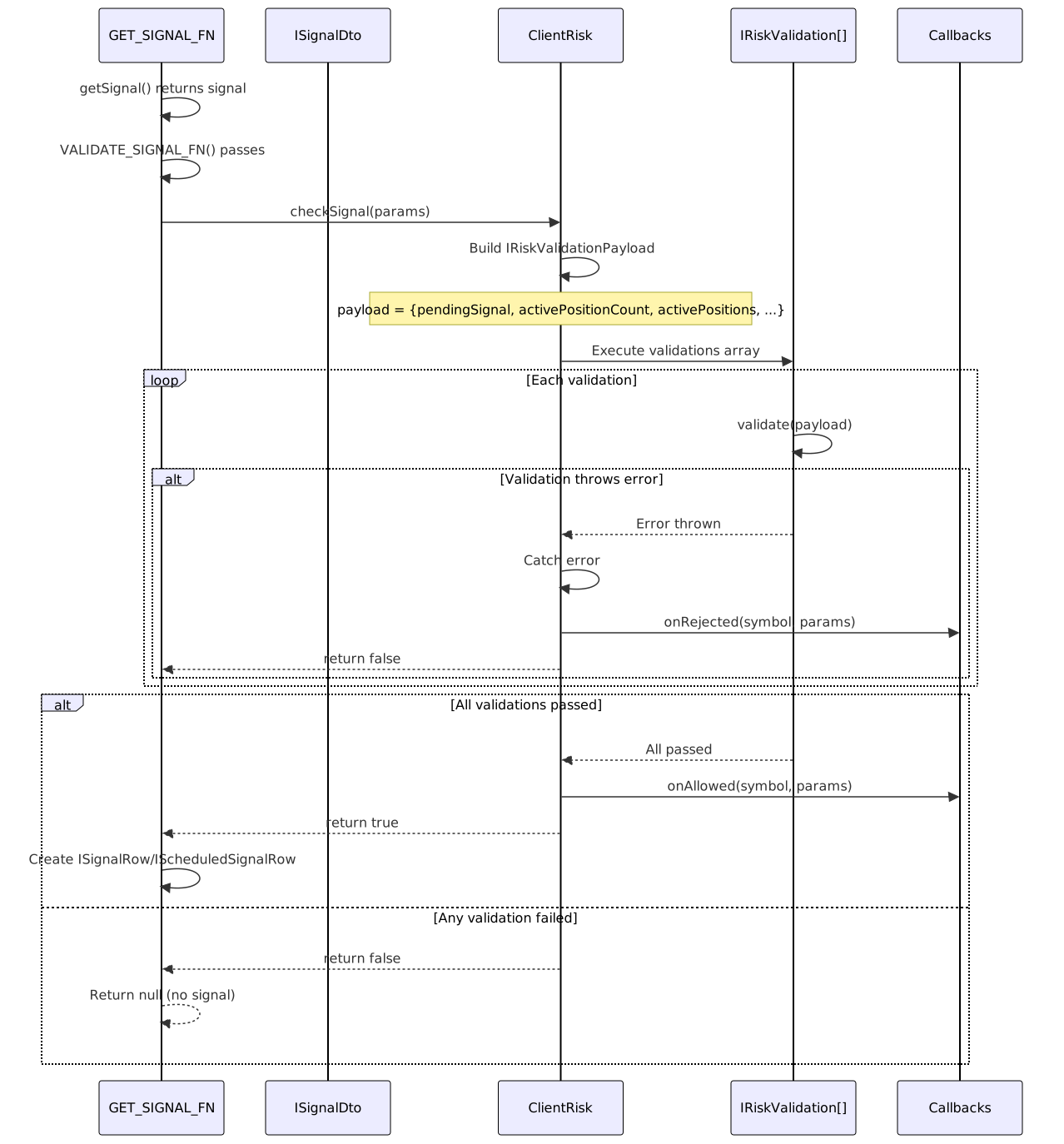
Risk Check Parameters (IRiskCheckArgs):
symbol: Trading pairpendingSignal: TheISignalDtobeing validatedstrategyName: Strategy requesting the signalexchangeName: Exchange identifiercurrentPrice: Current VWAP pricetimestamp: Current time in milliseconds
Risk Payload (IRiskValidationPayload extends IRiskCheckArgs):
activePositionCount: Number of currently open positionsactivePositions: Array ofIRiskActivePositionobjects with signal details
Rejection Behavior:
- If risk check fails,
checkSignal()returnsfalse - Signal generation aborts and returns
null - No signal is created or persisted
- Risk callbacks (
onRejected) are fired for monitoring
Error Handling and Recovery
Validation errors are caught by trycatch() wrapper around GET_SIGNAL_FN, preventing crashes and enabling graceful degradation.
Error Handling Flow

Error Handling Behavior:
- Catch:
trycatch()wrapper catches all exceptions in signal generation - Log: Error logged via
backtest.loggerService.warn() - Emit: Error emitted via
errorEmitter.next(error)for monitoring - Default: Returns
null(no signal) instead of crashing - Continue: Strategy continues processing future ticks
Example Error Log:
{
message: "ClientStrategy exception thrown",
payload: {
error: { ... },
message: "Invalid signal for long position:\nLong: priceTakeProfit (42000) must be > priceOpen (43000)"
}
}
Validation Test Coverage
The validation pipeline is extensively tested to ensure all edge cases are handled correctly and financial safety is maintained.
Critical Test Scenarios
| Test Category | Test Case | File Reference |
|---|---|---|
| LONG Logic | Limit order activates BEFORE StopLoss | test/e2e/defend.test.mjs:26-146 |
| SHORT Logic | Limit order activates BEFORE StopLoss | test/e2e/defend.test.mjs:158-278 |
| Instant TP | Scheduled signal activated and closed on same candle | test/e2e/defend.test.mjs:291-439 |
| Timeout | Scheduled signal cancelled at 120min boundary | test/e2e/defend.test.mjs:446-537 |
| Invalid TP | LONG signal rejected (TP below priceOpen) | test/e2e/defend.test.mjs:545-642 |
| Invalid TP | SHORT signal rejected (TP above priceOpen) | test/e2e/defend.test.mjs:649-744 |
| Invalid SL | LONG signal rejected (SL >= priceOpen) | test/e2e/defend.test.mjs:752-846 |
| Zero SL | Signal rejected (StopLoss = 0) | test/e2e/defend.test.mjs:858-950 |
| Inverted Logic | SHORT signal rejected (TP > priceOpen) | test/e2e/defend.test.mjs:963-1057 |
| Zero Time | Signal rejected (minuteEstimatedTime = 0) | test/e2e/defend.test.mjs:1069-1162 |
| Equal TP | Signal rejected (TP equals priceOpen) | test/e2e/defend.test.mjs:1174-1269 |
| SL Cancellation | Scheduled LONG cancelled by SL before activation | test/e2e/defend.test.mjs:1393-1507 |
| Extreme Volatility | Price crosses both TP and SL (TP wins) | test/e2e/defend.test.mjs:1520-1653 |
| Infrastructure | Exchange.getCandles throws error | test/e2e/defend.test.mjs:1664-1743 |
Test Philosophy: Each test validates that the system rejects invalid signals before they can cause financial harm. Tests verify error messages contain actionable information.
Code Entity Reference
Key Functions
| Function | Location | Purpose |
|---|---|---|
GET_SIGNAL_FN |
src/client/ClientStrategy.ts:332-476 | Main signal generation logic with throttling and risk checks |
VALIDATE_SIGNAL_FN |
src/client/ClientStrategy.ts:45-330 | Multi-layer validation pipeline |
getSignal (user-defined) |
IStrategySchema.getSignal |
User-provided signal generation callback |
Key Types
| Type | Location | Description |
|---|---|---|
ISignalDto |
src/interfaces/Strategy.interface.ts:24-39 | Signal data transfer object from getSignal |
ISignalRow |
src/interfaces/Strategy.interface.ts:45-62 | Validated signal with metadata |
IScheduledSignalRow |
src/interfaces/Strategy.interface.ts:70-73 | Scheduled signal awaiting activation |
IRiskCheckArgs |
types.d.ts:339-356 | Risk validation parameters |
IRiskValidationPayload |
types.d.ts:380-390 | Extended risk check with portfolio state |
Configuration Constants
| Constant | Type | Purpose |
|---|---|---|
CC_MIN_TAKEPROFIT_DISTANCE_PERCENT |
number | undefined |
Minimum TP distance percentage |
CC_MIN_STOPLOSS_DISTANCE_PERCENT |
number | undefined |
Minimum SL distance percentage |
CC_MAX_STOPLOSS_DISTANCE_PERCENT |
number | undefined |
Maximum SL distance percentage |
CC_MAX_SIGNAL_LIFETIME_MINUTES |
number | undefined |
Maximum signal duration |
CC_SCHEDULE_AWAIT_MINUTES |
number |
Scheduled signal timeout (default: 120) |
Best Practices for Signal Generation
DO: Return Null for No Signal
addStrategy({
strategyName: "example",
interval: "5m",
getSignal: async (symbol, when) => {
const candles = await getCandles(symbol, "1h", 24);
// Calculate indicators
const rsi = calculateRSI(candles);
// No signal condition
if (rsi > 30 && rsi < 70) {
return null; // ✅ Return null when no trade opportunity
}
// Signal condition
return {
position: "long",
priceTakeProfit: currentPrice * 1.02,
priceStopLoss: currentPrice * 0.98,
minuteEstimatedTime: 60,
note: `RSI ${rsi.toFixed(2)} oversold`
};
}
});
DO: Use priceOpen for Limit Orders
// Wait for better entry price
return {
position: "long",
priceOpen: 42000, // ✅ Wait for price to drop to 42000
priceTakeProfit: 43000,
priceStopLoss: 41000,
minuteEstimatedTime: 120,
note: "Limit order at 42000"
};
DO: Respect Validation Constraints
const currentPrice = await getAveragePrice(symbol);
return {
position: "long",
// ✅ TP is 2% above entry (covers fees + slippage)
priceTakeProfit: currentPrice * 1.02,
// ✅ SL is 1% below entry (reasonable risk)
priceStopLoss: currentPrice * 0.99,
// ✅ Integer minutes, reasonable duration
minuteEstimatedTime: 60,
note: "Valid signal parameters"
};
DON'T: Return Equal TP and priceOpen
// ❌ WRONG: TP equals entry = zero profit
return {
position: "long",
priceOpen: 42000,
priceTakeProfit: 42000, // ❌ No profit, only fees!
priceStopLoss: 41000,
minuteEstimatedTime: 60
};
// This will be REJECTED by validation
DON'T: Use Inverted Logic
// ❌ WRONG: SHORT with TP > priceOpen
return {
position: "short",
priceOpen: 42000,
priceTakeProfit: 43000, // ❌ SHORT needs TP < priceOpen!
priceStopLoss: 44000,
minuteEstimatedTime: 60
};
// This will be REJECTED by validation
DON'T: Generate Eternal Signals
// ❌ WRONG: 30 days = blocks risk limits for a month
return {
position: "long",
priceOpen: 42000,
priceTakeProfit: 45000,
priceStopLoss: 40000,
minuteEstimatedTime: 43200 // ❌ 30 days!
};
// This will be REJECTED if CC_MAX_SIGNAL_LIFETIME_MINUTES is set