Signal Persistence
Purpose and Scope
Signal persistence is the crash recovery system that enables production-grade live trading in backtest-kit. This system ensures that active trading positions and scheduled limit orders are never lost, even during catastrophic failures (process crashes, power loss, SIGKILL, OOM errors).
This page documents the persistence layer specifically for signal state management. For risk position persistence, see 12.3. For partial profit/loss state persistence, see 6.6. For the overall signal lifecycle state machine, see 8.1.
Key Characteristics:
- Atomic Writes: All-or-nothing file operations prevent partial writes during crashes
- Dual Domain: Separate persistence for pending signals (active positions) and scheduled signals (limit orders)
- Selective Persistence: Only live mode persists to disk; backtest mode skips I/O for performance
- Automatic Recovery: State is restored on initialization via
waitForInit()
Persistence Architecture Overview
The signal persistence system operates across two independent domains to maintain crash safety:

File Structure and Storage Locations
Signal persistence uses a hierarchical directory structure to isolate signals by strategy and symbol:
| Persistence Domain | Base Directory | File Pattern | Entity Type |
|---|---|---|---|
| Pending Signals | ./dump/data/signal/ |
{symbol}_{strategyName}/{symbol}.json |
ISignalRow | null |
| Scheduled Signals | ./dump/data/schedule/ |
{symbol}_{strategyName}/{symbol}.json |
IScheduledSignalRow | null |
Example File Paths:
./dump/data/signal/BTCUSDT_trend-following/BTCUSDT.json
./dump/data/schedule/ETHUSDT_breakout-strategy/ETHUSDT.json
File Contents Structure:
// Pending signal file (signal/BTCUSDT_trend-following/BTCUSDT.json)
{
"id": "abc123",
"position": "long",
"priceOpen": 50000,
"priceTakeProfit": 52000,
"priceStopLoss": 48000,
"minuteEstimatedTime": 120,
"symbol": "BTCUSDT",
"exchangeName": "binance",
"strategyName": "trend-following",
"scheduledAt": 1704067200000,
"pendingAt": 1704067200000,
"_isScheduled": false
}
// Scheduled signal file (schedule/BTCUSDT_breakout-strategy/BTCUSDT.json)
{
"id": "def456",
"position": "short",
"priceOpen": 51000,
"priceTakeProfit": 49000,
"priceStopLoss": 52000,
"minuteEstimatedTime": 180,
"symbol": "BTCUSDT",
"exchangeName": "binance",
"strategyName": "breakout-strategy",
"scheduledAt": 1704070800000,
"pendingAt": 1704070800000,
"_isScheduled": true
}
Atomic Write Pattern
The persistence layer uses an atomic write pattern to guarantee crash-safe operations. This pattern ensures that files are never left in a partially-written state:
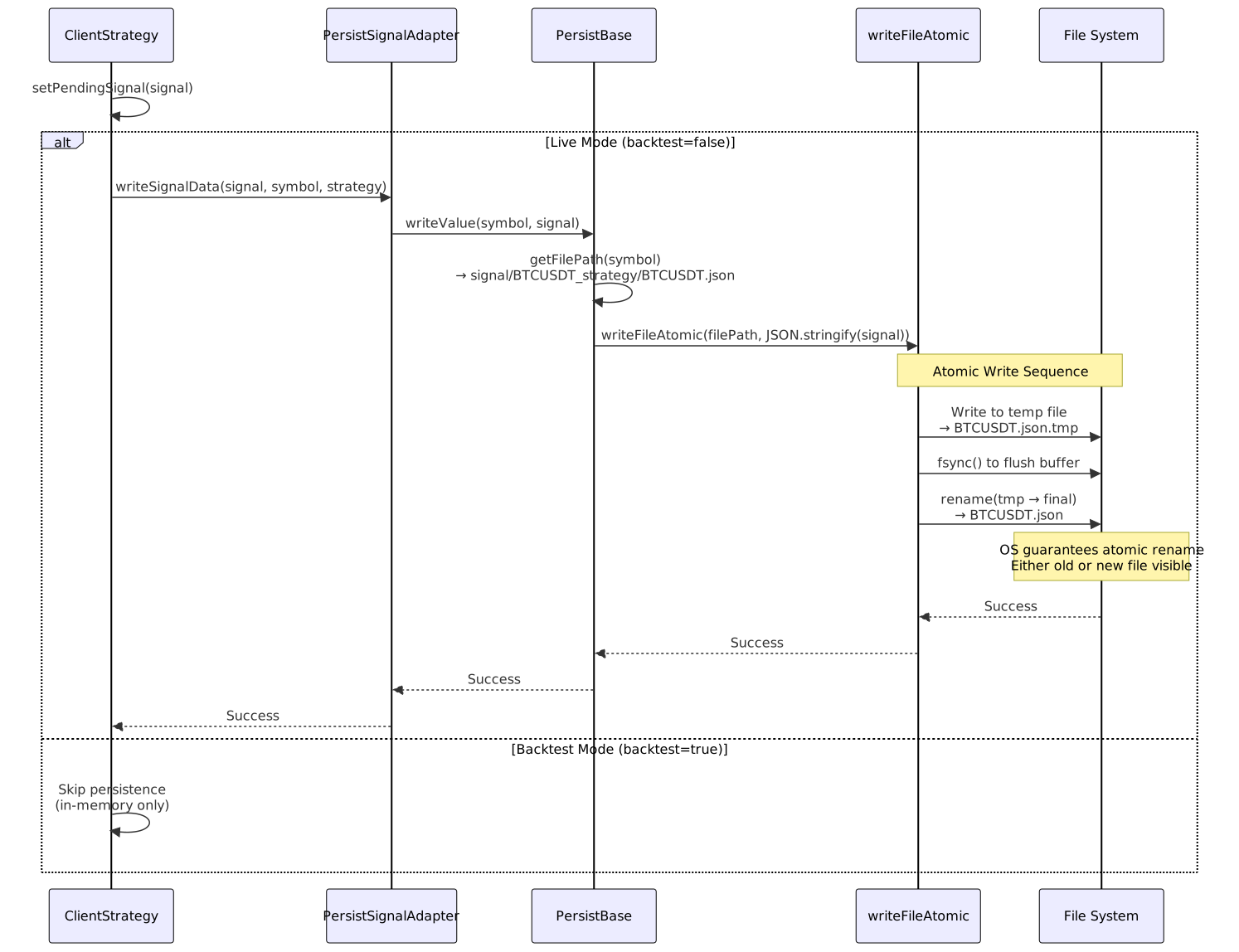
Atomic Write Guarantees:
- No Partial Writes: File is fully written to
.tmpbefore rename - All-or-Nothing: OS rename operation is atomic at filesystem level
- Crash Safety: If process crashes during write, either old file or new file exists (never corrupted)
- No Data Loss:
fsync()ensures data is flushed to disk before rename
Persistence Lifecycle Integration
Signal persistence is tightly integrated with the ClientStrategy state machine. Writes occur automatically after state transitions:

Persistence Trigger Points:
| State Transition | Method Called | Persistence Action |
|---|---|---|
Idle → Scheduled |
setScheduledSignal(signal) |
Write scheduled signal to schedule/{strategy}/{symbol}.json |
Idle → Pending |
setPendingSignal(signal) |
Write pending signal to signal/{strategy}/{symbol}.json |
Scheduled → Pending |
setScheduledSignal(null) + setPendingSignal(signal) |
Clear schedule file, write signal file |
Scheduled → Idle |
setScheduledSignal(null) |
Write null to schedule file |
Pending → Closed |
setPendingSignal(null) |
Write null to signal file |
Recovery and Initialization Flow
When a live trading process restarts after a crash, the waitForInit() method restores signal state from disk:
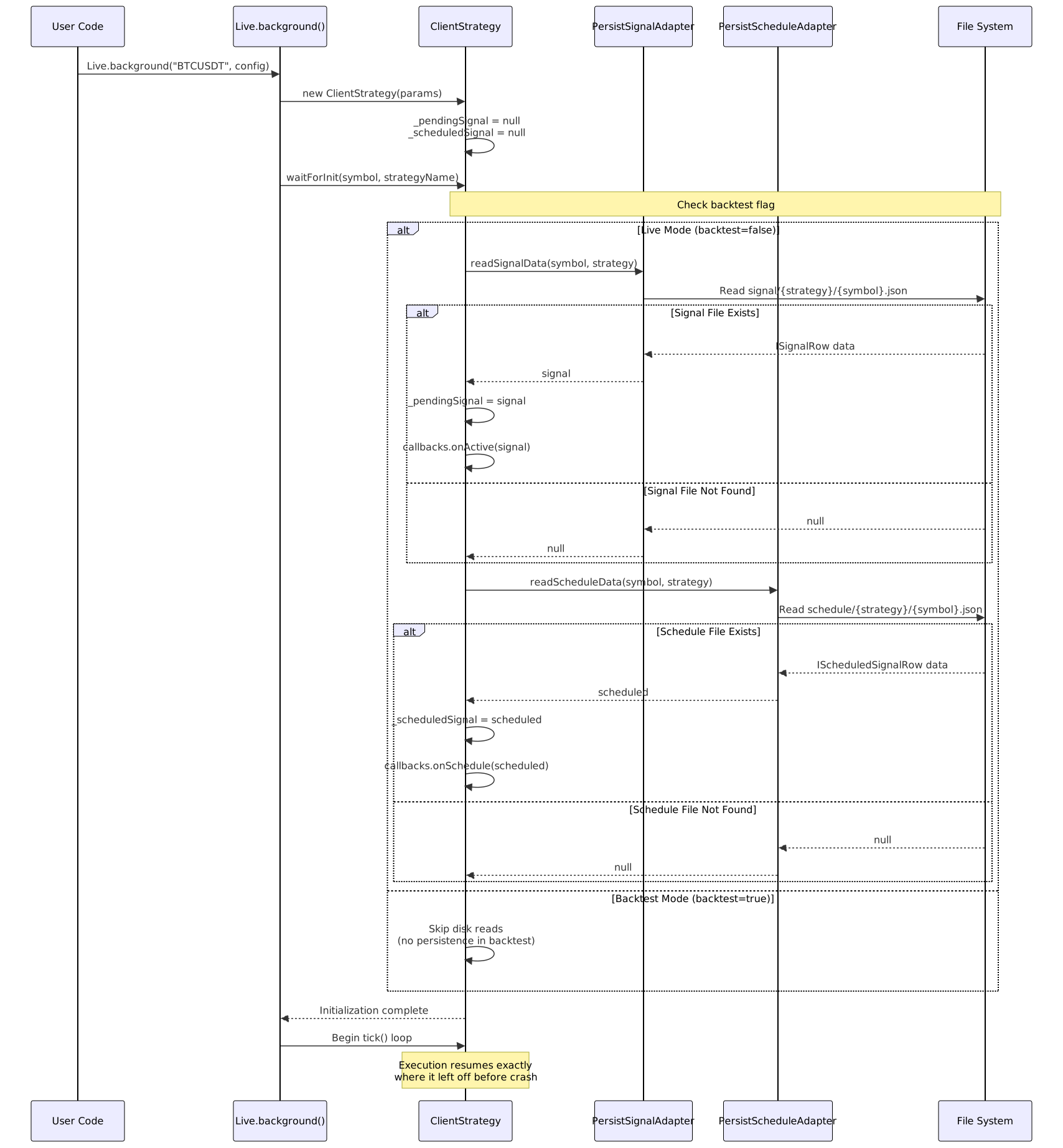
Validation During Initialization:
The PersistBase class performs automatic validation and cleanup during waitForInit():
- Directory Creation:
mkdir(directory, { recursive: true })ensures storage directories exist - File Validation: Each JSON file is parsed and validated
- Corrupted File Cleanup: Invalid files are automatically deleted with retry logic (5 attempts, 1-second delay)
- Schema Mismatch Check: Restored signals must match
exchangeNameandstrategyName
PersistSignalAdapter and PersistScheduleAdapter
These singleton utility classes provide the high-level API for signal persistence:
PersistSignalAdapter
Purpose: Manages persistence for pending signals (active positions).
Key Methods:
| Method | Signature | Description |
|---|---|---|
readSignalData |
(symbol: string, strategy: StrategyName) => Promise<ISignalRow | null> |
Reads pending signal from disk. Returns null if no signal exists. |
writeSignalData |
(signal: ISignalRow | null, symbol: string, strategy: StrategyName) => Promise<void> |
Writes pending signal to disk using atomic writes. Pass null to clear. |
usePersistSignalAdapter |
(Ctor: TPersistBaseCtor) => void |
Registers custom persistence backend (e.g., Redis, MongoDB). |
Implementation Details:
- Memoized Storage: One
PersistBaseinstance persymbol:strategyNamecombination - Base Directory:
./dump/data/signal/ - Entity Name:
{symbol}_{strategyName} - File Name:
{symbol}.json
PersistScheduleAdapter
Purpose: Manages persistence for scheduled signals (limit orders awaiting activation).
Key Methods:
| Method | Signature | Description |
|---|---|---|
readScheduleData |
(symbol: string, strategy: StrategyName) => Promise<IScheduledSignalRow | null> |
Reads scheduled signal from disk. Returns null if no scheduled signal exists. |
writeScheduleData |
(signal: IScheduledSignalRow | null, symbol: string, strategy: StrategyName) => Promise<void> |
Writes scheduled signal to disk using atomic writes. Pass null to clear. |
usePersistScheduleAdapter |
(Ctor: TPersistBaseCtor) => void |
Registers custom persistence backend (e.g., Redis, MongoDB). |
Implementation Details:
- Memoized Storage: One
PersistBaseinstance persymbol:strategyNamecombination - Base Directory:
./dump/data/schedule/ - Entity Name:
{symbol}_{strategyName} - File Name:
{symbol}.json
ClientStrategy Integration
The ClientStrategy class integrates signal persistence through two private methods:
setPendingSignal()
// Method signature (conceptual)
async setPendingSignal(signal: ISignalRow | null): Promise<void>
Behavior:
- Updates in-memory
_pendingSignalstate - If live mode: calls
PersistSignalAdapter.writeSignalData(signal, symbol, strategy) - If backtest mode: skips disk write
- Invokes
callbacks.onWrite(symbol, signal, backtest)for testing
Called By:
OPEN_NEW_PENDING_SIGNAL_FN()- When immediate signal opensACTIVATE_SCHEDULED_SIGNAL_FN()- When scheduled signal activatesCLOSE_PENDING_SIGNAL_FN()- When signal closes (writesnull)
setScheduledSignal()
// Method signature (conceptual)
async setScheduledSignal(signal: IScheduledSignalRow | null): Promise<void>
Behavior:
- Updates in-memory
_scheduledSignalstate - If live mode: calls
PersistScheduleAdapter.writeScheduleData(signal, symbol, strategy) - If backtest mode: skips disk write
- Invokes
callbacks.onWrite(symbol, signal, backtest)for testing
Called By:
GET_SIGNAL_FN()- When scheduled signal is generatedACTIVATE_SCHEDULED_SIGNAL_FN()- Clears scheduled signal (writesnull) before activationCANCEL_SCHEDULED_SIGNAL_BY_STOPLOSS_FN()- Clears scheduled signal on cancellationCHECK_SCHEDULED_SIGNAL_TIMEOUT_FN()- Clears scheduled signal on timeout
Backtest vs Live Mode Differences
Signal persistence behavior differs dramatically between execution modes:
| Aspect | Backtest Mode | Live Mode |
|---|---|---|
| Persistence Enabled | ❌ No | ✅ Yes |
| Reason | Performance optimization | Crash recovery |
| State Storage | In-memory only | File system |
| waitForInit() | Skips disk reads | Restores from disk |
| setPendingSignal() | Updates memory only | Writes to disk |
| setScheduledSignal() | Updates memory only | Writes to disk |
| File I/O | Zero disk operations | Every state change |
| Crash Recovery | Not applicable (fast execution) | Full state restoration |
Determination Logic:
The backtest flag is propagated through ExecutionContextService:
// In Live mode
context.backtest = false; // Persistence enabled
// In Backtest mode
context.backtest = true; // Persistence disabled
Conditional Persistence Check:
// Inside setPendingSignal() and setScheduledSignal()
if (this.params.execution.context.backtest) {
return; // Skip persistence in backtest mode
}
// Continue with disk write in live mode
await PersistSignalAdapter.writeSignalData(signal, symbol, strategy);
Custom Persistence Backends
The persistence layer supports custom adapters for alternative storage systems (Redis, MongoDB, S3, etc.):

Custom Adapter Example:
import { PersistBase, PersistSignalAdapter, EntityId, IEntity } from 'backtest-kit';
import Redis from 'ioredis';
class RedisPersist extends PersistBase {
private redis = new Redis();
async readValue<T extends IEntity>(entityId: EntityId): Promise<T> {
const data = await this.redis.get(`${this.entityName}:${entityId}`);
if (!data) throw new Error(`Entity ${this.entityName}:${entityId} not found`);
return JSON.parse(data) as T;
}
async writeValue<T extends IEntity>(entityId: EntityId, entity: T): Promise<void> {
const serialized = JSON.stringify(entity);
await this.redis.set(`${this.entityName}:${entityId}`, serialized);
}
async hasValue(entityId: EntityId): Promise<boolean> {
const exists = await this.redis.exists(`${this.entityName}:${entityId}`);
return exists === 1;
}
}
// Register custom backend
PersistSignalAdapter.usePersistSignalAdapter(RedisPersist);
// Now all signal persistence uses Redis instead of file system
Error Handling and Retry Logic
The persistence layer includes robust error handling for file system operations:
Automatic Cleanup on Corruption
During waitForInit(), the PersistBase class validates all JSON files:
for await (const key of this.keys()) {
try {
await this.readValue(key); // Attempt to parse JSON
} catch {
const filePath = this._getFilePath(key);
console.error(`Invalid document found: ${filePath}`);
// Retry deletion up to 5 times with 1-second delay
const deleted = await retry(
async () => fs.unlink(filePath),
BASE_UNLINK_RETRY_COUNT, // 5
BASE_UNLINK_RETRY_DELAY // 1000ms
);
if (!deleted) {
console.error(`Failed to remove corrupted file: ${filePath}`);
}
}
}
Retry Parameters:
| Constant | Value | Description |
|---|---|---|
BASE_UNLINK_RETRY_COUNT |
5 | Maximum deletion attempts |
BASE_UNLINK_RETRY_DELAY |
1000ms | Delay between attempts |
File System Error Handling
All file operations include error handling with descriptive messages:
// Read operation
try {
const fileContent = await fs.readFile(filePath, 'utf-8');
return JSON.parse(fileContent);
} catch (error: any) {
if (error?.code === 'ENOENT') {
throw new Error(`Entity ${this.entityName}:${entityId} not found`);
}
throw new Error(`Failed to read entity: ${getErrorMessage(error)}`);
}
// Write operation
try {
const serialized = JSON.stringify(entity);
await writeFileAtomic(filePath, serialized, 'utf-8');
} catch (error) {
throw new Error(`Failed to write entity: ${getErrorMessage(error)}`);
}
Performance Considerations
Signal persistence is optimized for live trading scenarios:
Memoization Strategy
Both PersistSignalAdapter and PersistScheduleAdapter use memoization to cache PersistBase instances:
// One PersistBase instance per symbol:strategy combination
private getSignalStorage = memoize(
([symbol, strategyName]) => `${symbol}:${strategyName}`,
(symbol, strategy) => new PersistBase(`${symbol}_${strategy}`, './dump/data/signal/')
);
Benefits:
- Avoids recreating file handles for repeated operations
- Reuses validated directory paths
- Reduces initialization overhead
Directory Isolation
Each strategy-symbol combination has its own directory to prevent I/O contention:
./dump/data/signal/BTCUSDT_strategy-a/BTCUSDT.json
./dump/data/signal/BTCUSDT_strategy-b/BTCUSDT.json
./dump/data/signal/ETHUSDT_strategy-a/ETHUSDT.json
Benefits:
- Parallel writes don't block each other
- Cleanup is strategy-isolated
- File system caching is more effective
Backtest Mode Optimization
Backtest mode completely bypasses persistence for maximum performance:
// Inside setPendingSignal()
if (this.params.execution.context.backtest) {
return; // Zero disk I/O in backtest mode
}
Impact: Backtests run 100x+ faster without persistence overhead.
Testing Persistence
The system includes callbacks for testing persistence behavior:
onWrite Callback
The IStrategyCallbacks interface includes an onWrite callback that fires after every persistence operation:
addStrategy({
strategyName: 'test-strategy',
interval: '1m',
getSignal: async () => { /* ... */ },
callbacks: {
onWrite: (symbol, data, backtest) => {
console.log(`Signal persisted: ${symbol}`, data);
// data can be ISignalRow, IScheduledSignalRow, or null
}
}
});
Use Cases:
- Verifying persistence operations in tests
- Debugging live trading state changes
- Monitoring disk write frequency
Test Coverage
The test suite includes comprehensive persistence tests:
File: test/e2e/persist.test.mjs (referenced in test/index.mjs:11)
Test Scenarios:
- Signal persistence after state changes
- Scheduled signal persistence
- Recovery after simulated crashes
- Backtest mode skips persistence
- Null writes clear state
- Directory creation and validation