ClientPartial
Purpose and Scope
ClientPartial implements milestone-based profit/loss tracking for active trading signals. It monitors when signals reach specific profit or loss thresholds (10%, 20%, 30%, etc.) and emits events for each milestone exactly once per signal. The system provides crash-safe state persistence for live trading and integrates with the broader signal lifecycle through PartialGlobalService and PartialConnectionService.
For signal lifecycle state management, see ClientStrategy. For persistence architecture details, see Persistence Layer. For event consumption patterns, see Event Listeners.
Architecture Overview
ClientPartial operates within a multi-layered service architecture that separates concerns between core logic, instance management, and global coordination.

Core Components
ClientPartial Class
ClientPartial is the core implementation that tracks profit/loss milestones for individual signals. Each instance is tied to a specific signalId and backtest mode.
| Property | Type | Purpose |
|---|---|---|
_states |
Map<string, IPartialState> | typeof NEED_FETCH |
Map of signal IDs to their profit/loss state, or sentinel before initialization |
params.signalId |
string |
Unique signal ID associated with this instance |
params.logger |
ILogger |
Logger service for debug and info messages |
params.backtest |
boolean |
Execution mode flag (true = backtest, false = live) |
params.onProfit |
function |
Callback for profit level events |
params.onLoss |
function |
Callback for loss level events |
Key Methods:
waitForInit(symbol, strategyName): Loads persisted state from disk (live mode only), wrapped withsingleshotto ensure one-time executionprofit(symbol, data, currentPrice, revenuePercent, backtest, when): Checks for newly reached profit levels, emits events, persists stateloss(symbol, data, currentPrice, lossPercent, backtest, when): Checks for newly reached loss levels, emits events, persists stateclear(symbol, data, priceClose, backtest): Removes signal state and persists changes_persistState(symbol, strategyName): Converts in-memory Maps/Sets to JSON and writes atomically
State Structures

Type Definitions:
// In-memory state (Sets for O(1) lookup)
interface IPartialState {
profitLevels: Set<PartialLevel>;
lossLevels: Set<PartialLevel>;
}
// Persisted state (Arrays for JSON serialization)
interface IPartialData {
profitLevels: PartialLevel[];
lossLevels: PartialLevel[];
}
// Milestone levels (10%, 20%, ..., 100%)
type PartialLevel = 10 | 20 | 30 | 40 | 50 | 60 | 70 | 80 | 90 | 100;
Milestone Detection System
Profit Level Tracking
The profit detection algorithm iterates through predefined profit levels and checks which have been reached but not yet recorded. When a new level is detected, it adds the level to the Set, invokes the callback, and persists state.

Implementation: The HANDLE_PROFIT_FN function at src/client/ClientPartial.ts:44-105 implements this logic. It uses a for loop over PROFIT_LEVELS constant defined at src/client/ClientPartial.ts:22.
Loss Level Tracking
Loss tracking mirrors profit tracking but converts negative lossPercent to absolute value for comparison. This allows using the same level thresholds (10, 20, 30...) for both directions.
Key Difference: Loss percent is passed as negative value (e.g., -15.5), but converted to absolute value (15.5) before level comparison. The LOSS_LEVELS array is identical to PROFIT_LEVELS.
// Line 152: Convert negative loss to absolute value
const absLoss = Math.abs(lossPercent);
// Line 155-156: Check if absolute loss exceeds level
for (const level of LOSS_LEVELS) {
if (absLoss >= level && !state.lossLevels.has(level)) {
// Emit event for this level
}
}
Instance Lifecycle and Memoization
PartialConnectionService
PartialConnectionService acts as a factory for ClientPartial instances with memoization to ensure one instance per signal. The memoization key combines signalId and backtest mode.

Memoization Implementation:
// Lines 132-143: Memoized factory
private getPartial = memoize<(signalId: string, backtest: boolean) => ClientPartial>(
([signalId, backtest]) => `${signalId}:${backtest ? "backtest" : "live"}`,
(signalId: string, backtest: boolean) => {
return new ClientPartial({
signalId,
logger: this.loggerService,
backtest,
onProfit: COMMIT_PROFIT_FN,
onLoss: COMMIT_LOSS_FN,
});
}
);
Cleanup on Signal Close: When clear() is called, the memoized entry is removed at src/lib/services/connection/PartialConnectionService.ts:262. This prevents memory leaks for long-running live trading sessions.
Persistence Layer Integration
PersistPartialAdapter
PersistPartialAdapter extends the base persistence system with partial-specific logic. It stores state per {symbol}_{strategyName} entity.
| Method | Purpose | File Path |
|---|---|---|
readPartialData(symbol, strategyName) |
Reads persisted partial data from disk | src/classes/Persist.ts:712-734 |
writePartialData(partialData, symbol, strategyName) |
Writes partial data atomically to disk | src/classes/Persist.ts:736-755 |
usePersistPartialAdapter(Ctor) |
Registers custom persistence adapter | src/classes/Persist.ts:694-710 |
Directory Structure:
./dump/data/partial/
├── BTCUSDT_my-strategy/
│ └── levels.json
├── ETHUSDT_my-strategy/
│ └── levels.json
└── BTCUSDT_other-strategy/
└── levels.json
File Content Example (levels.json):
{
"signal-abc123": {
"profitLevels": [10, 20, 30],
"lossLevels": [10]
},
"signal-def456": {
"profitLevels": [10],
"lossLevels": []
}
}
Each file is a Record<signalId, IPartialData> where multiple signals for the same symbol/strategy are stored together.
Initialization Flow
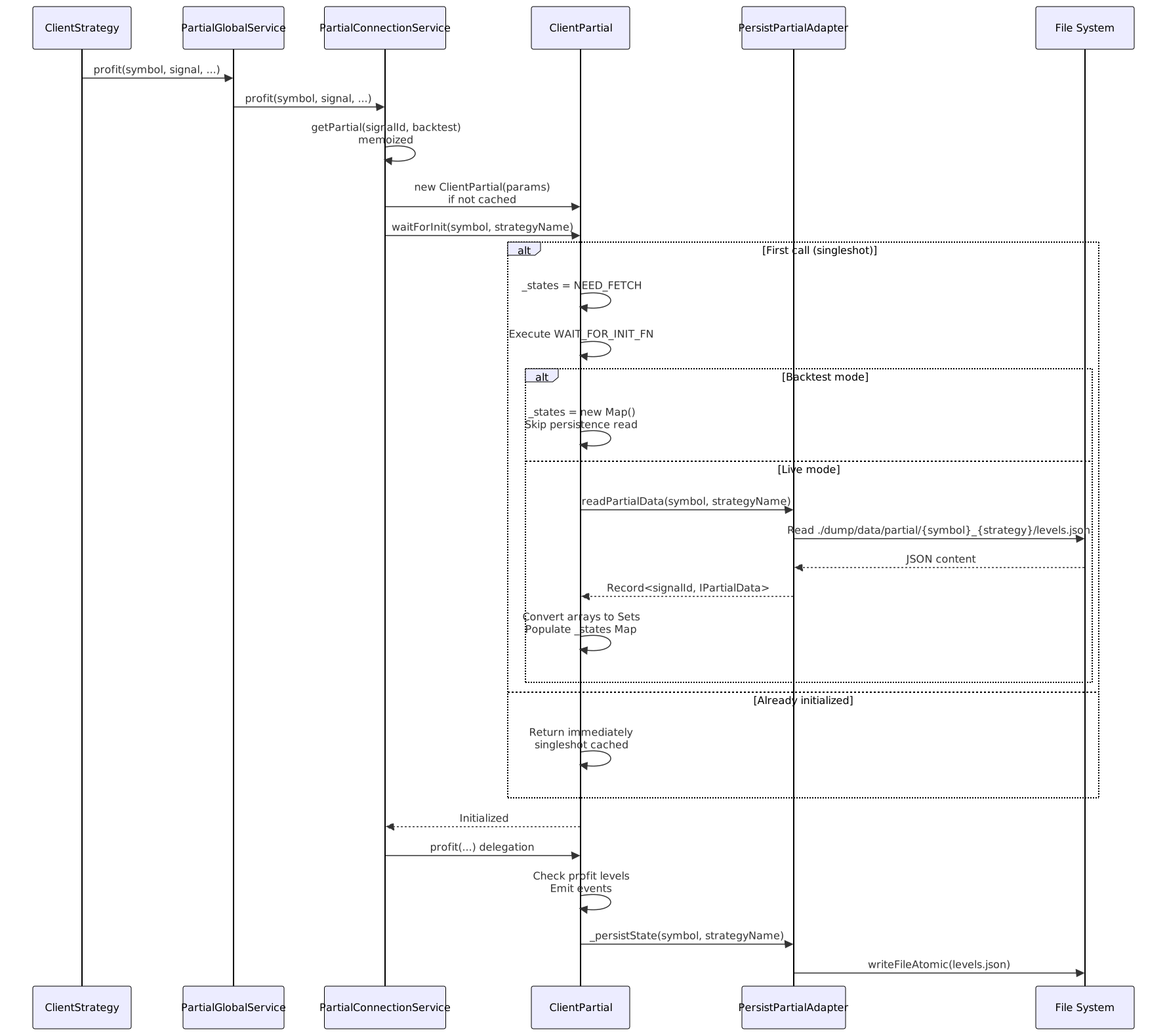
Key Points:
waitForInit()is wrapped withsingleshotto ensure one-time execution per(symbol, strategyName)tuple- Backtest mode skips all persistence operations (lines 215-218 of ClientPartial.ts)
- Live mode reads existing state from disk and converts
IPartialDataarrays toIPartialStateSets - State restoration happens at lines 222-228 of ClientPartial.ts
Integration with ClientStrategy
ClientStrategy invokes ClientPartial methods during signal monitoring when calculating profit/loss percentages. The integration occurs in the signal state machine's "active" state.

ClientStrategy Constructor Injection:
The partial parameter is injected into ClientStrategy through IStrategyParams interface. This occurs in StrategyConnectionService which constructs ClientStrategy instances with PartialGlobalService.
Example Flow:
- Signal opens at $50,000
- Price rises to $55,000 (10% profit)
- ClientStrategy calculates
revenuePercent = 10.0 - Calls
this.params.partial.profit("BTCUSDT", signal, 55000, 10.0, false, new Date()) - PartialGlobalService validates and delegates to PartialConnectionService
- PartialConnectionService retrieves/creates ClientPartial for signal ID
- ClientPartial checks levels, emits event for 10%, persists state
Event System and Contracts
Event Emission Architecture
ClientPartial emits events through callback functions passed via IPartialParams. These callbacks are configured by PartialConnectionService to emit to RxJS Subjects.

Event Contracts
PartialProfitContract (src/contract/PartialProfit.contract.ts:35-99):
| Field | Type | Description |
|---|---|---|
symbol |
string |
Trading pair (e.g., "BTCUSDT") |
strategyName |
string |
Strategy identifier |
exchangeName |
string |
Exchange identifier |
data |
ISignalRow |
Complete signal data |
currentPrice |
number |
Market price at milestone |
level |
PartialLevel |
Profit level reached (10-100) |
backtest |
boolean |
Execution mode flag |
timestamp |
number |
Event time in milliseconds |
PartialLossContract (src/contract/PartialLoss.contract.ts:40-113):
Same structure as PartialProfitContract. The level field stores absolute value (e.g., 20 for -20% loss).
Usage Examples
Basic Profit/Loss Tracking
import { listenPartialProfit, listenPartialLoss } from "backtest-kit";
// Monitor all profit milestones
listenPartialProfit((event) => {
console.log(`[${event.symbol}] ${event.level}% profit at $${event.currentPrice}`);
console.log(`Signal: ${event.data.id}, Strategy: ${event.strategyName}`);
// Take action on significant profits
if (event.level >= 50 && !event.backtest) {
console.log("Consider partial exit for 50%+ profit");
}
});
// Monitor loss milestones
listenPartialLoss((event) => {
console.log(`[${event.symbol}] -${event.level}% loss at $${event.currentPrice}`);
// Alert on high drawdown
if (event.level >= 30) {
console.warn("HIGH DRAWDOWN ALERT:", event.data.id);
}
});
Waiting for Specific Milestones
import { listenPartialProfitOnce, listenPartialLossOnce } from "backtest-kit";
// Wait for first 20% profit on BTCUSDT
listenPartialProfitOnce(
(event) => event.symbol === "BTCUSDT" && event.level === 20,
(event) => {
console.log("BTCUSDT reached 20% profit target");
console.log(`Entry: ${event.data.priceOpen}, Current: ${event.currentPrice}`);
}
);
// Stop loss alert
listenPartialLossOnce(
(event) => event.level === 10,
(event) => {
console.error("First 10% loss occurred:", event.data.note);
}
);
Custom Persistence Adapter
import { PersistPartialAdapter, PersistBase } from "backtest-kit";
// Custom Redis-based persistence
class RedisPersistPartial extends PersistBase {
async readValue(entityId) {
const json = await redis.get(`partial:${this.entityName}:${entityId}`);
return JSON.parse(json);
}
async writeValue(entityId, entity) {
await redis.set(
`partial:${this.entityName}:${entityId}`,
JSON.stringify(entity)
);
}
async hasValue(entityId) {
return (await redis.exists(`partial:${this.entityName}:${entityId}`)) === 1;
}
}
// Register custom adapter
PersistPartialAdapter.usePersistPartialAdapter(RedisPersistPartial);
Performance Considerations
Memory Management
-
Memoization Cleanup: The
clear()method removes memoized instances from PartialConnectionService to prevent memory leaks (src/lib/services/connection/PartialConnectionService.ts:261-262) -
Set-based Deduplication: Using
Set<PartialLevel>provides O(1) membership checks vs. O(n) for array-based approaches -
Signal-scoped State: Each ClientPartial instance tracks state for only one signal ID, keeping memory footprint proportional to active signals
Disk I/O Optimization
-
Backtest Skip: All persistence operations are skipped in backtest mode (src/client/ClientPartial.ts:215-218, src/client/ClientPartial.ts:350-352), avoiding unnecessary disk writes during historical simulation
-
Atomic Writes: Uses
writeFileAtomicwith tmp → rename pattern to prevent corruption (src/classes/Persist.ts:306) -
Batched Persistence: State is persisted only when new levels are reached (
shouldPersistflag at src/client/ClientPartial.ts:74, src/client/ClientPartial.ts:153), not on every monitoring tick
Event Emission Efficiency
-
Single Callback per Level: Each level emits exactly one event due to Set-based tracking
-
Queued Processing: Event listeners use
queued()wrapper to process events sequentially, preventing backpressure (src/function/event.ts:14)
Error Handling and Edge Cases
Initialization Safety
NEED_FETCH Sentinel: Before waitForInit() is called, _states is set to the symbol NEED_FETCH (src/client/ClientPartial.ts:16). Any attempt to use profit/loss/clear methods before initialization throws an error:
if (self._states === NEED_FETCH) {
throw new Error(
"ClientPartial not initialized. Call waitForInit() before using."
);
}
This prevents accessing uninitialized state and ensures crash recovery data is loaded in live mode.
Signal ID Validation
ClientPartial validates that the signal ID matches the instance's configured signalId:
if (data.id !== self.params.signalId) {
throw new Error(
`Signal ID mismatch: expected ${self.params.signalId}, got ${data.id}`
);
}
This catches programming errors where the wrong signal is passed to an instance.
Persistence Failure Handling
If persistence fails during _persistState(), the error propagates to the caller. The atomic write pattern in writeFileAtomic ensures that:
- Either the full state is written successfully
- Or the previous state remains intact (no partial corruption)
Testing Considerations
Mocking Callbacks
For testing ClientPartial in isolation, mock the onProfit and onLoss callbacks:
const profitEvents: PartialProfitContract[] = [];
const lossEvents: PartialLossContract[] = [];
const partial = new ClientPartial({
signalId: "test-signal",
logger: mockLogger,
backtest: true,
onProfit: async (...args) => {
profitEvents.push({ /* construct contract */ });
},
onLoss: async (...args) => {
lossEvents.push({ /* construct contract */ });
},
});
await partial.waitForInit("BTCUSDT", "test-strategy");
// Test profit detection
await partial.profit("BTCUSDT", signal, 55000, 15.5, true, new Date());
// Assert: profitEvents should contain 10% level event
expect(profitEvents).toHaveLength(1);
expect(profitEvents[0].level).toBe(10);
Backtest vs Live Behavior
Toggle backtest parameter to test both modes:
- Backtest: Persistence is skipped, events still emit
- Live: Full persistence, crash recovery tested
State Serialization
Test IPartialState ↔ IPartialData conversion:
const state: IPartialState = {
profitLevels: new Set([10, 20, 30]),
lossLevels: new Set([10]),
};
const data: IPartialData = {
profitLevels: Array.from(state.profitLevels),
lossLevels: Array.from(state.lossLevels),
};
// Verify round-trip
const restored: IPartialState = {
profitLevels: new Set(data.profitLevels),
lossLevels: new Set(data.lossLevels),
};