Overview
Purpose: This page introduces backtest-kit, a TypeScript framework for backtesting and live trading algorithmic strategies. It covers the framework's architecture, execution modes, and core components.
Scope: This overview provides a high-level understanding of the system's structure. For detailed API documentation, see Public API Reference. For signal lifecycle details, see Signal Lifecycle. For execution mode specifics, see Backtest, Live Trading, and Walker Mode.
What is backtest-kit?
backtest-kit is a TypeScript framework for backtesting and live trading strategies on crypto markets or forex. The framework enables identical code execution across environments with production-grade reliability.
Key Features:
| Feature | Implementation | Benefit |
|---|---|---|
| Signal Lifecycle | Type-safe state machine with 6 states (idle, scheduled, opened, active, closed, cancelled) |
Compile-time guarantees prevent invalid state transitions |
| VWAP Pricing | Volume-weighted average from last 5 1-minute candles via ExchangeCoreService.getAveragePrice() |
Realistic execution pricing vs simple close prices |
| Crash Recovery | Atomic file writes via PersistSignalAdapter, PersistRiskAdapter, PersistScheduleAdapter |
Zero signal loss on process restart |
| Validation | Multi-layer checks: type validation, price logic, distance checks, risk limits, time constraints | Invalid signals rejected before execution |
| Event System | RxJS Subject-based pub-sub with queued() wrapper |
Sequential callback execution prevents race conditions |
| Async Generators | BacktestLogicPrivateService.run() and LiveLogicPrivateService.run() yield results |
Memory-efficient streaming for large datasets |
| AI Integration | ClientOptimizer with Ollama deepseek-v3.1:671b model |
LLM-powered strategy generation from market data |
System Architecture
backtest-kit implements a layered architecture with 50+ services organized into distinct categories. The system uses dependency injection (di-kit) and async context propagation (di-scoped) for service coordination.
System Architecture Diagram:

Layer Responsibilities:
| Layer | Purpose | Key Classes |
|---|---|---|
| Public API | User-facing functions exported from src/index.ts |
addExchange, addStrategy, BacktestUtils, LiveUtils, listenSignal |
| Command Services | Orchestrate execution workflows | BacktestCommandService.run(), LiveCommandService.run(), WalkerCommandService.run() |
| Logic Services | Implement execution algorithms (private/public separation) | BacktestLogicPrivateService.execute(), LiveLogicPrivateService.loop() |
| Connection Services | Factory pattern with memoization by composite keys | StrategyConnectionService.getStrategy(), ExchangeConnectionService.getExchange() |
| Core Services | Domain logic without DI dependencies | StrategyCoreService.execute(), ExchangeCoreService.getAveragePrice() |
| Schema Services | Store registered configurations using ToolRegistry |
StrategySchemaService.add(), ExchangeSchemaService.add() |
| Client Implementations | Business logic for strategies, exchanges, risk | ClientStrategy.tick(), ClientExchange.getCandles(), ClientRisk.checkSignal() |
| Persistence Layer | Atomic file writes for crash recovery | PersistSignalAdapter.writeSignalData(), PersistRiskAdapter.writePositionData() |
Execution Modes
backtest-kit provides three execution modes with distinct data flow and persistence characteristics:
Execution Mode Comparison:

Mode Characteristics:
| Mode | Entry Point | Data Source | Output Type | Persistence |
|---|---|---|---|---|
| Backtest | BacktestUtils.run() or .background() |
FrameCoreService.getTimeframes() with IFrameSchema.startDate/endDate |
IStrategyBacktestResult (closed/cancelled only) |
In-memory only, no disk writes |
| Live | LiveUtils.run() or .background() |
new Date() every TICK_TTL (60 seconds) |
IStrategyTickResult (all 6 states) |
Atomic writes to ./dump/data/signal/{strategy}/{symbol}.json |
| Walker | WalkerUtils.run() or .background() |
Sequential calls to BacktestLogicPrivateService per strategy |
WalkerCompleteContract with ranked results |
Markdown reports via WalkerMarkdownService |
Execution Context:
All modes use ExecutionContextService with AsyncLocalStorage to propagate:
symbol: string- Trading pair (e.g., "BTCUSDT")when: Date- Current timestamp for temporal isolationbacktest: boolean- Mode flag determining persistence behavior
Core Component Registration
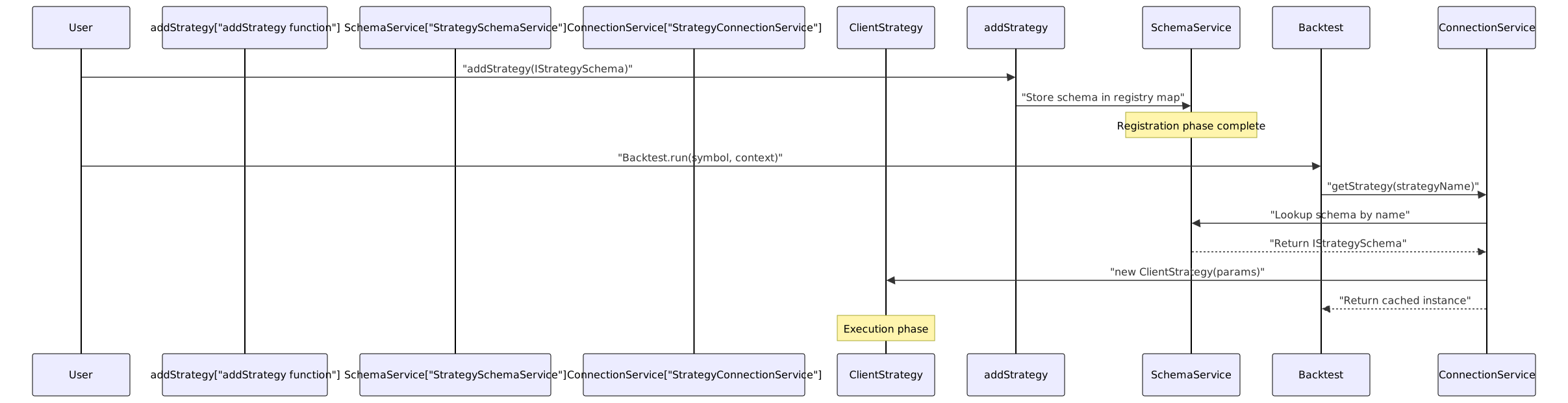
The framework uses dependency inversion for component registration. Components are defined separately and wired together at runtime using string identifiers:

Registration Example (from codebase pattern):
// Register exchange
addExchange({
exchangeName: "binance",
getCandles: async (symbol, interval, since, limit) => { /* ... */ }
});
// Register strategy
addStrategy({
strategyName: "sma-crossover",
interval: "5m",
getSignal: async (symbol) => { /* ... */ }
});
// Wire components at execution time
Backtest.background("BTCUSDT", {
strategyName: "sma-crossover", // String identifier
exchangeName: "binance", // String identifier
frameName: "1d-backtest"
});
Signal Lifecycle States
Signals progress through a type-safe state machine implemented as TypeScript discriminated unions. Each state has a distinct interface (IStrategyTickResult*) with the action property as the discriminator.
Signal State Machine:

TypeScript Interfaces:
| State | Interface | Key Properties | Persistence File |
|---|---|---|---|
idle |
IStrategyTickResultIdle |
action: "idle", signal: null |
None |
scheduled |
IStrategyTickResultScheduled |
action: "scheduled", signal: IScheduledSignalRow |
./dump/data/schedule/{strategy}/{symbol}.json |
opened |
IStrategyTickResultOpened |
action: "opened", signal: ISignalRow |
./dump/data/signal/{strategy}/{symbol}.json (created) |
active |
IStrategyTickResultActive |
action: "active", signal: ISignalRow, percentTp, percentSl |
./dump/data/signal/{strategy}/{symbol}.json (updated) |
closed |
IStrategyTickResultClosed |
action: "closed", signal: ISignalRow, closeReason, pnl: IStrategyPnL |
./dump/data/signal/{strategy}/{symbol}.json (deleted) |
cancelled |
IStrategyTickResultCancelled |
action: "cancelled", signal: IScheduledSignalRow |
./dump/data/schedule/{strategy}/{symbol}.json (deleted) |
State Transition Functions (in ClientStrategy):
GET_SIGNAL_FN()- Generates new signals, returnsISignalRoworIScheduledSignalRowCHECK_SCHEDULED_SIGNAL_PRICE_ACTIVATION_FN()- Checks if scheduled signal should activate or cancelACTIVATE_SCHEDULED_SIGNAL_FN()- ConvertsIScheduledSignalRowtoISignalRowand persistsCHECK_PENDING_SIGNAL_COMPLETION_FN()- Monitors active signal for TP/SL/time exitCLOSE_PENDING_SIGNAL_FN()- Calculates PNL and closes signal
Event System Architecture
backtest-kit implements an event-driven architecture using RxJS Subject instances for type-safe pub-sub. All event listeners use the queued() wrapper from functools-kit to ensure sequential callback execution.
Event Flow Diagram:

Queued Processing:
All listener functions wrap callbacks with queued() to ensure sequential execution:
// Example from src/function/event.ts
export const listenSignal = (handler: (signal: IStrategyTickResult) => void) => {
return signalEmitter.subscribe(queued(handler));
};
This prevents race conditions when multiple events fire rapidly (e.g., signal opened, partial profit hit, signal closed in quick succession).
Event Hierarchies:
| Base Emitter | Specialized Emitters | Listener Functions |
|---|---|---|
signalEmitter (all signals) |
signalBacktestEmitter, signalLiveEmitter |
listenSignal(), listenSignalBacktest(), listenSignalLive() |
partialProfitSubject |
None | listenPartialProfit(), listenPartialProfitOnce() |
partialLossSubject |
None | listenPartialLoss(), listenPartialLossOnce() |
riskSubject |
None | listenRisk(), listenRiskOnce() |
walkerCompleteSubject |
None | listenWalkerComplete() |
Event Contracts:
Each event emitter has a corresponding TypeScript interface:
IStrategyTickResult- Signal state changes (6 discriminated union types)RiskEvent- Risk validation failures with rejection reasonPartialEvent- Partial profit/loss milestone reachedWalkerCompleteContract- Walker comparison results with rankingsPerformanceContract- Operation timing metrics
Technology Stack
The framework is built on the following core dependencies:
Key Dependencies:
| Package | Version | Purpose |
|---|---|---|
di-kit |
^1.0.18 | Symbol-based dependency injection registry |
di-scoped |
^1.0.20 | Async context propagation (ExecutionContext, MethodContext) |
functools-kit |
^1.0.94 | Reactive primitives (Subject), async utilities (queued, singleshot) |
get-moment-stamp |
^1.1.1 | Timestamp formatting for candles and reports |
ollama |
^0.6.3 | LLM integration for AI-driven strategy generation |
Repository Structure
The codebase follows a modular structure with clear separation of concerns:
backtest-kit/
├── src/ # Framework source code
│ ├── interfaces/ # TypeScript interfaces (IStrategySchema, etc.)
│ ├── services/ # Service layer implementations
│ ├── client/ # Client implementations (ClientStrategy, etc.)
│ └── index.ts # Public API exports
├── test/ # Comprehensive test suite
│ ├── e2e/ # End-to-end integration tests
│ ├── spec/ # Unit tests for specific features
│ └── mock/ # Mock data generators
├── build/ # Compiled output (CJS + ESM)
├── types.d.ts # TypeScript type definitions
└── package.json # Package metadata and dependencies
Export Strategy: The framework exposes a single entry point (src/index.ts) with selective exports for:
- Configuration functions (
addExchange,addStrategy, etc.) - Execution engines (
Backtest,Live,Walker) - Event listeners (
listenSignal,listenError, etc.) - Utility functions (
getCandles,formatPrice, etc.)
Test Coverage
The framework includes comprehensive test coverage across multiple categories:

Test Categories:
| Category | Files | Coverage |
|---|---|---|
| E2E Integration | defend.test.mjs, risk.test.mjs, scheduled.test.mjs, persist.test.mjs |
Edge cases, crash recovery, risk limits |
| Spec Tests | backtest.test.mjs, live.test.mjs, walker.test.mjs, heat.test.mjs |
Feature validation, PNL accuracy |
| Mock Infrastructure | getMockCandles.mjs |
Deterministic candle generation for reproducible tests |
Next Steps
- For detailed API reference, see Public API Reference
- For signal lifecycle deep dive, see Signal Lifecycle
- For execution mode details, see Execution Modes
- For risk management, see Risk Management
- For AI optimization, see AI-Powered Strategy Optimization