Walker Mode
Walker Mode is a strategy comparison and optimization system that executes multiple backtest runs sequentially and ranks strategies by a configurable performance metric. This mode enables automated strategy selection by comparing historical performance across different strategy implementations for the same market conditions. For information about individual backtest execution, see Backtesting. For live trading execution, see Live Trading.
Overview
Walker Mode orchestrates multiple ClientStrategy instances through the same historical timeframe, collecting performance statistics for each strategy and identifying the best performer based on a selected metric. Unlike Backtest Mode which evaluates a single strategy, Walker Mode provides comparative analysis across strategy variants.
The walker system consists of three primary components:
| Component | Purpose | File Reference |
|---|---|---|
WalkerLogicPrivateService |
Orchestrates sequential backtest execution and metric comparison | src/lib/services/logic/private/WalkerLogicPrivateService.ts:1-255 |
WalkerSchema |
Defines strategies to compare, metric selection, and callbacks | src/interfaces/Walker.interface.ts |
WalkerMarkdownService |
Accumulates results and generates comparative reports | src/lib/services/markdown/WalkerMarkdownService.ts |
Execution Flow
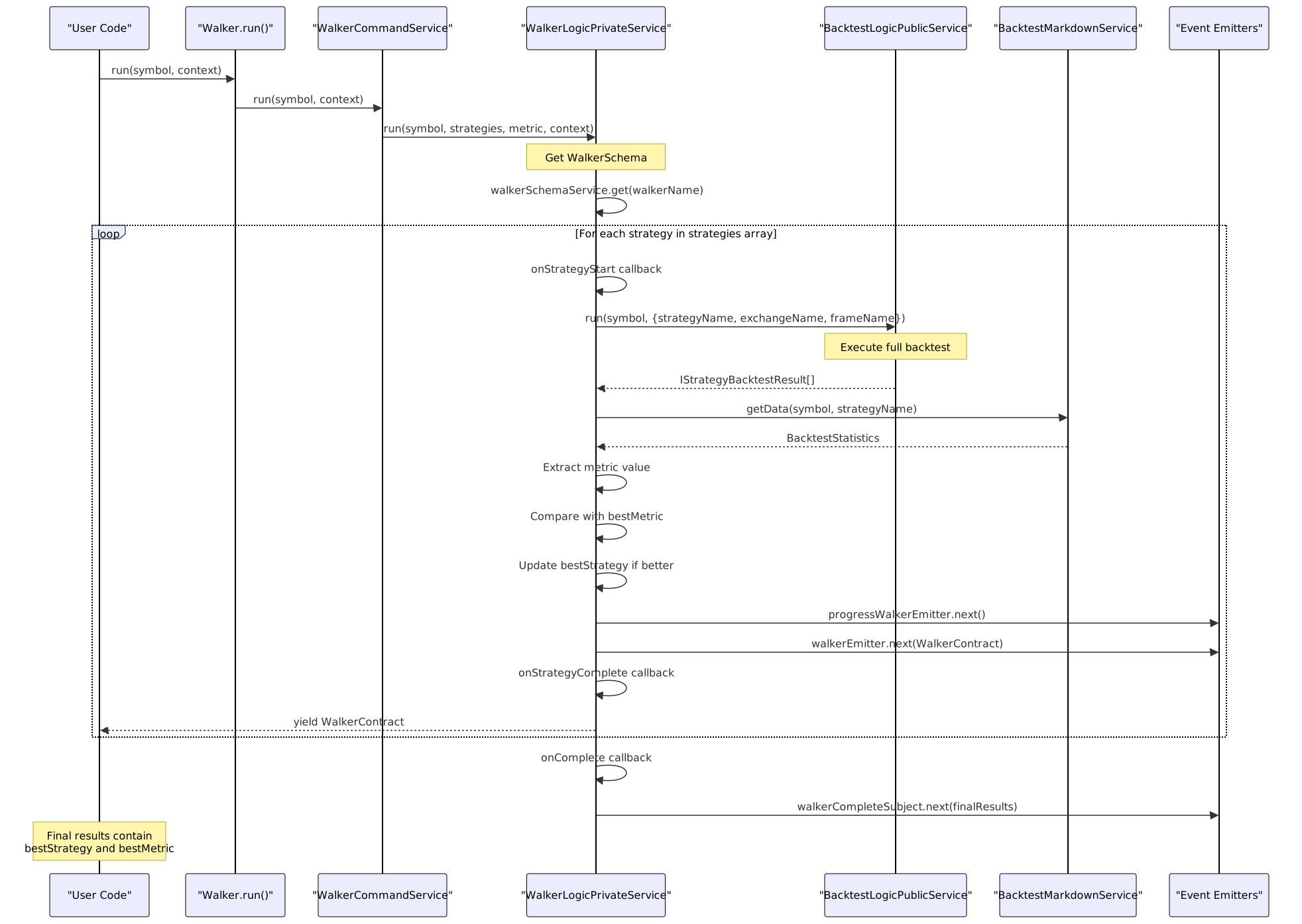
Diagram: Sequential Strategy Execution and Metric Comparison
The walker execution follows a strict sequential pattern to ensure fair comparison:
- Initialization: Retrieves the
IWalkerSchemafromWalkerSchemaServiceusing thewalkerNamecontext parameter src/lib/services/logic/private/WalkerLogicPrivateService.ts:88 - Strategy Iteration: Loops through each strategy name in the
strategiesarray src/lib/services/logic/private/WalkerLogicPrivateService.ts:107-228 - Backtest Execution: Invokes
BacktestLogicPublicService.run()for each strategy with the sameexchangeNameandframeNamesrc/lib/services/logic/private/WalkerLogicPrivateService.ts:117-121 - Statistics Collection: Retrieves performance metrics via
BacktestMarkdownService.getData()src/lib/services/logic/private/WalkerLogicPrivateService.ts:165 - Metric Comparison: Extracts the configured metric value and updates
bestStrategy/bestMetricif the current strategy outperforms src/lib/services/logic/private/WalkerLogicPrivateService.ts:168-186 - Progress Emission: Yields
WalkerContractafter each strategy completion for real-time monitoring src/lib/services/logic/private/WalkerLogicPrivateService.ts:190-227
Walker Schema Definition
Walker configuration is registered via addWalker() and must conform to the IWalkerSchema interface:
interface IWalkerSchema {
walkerName: WalkerName;
strategies: StrategyName[];
metric: WalkerMetric;
exchangeName: ExchangeName;
frameName: FrameName;
callbacks?: IWalkerCallbacks;
}
Key Schema Fields:
| Field | Type | Description |
|---|---|---|
walkerName |
WalkerName |
Unique identifier for this walker configuration |
strategies |
StrategyName[] |
Array of strategy names to compare (order preserved) |
metric |
WalkerMetric |
Performance metric used for ranking |
exchangeName |
ExchangeName |
Exchange to use for all strategy backtests |
frameName |
FrameName |
Timeframe to use for all strategy backtests |
callbacks |
IWalkerCallbacks |
Optional lifecycle hooks |
IWalkerCallbacks Interface:
| Callback | Signature | Invocation Point |
|---|---|---|
onStrategyStart |
(strategyName, symbol) => void |
Before each strategy backtest begins src/lib/services/logic/private/WalkerLogicPrivateService.ts:109-111 |
onStrategyComplete |
(strategyName, symbol, stats, metricValue) => void |
After each strategy backtest completes src/lib/services/logic/private/WalkerLogicPrivateService.ts:217-224 |
onStrategyError |
(strategyName, symbol, error) => void |
If a strategy backtest throws an exception src/lib/services/logic/private/WalkerLogicPrivateService.ts:143-145 |
onComplete |
(finalResults) => void |
After all strategies complete with final best results src/lib/services/logic/private/WalkerLogicPrivateService.ts:245-248 |
Metric Selection and Comparison
Walker Mode supports multiple performance metrics for strategy ranking. The metric value is extracted from BacktestStatistics returned by each backtest execution.
Available Metrics (WalkerMetric type):
| Metric | Description | Formula/Calculation |
|---|---|---|
sharpeRatio |
Risk-adjusted returns (default) | (avgReturn - riskFreeRate) / stdDevReturns |
sharpeRatioAnnualized |
Annualized Sharpe Ratio | sharpeRatio * sqrt(tradingDaysPerYear) |
winRate |
Percentage of profitable trades | winCount / totalTrades * 100 |
avgPnl |
Average profit/loss per trade | totalPnl / totalTrades |
totalPnl |
Cumulative profit/loss | Sum of all trade PnL values |
certaintyRatio |
Win rate adjusted for trade frequency | Custom calculation in statistics layer |
Metric Extraction and Validation:
The walker extracts the metric value with safety checks for invalid numbers src/lib/services/logic/private/WalkerLogicPrivateService.ts:168-176:
const value = stats[metric];
const metricValue =
value !== null &&
value !== undefined &&
typeof value === "number" &&
!isNaN(value) &&
isFinite(value)
? value
: null;
Comparison Logic:
Strategies are compared using a simple "greater is better" rule src/lib/services/logic/private/WalkerLogicPrivateService.ts:179-186:
const isBetter =
bestMetric === null ||
(metricValue !== null && metricValue > bestMetric);
if (isBetter && metricValue !== null) {
bestMetric = metricValue;
bestStrategy = strategyName;
}
If a strategy produces an invalid metric (NaN, Infinity, null), it is excluded from comparison but does not halt execution.
Walker Contract and Progress Tracking

Diagram: WalkerContract Construction and Event Flow
WalkerContract Structure:
Each iteration yields a WalkerContract object containing src/lib/services/logic/private/WalkerLogicPrivateService.ts:190-203:
| Field | Type | Description |
|---|---|---|
walkerName |
string |
Walker identifier from context |
exchangeName |
string |
Exchange used for all backtests |
frameName |
string |
Frame used for all backtests |
symbol |
string |
Symbol being analyzed |
strategyName |
string |
Current strategy that just completed |
stats |
BacktestStatistics |
Full statistics for current strategy |
metricValue |
number | null |
Current strategy's metric value |
metric |
WalkerMetric |
Metric being used for comparison |
bestMetric |
number | null |
Best metric value seen so far |
bestStrategy |
string | null |
Strategy name with best metric |
strategiesTested |
number |
Number of strategies completed |
totalStrategies |
number |
Total strategies in array |
Event Emission:
Two event channels emit progress updates:
-
progressWalkerEmittersrc/lib/services/logic/private/WalkerLogicPrivateService.ts:206-214: EmitsProgressWalkerContractwith progress percentageawait progressWalkerEmitter.next({
walkerName: context.walkerName,
exchangeName: context.exchangeName,
frameName: context.frameName,
symbol,
totalStrategies: strategies.length,
processedStrategies: strategiesTested,
progress: strategiesTested / strategies.length
}); -
walkerEmittersrc/lib/services/logic/private/WalkerLogicPrivateService.ts:226: Emits fullWalkerContractafter each strategy -
walkerCompleteSubjectsrc/lib/services/logic/private/WalkerLogicPrivateService.ts:250: Emits final results with best strategy and statistics
Walker API
The public API provides four methods for walker execution and reporting, mirroring the Backtest API pattern.
Walker Utility Class Methods:
| Method | Return Type | Purpose |
|---|---|---|
Walker.run() |
AsyncGenerator<WalkerContract> |
Execute walker and yield progress after each strategy |
Walker.background() |
() => void |
Execute walker without yielding results, return stop function |
Walker.getData() |
Promise<WalkerStatistics> |
Retrieve aggregated statistics for all strategies |
Walker.getReport() |
Promise<string> |
Generate markdown report with strategy comparison table |
Walker.dump() |
Promise<void> |
Write report to filesystem |
Walker.run() Usage:
for await (const progress of Walker.run("BTCUSDT", {
walkerName: "strategy-comparison",
exchangeName: "binance",
frameName: "2024-backtest"
})) {
console.log(`Testing ${progress.strategyName}: ${progress.metricValue}`);
console.log(`Best so far: ${progress.bestStrategy} (${progress.bestMetric})`);
console.log(`Progress: ${progress.strategiesTested}/${progress.totalStrategies}`);
}
The generator yields after each strategy completes, allowing real-time monitoring of the comparison process. The final yield contains the complete results with bestStrategy and bestMetric identified.
Walker.background() Usage:
const stopWalker = Walker.background("BTCUSDT", {
walkerName: "strategy-comparison",
exchangeName: "binance",
frameName: "2024-backtest"
});
// Walker runs in background consuming the generator
// Call stopWalker() to terminate early if needed
This method consumes the walker generator internally without exposing progress events. Useful when only callbacks or final results are needed.
Walker.getData() Usage:
const stats = await Walker.getData("BTCUSDT", "strategy-comparison");
console.log("Strategies tested:", stats.strategiesCount);
console.log("Best strategy:", stats.bestStrategy);
console.log("Best metric value:", stats.bestMetric);
console.log("All results:", stats.results); // Array of all strategy results
Returns aggregated statistics including all strategy results ranked by metric value.
Walker.getReport() Usage:
const markdown = await Walker.getReport("BTCUSDT", "strategy-comparison");
console.log(markdown);
Generates a markdown table comparing all strategies with their metrics, ranked from best to worst.
Integration with Backtest System

Diagram: Walker's Layered Integration with Backtest System
Walker Mode achieves strategy comparison by orchestrating multiple backtest executions through shared services:
Context Propagation:
For each strategy iteration, walker updates the MethodContextService context src/lib/services/logic/public/WalkerLogicPublicService.ts:
for await (const result of backtestLogicPublicService.run(symbol, {
strategyName, // Different for each iteration
exchangeName, // Same for all strategies
frameName // Same for all strategies
})) {
// Process backtest results
}
This ensures:
- Each strategy gets a separate
ClientStrategyinstance via memoization keys - All strategies use the same exchange and timeframe for fair comparison
- Event emissions are tagged with correct strategy name
Statistics Aggregation:
After each backtest completes, walker retrieves statistics from BacktestMarkdownService src/lib/services/logic/private/WalkerLogicPrivateService.ts:165:
const stats = await this.backtestMarkdownService.getData(symbol, strategyName);
The BacktestMarkdownService accumulates all signal events emitted by signalBacktestEmitter during the backtest execution, maintaining separate statistics for each strategy name.
Memoization and Isolation:
The StrategyConnectionService uses a composite key ${symbol}-${strategyName} to memoize ClientStrategy instances. This ensures:
- Each strategy gets its own isolated state
- Multiple walker runs for the same symbol don't interfere
- Strategy instances persist across multiple walker executions
Cancellation and Error Handling
Walker execution can be interrupted via walkerStopSubject or handle strategy-level errors gracefully.
Early Termination:
Walker listens to the walkerStopSubject stream for cancellation signals src/lib/services/logic/private/WalkerLogicPrivateService.ts:96-104:
const listenStop = walkerStopSubject
.filter((data) => {
let isOk = true;
isOk = isOk && data.symbol === symbol;
isOk = isOk && data.strategyName === pendingStrategy;
return isOk;
})
.map(() => CANCEL_SYMBOL)
.toPromise();
The walker races this promise against each backtest execution src/lib/services/logic/private/WalkerLogicPrivateService.ts:127-130:
result = await Promise.race([
await resolveDocuments(iterator),
listenStop,
]);
If the stop signal fires, walker breaks out of the strategy loop immediately src/lib/services/logic/private/WalkerLogicPrivateService.ts:149-157.
Strategy-Level Error Recovery:
If a strategy backtest throws an exception, walker:
- Logs the error via
LoggerServicesrc/lib/services/logic/private/WalkerLogicPrivateService.ts:132-140 - Emits the error to
errorEmittersrc/lib/services/logic/private/WalkerLogicPrivateService.ts:141 - Invokes
onStrategyErrorcallback if provided src/lib/services/logic/private/WalkerLogicPrivateService.ts:143-145 - Skips the failed strategy with
continuestatement src/lib/services/logic/private/WalkerLogicPrivateService.ts:146 - Proceeds to the next strategy in the array
This graceful degradation ensures that one failing strategy does not abort the entire walker comparison.
Use Cases and Patterns
1. Parameter Optimization:
Register multiple strategies with different parameter values and compare performance:
addStrategy({
strategyName: "ema-cross-fast-10-20",
interval: "1h",
getSignal: (context) => emaStrategy(context, 10, 20)
});
addStrategy({
strategyName: "ema-cross-medium-20-50",
interval: "1h",
getSignal: (context) => emaStrategy(context, 20, 50)
});
addStrategy({
strategyName: "ema-cross-slow-50-200",
interval: "1h",
getSignal: (context) => emaStrategy(context, 50, 200)
});
addWalker({
walkerName: "ema-optimization",
strategies: ["ema-cross-fast-10-20", "ema-cross-medium-20-50", "ema-cross-slow-50-200"],
metric: "sharpeRatio",
exchangeName: "binance",
frameName: "2024-backtest"
});
2. Real-Time Monitoring:
Track progress as each strategy completes:
listenWalker((progress) => {
console.log(`[${progress.strategiesTested}/${progress.totalStrategies}] ${progress.strategyName}`);
console.log(` Metric: ${progress.metricValue}`);
console.log(` Best: ${progress.bestStrategy} (${progress.bestMetric})`);
});
Walker.background("BTCUSDT", {
walkerName: "ema-optimization",
exchangeName: "binance",
frameName: "2024-backtest"
});
3. Multi-Metric Analysis:
Run walker multiple times with different metrics to get comprehensive comparison:
const metrics: WalkerMetric[] = ["sharpeRatio", "winRate", "totalPnl"];
for (const metric of metrics) {
addWalker({
walkerName: `analysis-${metric}`,
strategies: strategyList,
metric,
exchangeName: "binance",
frameName: "2024-backtest"
});
for await (const _ of Walker.run("BTCUSDT", {
walkerName: `analysis-${metric}`,
exchangeName: "binance",
frameName: "2024-backtest"
})) {}
const stats = await Walker.getData("BTCUSDT", `analysis-${metric}`);
console.log(`Best by ${metric}: ${stats.bestStrategy}`);
}
4. AI-Driven Strategy Generation:
Walker Mode integrates with the Optimizer system for LLM-generated strategy comparison. See AI-Powered Strategy Optimization for details on the complete pipeline. The optimizer generates multiple strategy variants and uses walker to identify the best performer on test data.