Live Trading
Live Trading mode executes trading strategies in real-time against current market conditions with automatic crash recovery. Unlike Backtest mode (see Backtesting), which simulates historical data, Live mode operates continuously with Date.now() timestamps and persists state to disk after every tick. This enables production-grade trading that survives process crashes, power failures, and system restarts.
For basic execution concepts, see Execution Modes. For persistence details, see Persistence Layer. For signal state management, see Signal Lifecycle.
Overview
Live Trading provides:
| Feature | Description |
|---|---|
| Infinite Loop | Continuous while(true) monitoring that never completes |
| Real-time Timestamps | Uses new Date() for current market time |
| Crash Recovery | Restores active positions from disk on restart |
| State Persistence | Atomic file writes after every tick |
| Graceful Shutdown | Allows open positions to complete before stopping |
Key Differences from Backtest
| Aspect | Backtest | Live |
|---|---|---|
| Timestamps | Historical timeframes from FrameCoreService |
Real-time new Date() |
| Completion | Finite (ends when timeframes exhausted) | Infinite (runs until stopped) |
| Persistence | Disabled (in-memory only) | Enabled (atomic disk writes) |
| Speed | Fast-forward through candles | Real-time (1 tick per TICK_TTL) |
Execution Flow
High-Level Architecture

Infinite Loop Structure
The core live trading loop is implemented in LiveLogicPrivateService.run():

LiveUtils Public API
The LiveUtils class provides a singleton interface for live trading operations:

Crash Recovery
Persistence Architecture
Live Trading persists four types of state to disk after every tick:
| Adapter | Path | Content | Purpose |
|---|---|---|---|
PersistSignalAdapter |
./dump/data/signal/{strategy}/{symbol}.json |
Active pending signals | Restore open positions |
PersistRiskAdapter |
./dump/data/risk/{riskName}.json |
Portfolio positions | Enforce risk limits |
PersistScheduleAdapter |
./dump/data/schedule/{strategy}/{symbol}.json |
Scheduled signals | Restore pending limit orders |
PersistPartialAdapter |
./dump/data/partial/{strategy}/{symbol}.json |
Partial TP/SL levels | Track milestone progress |
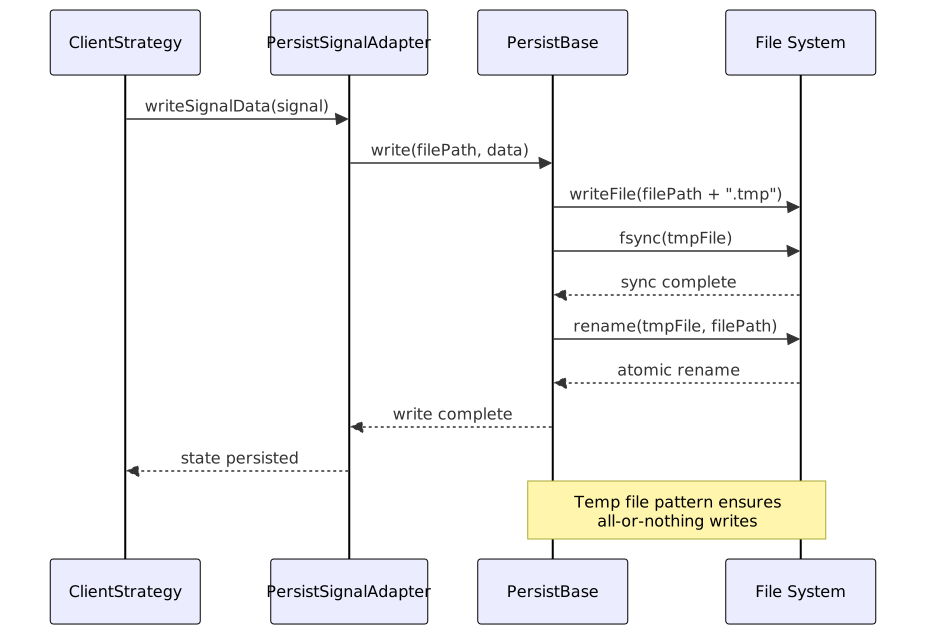
Atomic Write Pattern
All persistence uses the atomic write pattern to prevent data corruption:
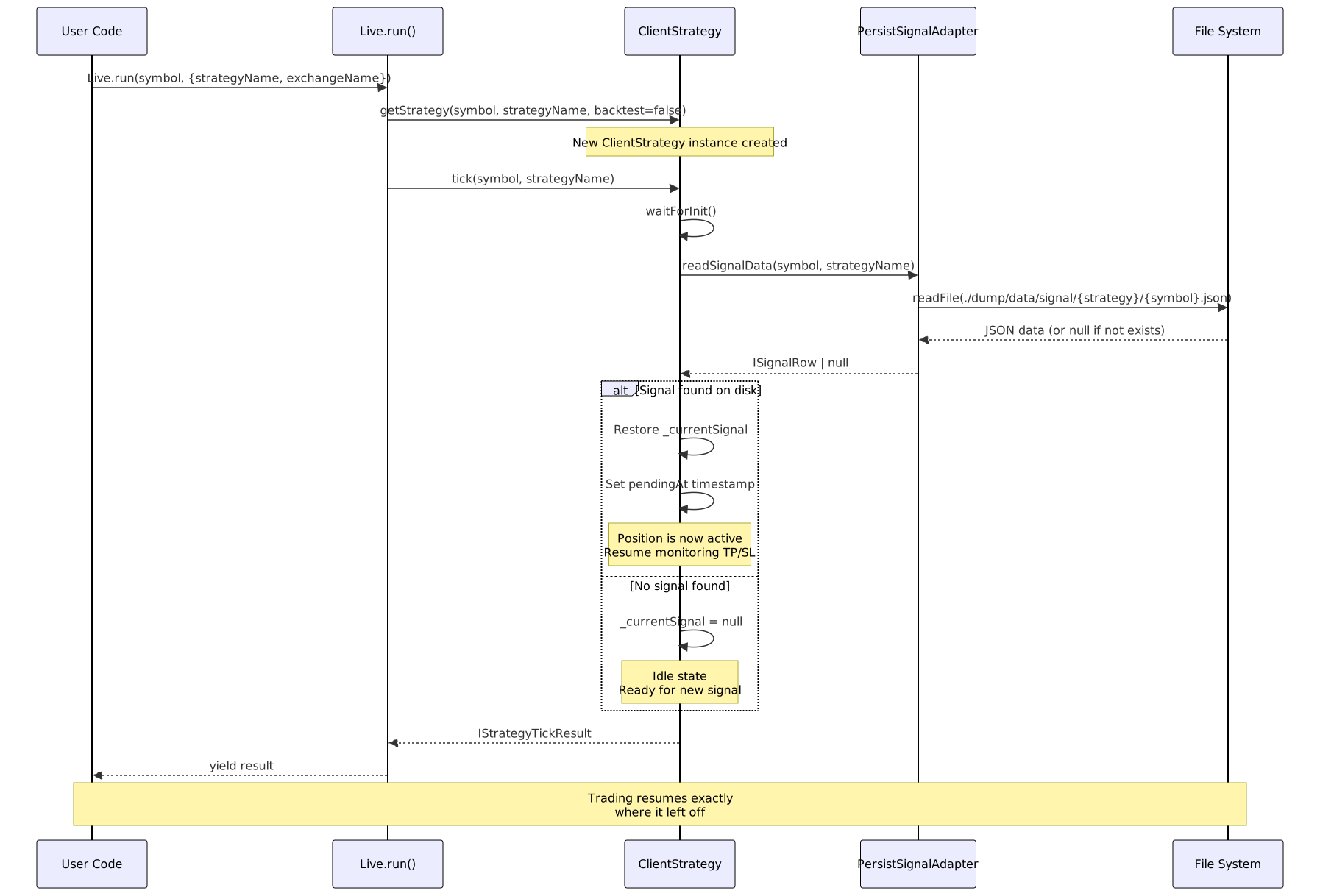
Recovery Flow
When a live trading process restarts after a crash:
Validation on Init
PersistBase validates all JSON files on initialization:

Real-time Monitoring
Tick Processing
Each tick evaluates the current signal state and returns a discriminated union:
| Result Action | When | Yielded to User | Description |
|---|---|---|---|
idle |
No active signal | ❌ No | Strategy is ready for new signal |
scheduled |
Signal waiting for priceOpen |
❌ No | Limit order pending activation |
active |
Signal open, monitoring TP/SL | ❌ No | Position is active |
opened |
Signal just activated | ✅ Yes | New position opened |
closed |
Signal hit TP/SL/time | ✅ Yes | Position closed with PNL |
Signal State Transitions in Live Mode

Event Emission
Live mode emits events to three distinct channels:

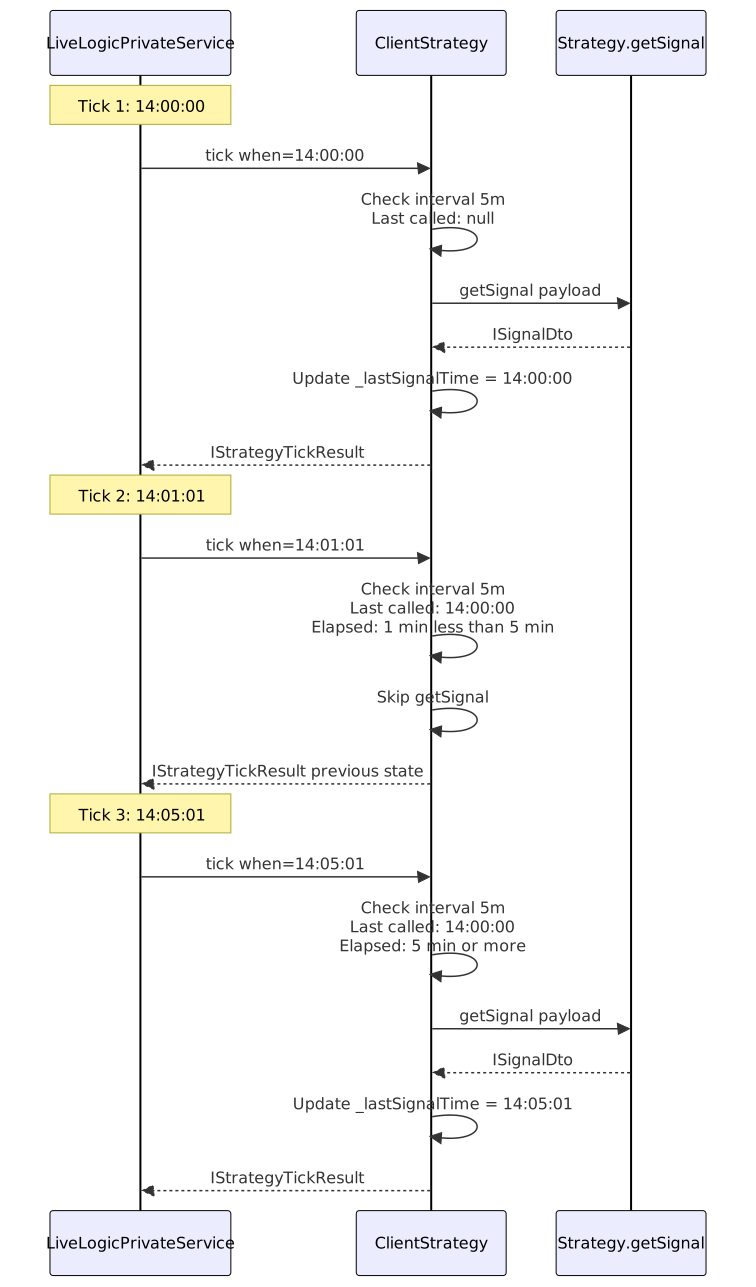
Interval Throttling
Strategy Interval Configuration
Each strategy declares a minimum interval that throttles signal generation:
addStrategy({
strategyName: "my-strategy",
interval: "5m", // Only generate signals every 5 minutes
getSignal: async (payload) => {
// Called at most once per 5 minutes
}
})
Supported Intervals
| Interval | Minutes | Description |
|---|---|---|
1m |
1 | Every tick (no throttling) |
3m |
3 | Every 3 minutes |
5m |
5 | Every 5 minutes |
15m |
15 | Every 15 minutes |
30m |
30 | Every 30 minutes |
1h |
60 | Every hour |
Throttling Mechanism
TICK_TTL Constant
The TICK_TTL constant defines sleep duration between ticks:
TICK_TTL = 1 * 60 * 1_000 + 1
= 60,001 milliseconds
≈ 60 seconds
This ensures approximately 1 tick per minute, regardless of strategy interval. Strategies with longer intervals (e.g., 5m, 1h) simply skip calling getSignal() on intermediate ticks.
Usage Examples
Basic Live Trading
import { Live, addStrategy, addExchange } from "backtest-kit";
// Configure components
addStrategy({
strategyName: "my-live-strategy",
interval: "5m",
getSignal: async (payload) => {
// Strategy logic
}
});
addExchange({
exchangeName: "binance",
getCandles: async (symbol, interval, startTime, limit) => {
// Fetch real-time data from Binance API
}
});
// Run live trading
for await (const result of Live.run("BTCUSDT", {
strategyName: "my-live-strategy",
exchangeName: "binance"
})) {
if (result.action === "opened") {
console.log("Position opened:", result.signal.id);
}
if (result.action === "closed") {
console.log("Position closed:", result.pnl.pnlPercentage);
}
}
Background Execution
// Run in background without yielding results
const cancel = Live.background("BTCUSDT", {
strategyName: "my-live-strategy",
exchangeName: "binance"
});
// Stop gracefully after some condition
setTimeout(() => {
cancel(); // Sets stop flag
}, 3600000); // 1 hour
Graceful Shutdown
// Stop strategy from generating new signals
await Live.stop("BTCUSDT", "my-live-strategy");
// Get pending signal to check if position is still open
const pending = await strategyCoreService.getPendingSignal(
false, // backtest = false (live mode)
"BTCUSDT",
"my-live-strategy"
);
if (pending) {
console.log("Position still open, waiting for close...");
// Allow signal to complete normally
}
Crash Recovery Example
// Initial run - process crashes at 14:30 with open position
Live.background("BTCUSDT", {
strategyName: "my-strategy",
exchangeName: "binance"
});
// [Process crashes]
// Restart - position is automatically recovered
Live.background("BTCUSDT", {
strategyName: "my-strategy",
exchangeName: "binance"
});
// ClientStrategy.waitForInit() loads state from:
// - ./dump/data/signal/my-strategy/BTCUSDT.json
// - ./dump/data/risk/{riskName}.json
// - ./dump/data/schedule/my-strategy/BTCUSDT.json
// - ./dump/data/partial/my-strategy/BTCUSDT.json
// Trading resumes monitoring TP/SL exactly where it left off
Instance Management
Memoization Strategy
LiveUtils uses memoize() to ensure one LiveInstance per symbol-strategy pair:
Key Format: "${symbol}:${strategyName}"
Example: "BTCUSDT:my-strategy"
Cache: Map<string, LiveInstance>
This prevents:
- Multiple concurrent instances for the same pair
- State conflicts between instances
- Resource leaks from duplicate connections
Instance Status
const statusList = await Live.list();
statusList.forEach(status => {
console.log(`${status.id}: ${status.symbol} - ${status.strategyName}`);
console.log(`Status: ${status.status}`); // "idle" | "running" | "done"
});
Status Values:
idle: Instance created but not runningrunning: Active infinite loop in progressdone: Loop terminated (rare in live mode)
Comparison with Backtest Mode
Execution Context
| Context Property | Backtest | Live |
|---|---|---|
backtest flag |
true |
false |
when timestamp |
Historical from FrameCoreService |
Real-time new Date() |
symbol |
Provided by user | Provided by user |
Strategy Instance Isolation
StrategyConnectionService.getStrategy() creates separate instances based on mode:
Backtest: memoize key = "${symbol}:${strategyName}:backtest"
Live: memoize key = "${symbol}:${strategyName}:live"
This allows running the same strategy in both modes simultaneously without interference.
Persistence Behavior
| Operation | Backtest | Live |
|---|---|---|
PersistSignalAdapter |
Skipped | Active |
PersistRiskAdapter |
Skipped | Active |
PersistScheduleAdapter |
Skipped | Active |
PersistPartialAdapter |
Skipped | Active |
ClientStrategy.waitForInit() |
No-op | Loads state from disk |
Backtest mode skips all persistence for performance, while Live mode persists state after every tick to enable crash recovery.
Error Handling
Tick Failures
When strategyCoreService.tick() throws an error:
try {
result = await this.strategyCoreService.tick(symbol, when, false);
} catch (error) {
console.warn(`tick failed when=${when.toISOString()} symbol=${symbol}`);
this.loggerService.warn("tick failed, retrying after sleep", { error });
await errorEmitter.next(error);
await sleep(TICK_TTL);
continue; // Retry on next iteration
}
The loop continues, allowing transient errors (network timeouts, API rate limits) to self-recover.
Persistence Failures
If atomic write fails:
- Temporary file is not renamed
- Original file remains unchanged
- Error is logged but does not crash the loop
- Next tick will retry persistence
This ensures trading continues even if disk I/O is temporarily unavailable.
Performance Tracking
Live mode emits performance metrics for each tick:
await performanceEmitter.next({
timestamp: Date.now(),
previousTimestamp: previousEventTimestamp,
metricType: "live_tick",
duration: tickEndTime - tickStartTime,
strategyName: this.methodContextService.context.strategyName,
exchangeName: this.methodContextService.context.exchangeName,
symbol,
backtest: false,
});
Subscribe to these events to monitor:
- Tick processing duration
- Time between ticks
- System performance trends
Related Pages
- Backtesting - Historical simulation mode
- Signal Lifecycle - Signal state transitions
- Crash Recovery - Detailed persistence mechanisms
- Client Implementations - ClientStrategy details
- Persistence Layer - Atomic write patterns