Signal Lifecycle
This document provides a comprehensive guide to the signal lifecycle in backtest-kit. It covers signal states, generation, validation, state transitions, and persistence. The signal lifecycle is the core mechanism through which trading positions are created, monitored, and closed by the framework.
For information about risk management checks that occur during signal generation, see Risk Management. For details on execution modes (Backtest vs Live) that affect lifecycle behavior, see Execution Modes.
Signal States Overview
Signals in backtest-kit follow a discriminated union pattern (IStrategyTickResult) with six possible states. Each state is represented by a specific TypeScript interface with an action discriminator field for type-safe handling.

Signal Data Structures
The framework defines a hierarchy of signal types with increasing levels of completeness and metadata.
Core Signal Types
| Type | Description | Key Fields | Usage |
|---|---|---|---|
ISignalDto |
User-returned signal from getSignal() |
position, priceTakeProfit, priceStopLoss, minuteEstimatedTime, optional priceOpen |
Returned by strategy's getSignal function |
ISignalRow |
Validated signal with metadata | Extends ISignalDto + id, priceOpen (required), scheduledAt, pendingAt, symbol, strategyName, exchangeName, _isScheduled |
Used throughout lifecycle |
IScheduledSignalRow |
Scheduled signal variant | Extends ISignalRow, enforces priceOpen presence |
Represents delayed entry signals |

Signal Generation Process
Signal generation occurs within ClientStrategy.tick() via the GET_SIGNAL_FN wrapper (ClientStrategy.ts:332-476), which coordinates throttling, risk checks, validation, and signal augmentation.
Signal Generation Pipeline
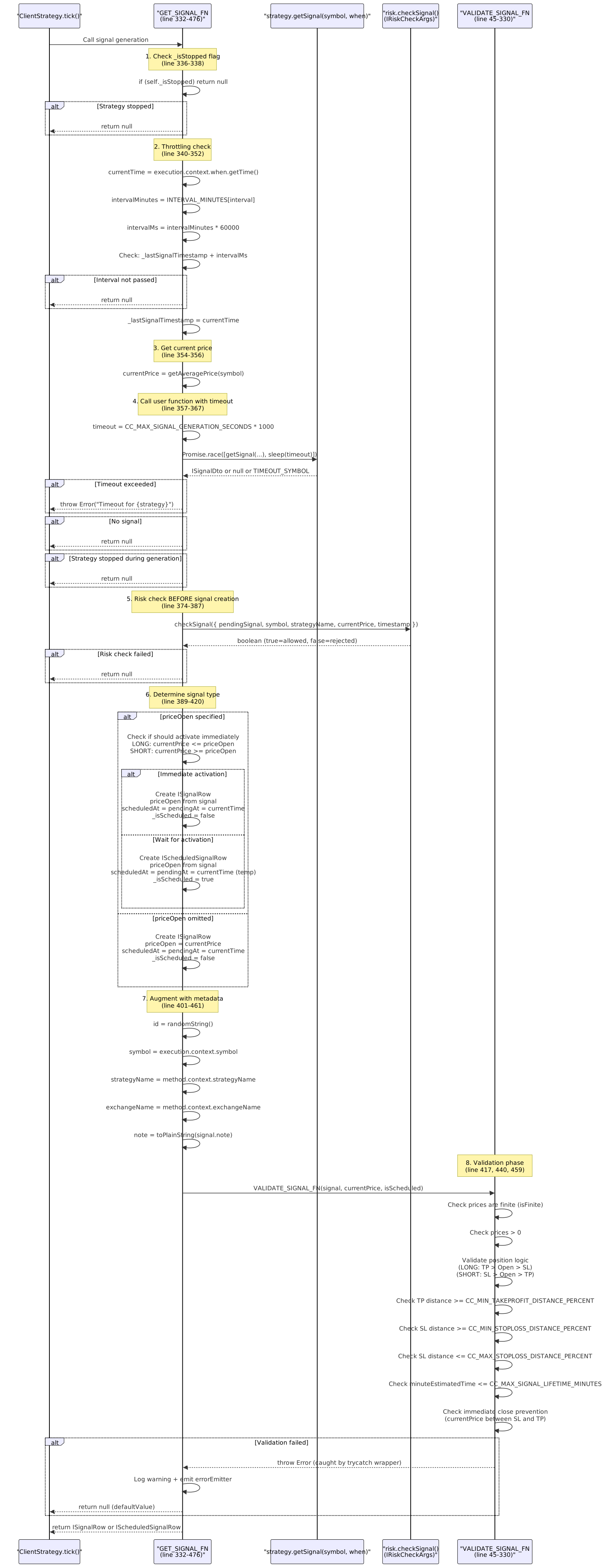
Throttling Mechanism: INTERVAL_MINUTES
The framework enforces minimum time between getSignal() calls using the interval field from IStrategySchema:
// INTERVAL_MINUTES constant (line 34-41)
const INTERVAL_MINUTES: Record<SignalInterval, number> = {
"1m": 1,
"3m": 3,
"5m": 5,
"15m": 15,
"30m": 30,
"1h": 60,
};
// Throttling logic (line 340-352)
const intervalMinutes = INTERVAL_MINUTES[self.params.interval];
const intervalMs = intervalMinutes * 60 * 1000;
if (
self._lastSignalTimestamp !== null &&
currentTime - self._lastSignalTimestamp < intervalMs
) {
return null; // Too soon, skip signal generation
}
self._lastSignalTimestamp = currentTime; // Update timestamp
Purpose:
- Prevents strategy spam (generating signal every tick)
- Reduces computational overhead
- Enforces deliberate strategy design (e.g., "1h" interval = strategy runs hourly)
Error Handling:
The GET_SIGNAL_FN is wrapped with trycatch from functools-kit (ClientStrategy.ts:332), which catches all exceptions and:
- Logs warning via
loggerService.warn() - Emits error via
errorEmitter.next(error) - Returns
null(defaultValue) instead of crashing
Signal Validation Rules
The VALIDATE_SIGNAL_FN (defined at ClientStrategy.ts:45-330) enforces critical safety checks to prevent invalid signals from entering the system. All validations throw descriptive errors with context if checks fail.
Validation Categories and Configuration
| Validation | Check | Config Parameter | Default | Purpose |
|---|---|---|---|---|
| Finite Numbers | isFinite(price) |
N/A | Required | Protect against NaN/Infinity from calculation errors |
| Price Positivity | price > 0 |
N/A | Required | All prices must be positive real numbers |
| Position Logic (LONG) | TP > priceOpen > SL |
N/A | Required | Ensure valid long position price ordering |
| Position Logic (SHORT) | SL > priceOpen > TP |
N/A | Required | Ensure valid short position price ordering |
| TakeProfit Distance | distance >= threshold |
CC_MIN_TAKEPROFIT_DISTANCE_PERCENT |
0.3% |
Must cover trading fees (2×0.1% entry+exit) |
| StopLoss Min Distance | distance >= threshold |
CC_MIN_STOPLOSS_DISTANCE_PERCENT |
0.1% |
Prevent instant stop-out from volatility |
| StopLoss Max Distance | distance <= threshold |
CC_MAX_STOPLOSS_DISTANCE_PERCENT |
20% |
Prevent catastrophic losses |
| Signal Lifetime | minutes <= max |
CC_MAX_SIGNAL_LIFETIME_MINUTES |
1440 (1 day) |
Prevent eternal signals blocking risk limits |
| Immediate Close Check | Complex logic | N/A | Required | Prevent signals that close instantly |
Validation Logic: Position Price Ordering
LONG Position (Buy Low, Sell High):
// VALIDATE_SIGNAL_FN line 112-200
if (signal.position === "long") {
// Price ordering validation
if (signal.priceTakeProfit <= signal.priceOpen) {
throw new Error(
`Long: priceTakeProfit (${signal.priceTakeProfit}) must be > priceOpen (${signal.priceOpen})`
);
}
if (signal.priceStopLoss >= signal.priceOpen) {
throw new Error(
`Long: priceStopLoss (${signal.priceStopLoss}) must be < priceOpen (${signal.priceOpen})`
);
}
// TakeProfit distance check (covers fees)
if (GLOBAL_CONFIG.CC_MIN_TAKEPROFIT_DISTANCE_PERCENT) {
const tpDistancePercent = ((signal.priceTakeProfit - signal.priceOpen) / signal.priceOpen) * 100;
if (tpDistancePercent < GLOBAL_CONFIG.CC_MIN_TAKEPROFIT_DISTANCE_PERCENT) {
throw new Error(
`Long: TakeProfit too close to priceOpen (${tpDistancePercent.toFixed(3)}%). ` +
`Minimum distance: ${GLOBAL_CONFIG.CC_MIN_TAKEPROFIT_DISTANCE_PERCENT}% to cover trading fees.`
);
}
}
// StopLoss distance checks (prevent instant stop-out and catastrophic losses)
if (GLOBAL_CONFIG.CC_MIN_STOPLOSS_DISTANCE_PERCENT) {
const slDistancePercent = ((signal.priceOpen - signal.priceStopLoss) / signal.priceOpen) * 100;
if (slDistancePercent < GLOBAL_CONFIG.CC_MIN_STOPLOSS_DISTANCE_PERCENT) {
throw new Error(
`Long: StopLoss too close to priceOpen (${slDistancePercent.toFixed(3)}%). ` +
`Minimum distance: ${GLOBAL_CONFIG.CC_MIN_STOPLOSS_DISTANCE_PERCENT}% to avoid instant stop out.`
);
}
}
if (GLOBAL_CONFIG.CC_MAX_STOPLOSS_DISTANCE_PERCENT) {
const slDistancePercent = ((signal.priceOpen - signal.priceStopLoss) / signal.priceOpen) * 100;
if (slDistancePercent > GLOBAL_CONFIG.CC_MAX_STOPLOSS_DISTANCE_PERCENT) {
throw new Error(
`Long: StopLoss too far from priceOpen (${slDistancePercent.toFixed(3)}%). ` +
`Maximum distance: ${GLOBAL_CONFIG.CC_MAX_STOPLOSS_DISTANCE_PERCENT}% to protect capital.`
);
}
}
}
SHORT Position (Sell High, Buy Low):
// VALIDATE_SIGNAL_FN line 202-291
if (signal.position === "short") {
// Price ordering validation (opposite of long)
if (signal.priceTakeProfit >= signal.priceOpen) {
throw new Error(
`Short: priceTakeProfit (${signal.priceTakeProfit}) must be < priceOpen (${signal.priceOpen})`
);
}
if (signal.priceStopLoss <= signal.priceOpen) {
throw new Error(
`Short: priceStopLoss (${signal.priceStopLoss}) must be > priceOpen (${signal.priceOpen})`
);
}
// Similar distance checks as LONG, but reversed direction
// ...
}
Critical Validation: Prevent Immediate Close
The framework prevents signals that would close instantly by checking if current price already exceeds TP/SL boundaries:
// VALIDATE_SIGNAL_FN line 125-160 (LONG immediate check)
if (!isScheduled && isFinite(currentPrice)) {
// LONG: currentPrice must be BETWEEN SL and TP
// SL < currentPrice < TP
if (currentPrice <= signal.priceStopLoss) {
throw new Error(
`Long immediate: currentPrice (${currentPrice}) <= priceStopLoss (${signal.priceStopLoss}). ` +
`Signal would be immediately closed by stop loss. Cannot open position that is already stopped out.`
);
}
if (currentPrice >= signal.priceTakeProfit) {
throw new Error(
`Long immediate: currentPrice (${currentPrice}) >= priceTakeProfit (${signal.priceTakeProfit}). ` +
`Signal would be immediately closed by take profit. The profit opportunity has already passed.`
);
}
}
Why This Matters:
- Prevents opening positions that close on the same tick
- Avoids wasting trading fees (0.2%) on instant-close trades
- Improves strategy statistics accuracy
- Catches logic errors in user's
getSignal()implementation
Example of Caught Error:
getSignal returns:
position: "long"
priceOpen: 100000 (current market price)
priceTakeProfit: 99000 (below current price!)
priceStopLoss: 98000
VALIDATE_SIGNAL_FN throws:
"Long immediate: currentPrice (100000) >= priceTakeProfit (99000).
Signal would be immediately closed by take profit.
The profit opportunity has already passed."
State Transition: Idle to Opened/Scheduled
When no active signal exists, ClientStrategy.tick() attempts to generate a new signal. The flow differs based on whether priceOpen is specified.

Key Difference: Immediate signals undergo risk check and call risk.addSignal() immediately. Scheduled signals defer risk check until price activation.
Scheduled Signal Lifecycle
Scheduled signals (IScheduledSignalRow) represent delayed entry positions that wait for price to reach priceOpen. They are stored in ClientStrategy._scheduledSignal and undergo special activation/cancellation logic before becoming active positions.
Scheduled Signal Monitoring Flow

Activation Priority: StopLoss Before Entry
The framework checks StopLoss before checking entry activation to prevent opening positions that would immediately lose:
// CHECK_SCHEDULED_SIGNAL_PRICE_ACTIVATION_FN (line 610-644)
const CHECK_SCHEDULED_SIGNAL_PRICE_ACTIVATION_FN = (
scheduled: IScheduledSignalRow,
currentPrice: number
): { shouldActivate: boolean; shouldCancel: boolean } => {
let shouldActivate = false;
let shouldCancel = false;
if (scheduled.position === "long") {
// CRITICAL: Check StopLoss FIRST (cancellation priority)
if (currentPrice <= scheduled.priceStopLoss) {
shouldCancel = true; // Price fell too low - cancel signal
}
// Only activate if SL not hit
else if (currentPrice <= scheduled.priceOpen) {
shouldActivate = true; // Price reached entry - activate
}
}
if (scheduled.position === "short") {
// CRITICAL: Check StopLoss FIRST (cancellation priority)
if (currentPrice >= scheduled.priceStopLoss) {
shouldCancel = true; // Price rose too high - cancel signal
}
// Only activate if SL not hit
else if (currentPrice >= scheduled.priceOpen) {
shouldActivate = true; // Price reached entry - activate
}
}
return { shouldActivate, shouldCancel };
};
Why This Priority Matters:
- Prevents opening positions that would instantly hit StopLoss
- Saves trading fees (0.2% per trade)
- Avoids artificially inflating loss statistics
Example Scenario (LONG position):
priceOpen = 99500
priceStopLoss = 98500
priceTakeProfit = 100500
Candle: low=98000, high=100000
Without priority check:
1. Price touches priceOpen (99500) - activate signal
2. Same candle touches priceStopLoss (98500) - instant loss
3. Result: -1% loss + 0.2% fees = -1.2% total loss
With priority check:
1. Price touches priceStopLoss first (98000 < 98500) - cancel signal
2. Never opens position
3. Result: No loss, no fees wasted
Activation vs Cancellation Priority
The framework prioritizes StopLoss cancellation over activation to prevent opening positions that would immediately lose:
// CHECK_SCHEDULED_SIGNAL_PRICE_ACTIVATION_FN logic
if (scheduled.position === "long") {
// Check StopLoss FIRST (cancellation priority)
if (currentPrice <= scheduled.priceStopLoss) {
shouldCancel = true;
}
// Only activate if NOT cancelled
else if (currentPrice <= scheduled.priceOpen) {
shouldActivate = true;
}
}
State Transition: Active to Closed
Once a signal is opened (stored in _pendingSignal), it enters active monitoring. The framework checks for TP/SL conditions and time expiration on each tick.

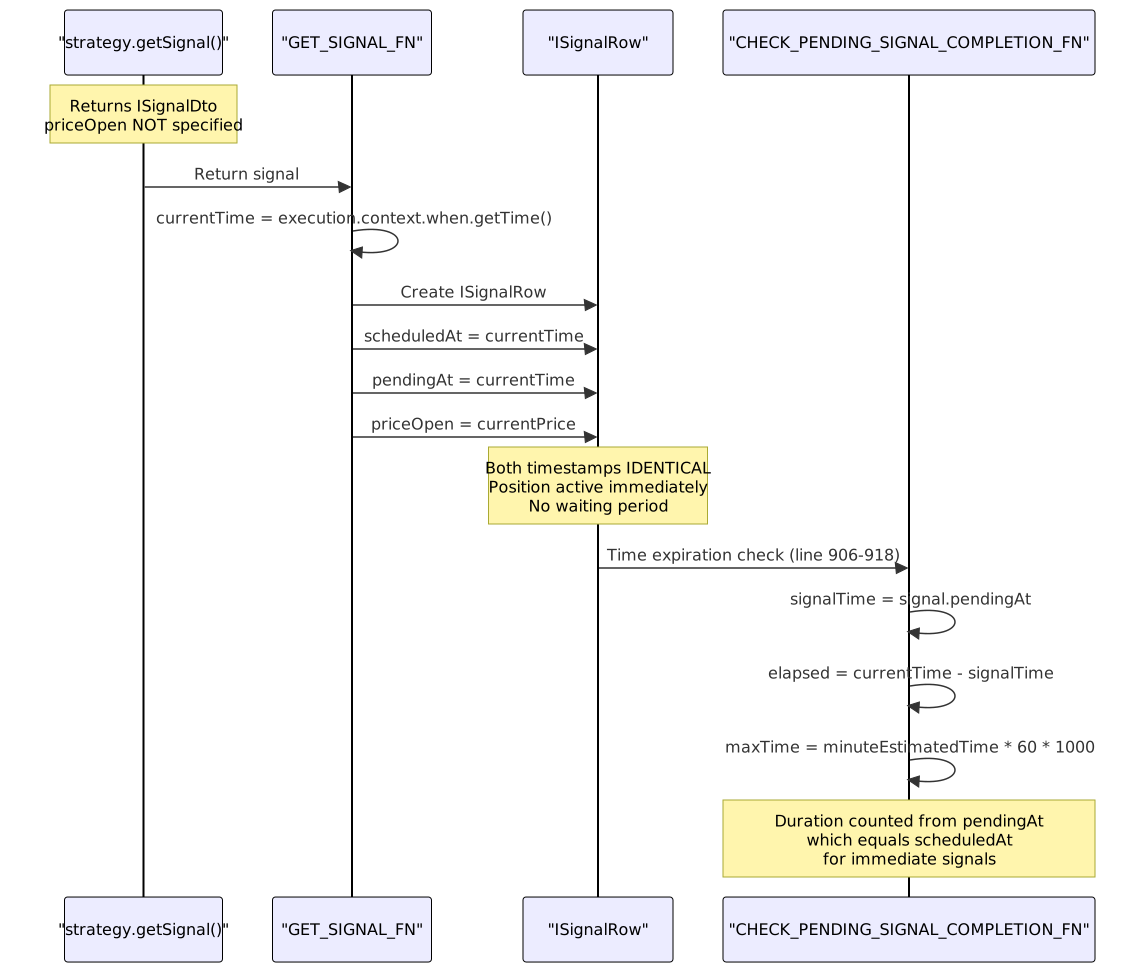
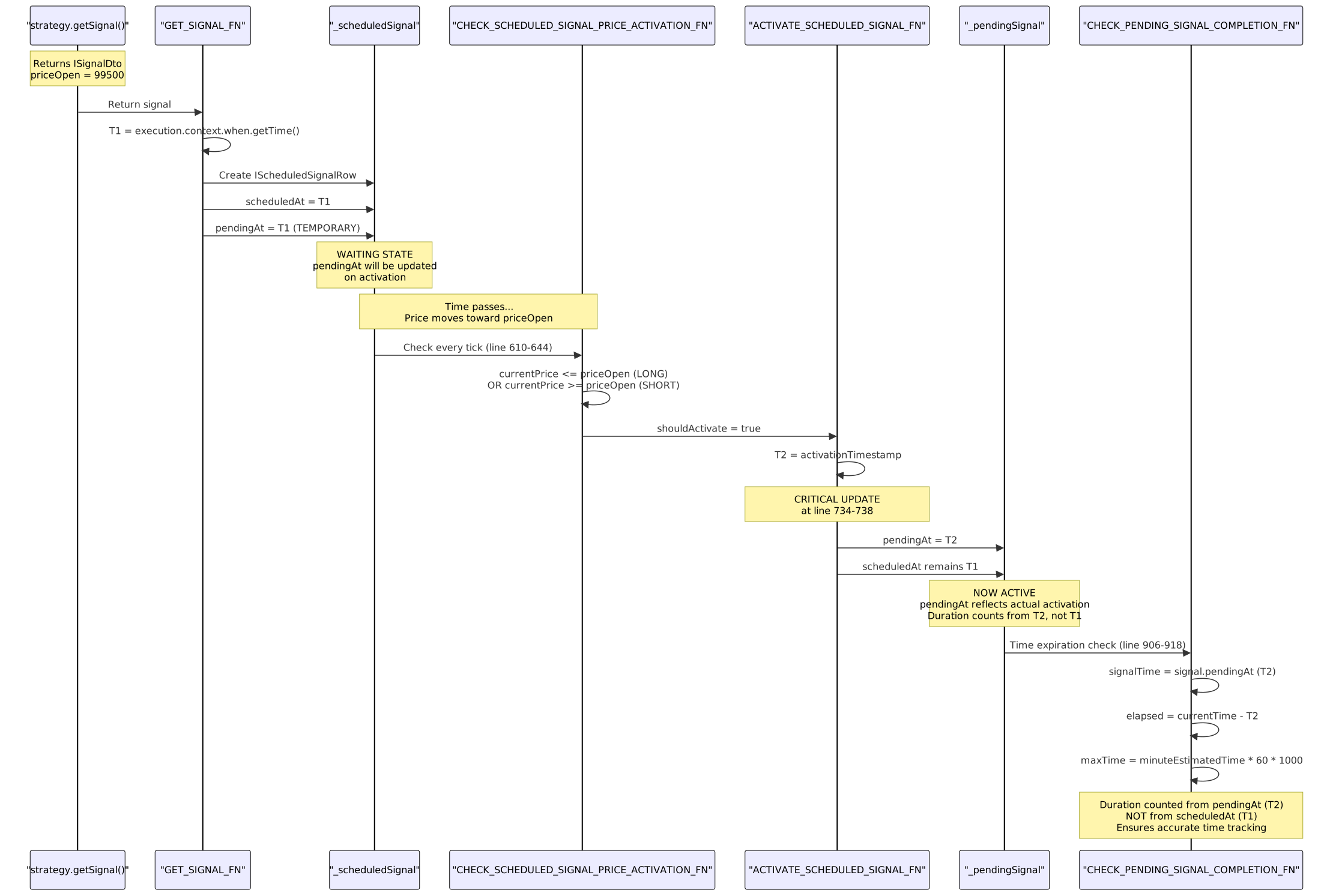
Critical Detail: Time expiration uses pendingAt timestamp, not scheduledAt. For scheduled signals, this ensures minuteEstimatedTime counts from activation, not from creation.
Timestamp Management: scheduledAt vs pendingAt
Signals maintain two critical timestamps that enable proper lifecycle tracking. The distinction is essential for accurate minuteEstimatedTime calculations, especially for scheduled signals.
Timestamp Semantics
| Field | Type | Semantic Meaning | Set Location | Purpose |
|---|---|---|---|---|
scheduledAt |
number |
Signal creation time (when getSignal() returned signal) |
ClientStrategy.ts:445-453 for immediate ClientStrategy.ts:423-437 for scheduled |
Tracks signal age Timeout calc for scheduled signals via CHECK_SCHEDULED_SIGNAL_TIMEOUT_FN |
pendingAt |
number |
Position activation time (when position became active at priceOpen) |
Immediate: same as scheduledAtScheduled: updated in ACTIVATE_SCHEDULED_SIGNAL_FN |
Duration calculation: minuteEstimatedTime countdownTP/SL/time_expired monitoring |
Critical Difference: Immediate vs Scheduled Signals
Immediate Signal (no priceOpen specified):
// GET_SIGNAL_FN creates ISignalRow at line 445-461
const signalRow: ISignalRow = {
id: randomString(),
priceOpen: currentPrice, // Set to current market price
// ...
scheduledAt: currentTime,
pendingAt: currentTime, // SAME as scheduledAt - position active immediately
_isScheduled: false,
};
Scheduled Signal (with priceOpen specified):
// GET_SIGNAL_FN creates IScheduledSignalRow at line 423-442
const scheduledSignalRow: IScheduledSignalRow = {
id: randomString(),
priceOpen: signal.priceOpen, // User-specified entry price
// ...
scheduledAt: currentTime,
pendingAt: currentTime, // TEMPORARY - will be updated on activation
_isScheduled: true,
};
// Later, when price reaches priceOpen...
// ACTIVATE_SCHEDULED_SIGNAL_FN at line 734-738
const activatedSignal: ISignalRow = {
...scheduled,
pendingAt: activationTime, // CRITICAL: Updated to actual activation time
_isScheduled: false,
};
Timestamp Flow: Immediate Entry Signal
Timestamp Flow: Scheduled Entry Signal
Why This Matters: Financial Impact
Problem Without Correct Timestamp Handling:
// BUG SCENARIO (if using scheduledAt for duration):
// Signal created at T1 = 10:00:00
// Signal activated at T2 = 10:30:00 (30 minutes later)
// minuteEstimatedTime = 60 minutes
// WRONG: Using scheduledAt
elapsed = currentTime - scheduledAt
// At 11:00:00, elapsed = 60 minutes, signal expires
// But it was only ACTIVE for 30 minutes!
// CORRECT: Using pendingAt
elapsed = currentTime - pendingAt
// At 11:00:00, elapsed = 30 minutes, signal continues
// At 11:30:00, elapsed = 60 minutes, signal expires correctly
Consequences of bug:
- Premature signal closure causes financial losses (wasted trading fees: ~0.2% per trade)
- Strategy appears to perform worse than actual backtests
- Risk management becomes inaccurate (positions close before expected)
Signal Persistence (Live Mode Only)
In live trading mode, signals are persisted to disk after every state change to enable crash recovery. The PersistSignalAdapter provides atomic file operations.
Persistence Architecture

Persistence Flow Example
// setPendingSignal implementation
async setPendingSignal(signal: ISignalRow | null) {
this._pendingSignal = signal;
// Persist only in live mode (not backtest)
if (!this.params.execution.context.backtest) {
await PersistSignalAdaper.writeSignalData(
this.params.strategyName,
this.params.execution.context.symbol,
signal
);
}
}
// waitForInit implementation
async waitForInit() {
if (this.params.execution.context.backtest) {
return; // No persistence in backtest
}
const pendingSignal = await PersistSignalAdaper.readSignalData(
this.params.strategyName,
this.params.execution.context.symbol
);
if (pendingSignal) {
this._pendingSignal = pendingSignal;
// Call onActive callback for restored signal
if (this.params.callbacks?.onActive) {
const currentPrice = await this.params.exchange.getAveragePrice(
this.params.execution.context.symbol
);
this.params.callbacks.onActive(
this.params.execution.context.symbol,
pendingSignal,
currentPrice,
false // backtest=false
);
}
}
}
Note: Scheduled signals (_scheduledSignal) are NOT persisted. Only active positions (_pendingSignal) survive crashes.
PnL Calculation
Profit and loss is calculated by toProfitLossDto which applies trading fees and slippage to both entry and exit prices.
Fee and Slippage Model

Long Position Example
// Original signal
priceOpen = 100
priceTakeProfit = 101
// TP hit, calculate PnL
priceClose = 101
// Apply fees/slippage to entry
entryPrice = 100 * (1 + 0.001) * (1 + 0.001) = 100.2001
// Apply fees/slippage to exit
exitPrice = 101 * (1 - 0.001) * (1 - 0.001) = 100.797999
// Calculate PnL
pnlPercentage = ((100.797999 - 100.2001) / 100.2001) * 100 = 0.597%
Short Position Example
// Original signal
priceOpen = 100
priceTakeProfit = 99
// TP hit, calculate PnL
priceClose = 99
// Apply fees/slippage to entry (worse price for short = lower)
entryPrice = 100 * (1 - 0.001) * (1 - 0.001) = 99.7999
// Apply fees/slippage to exit (worse price for short = higher)
exitPrice = 99 * (1 + 0.001) * (1 + 0.001) = 99.198001
// Calculate PnL
pnlPercentage = ((99.7999 - 99.198001) / 99.7999) * 100 = 0.603%
Note: The CC_MIN_TAKEPROFIT_DISTANCE_PERCENT default of 0.3% accounts for the 0.2% total fees (entry + exit), ensuring profitable trades after costs.
Backtest vs Live Lifecycle Differences
The signal lifecycle behaves differently in backtest and live modes due to timing and data availability constraints.
| Aspect | Backtest Mode | Live Mode |
|---|---|---|
| Time Source | Historical candle timestamps | Date.now() |
| Signal Generation | Once per candle timestamp | Throttled by real time + INTERVAL_MINUTES |
| TP/SL Detection | Check candle.high and candle.low |
Check VWAP from getAveragePrice() |
| Fast-Forward | strategy.backtest(candles) processes all at once |
strategy.tick() processes one tick at a time |
| Scheduled Activation Timestamp | candle.timestamp + 60*1000 (next candle) |
Actual tick time when detected |
| Persistence | None | PersistSignalAdapter writes to disk |
| Crash Recovery | N/A | waitForInit() restores state |
| Callbacks | backtest=true flag |
backtest=false flag |
Backtest Fast-Forward Algorithm

Key Optimization: The backtest method processes all candles in a single pass without yielding control, making it significantly faster than tick-by-tick iteration.
Event Emission During Lifecycle
Every state transition emits events through Subject-based emitters, enabling observability and report generation.

Event Flow: Each state transition calls the specific lifecycle callback (e.g., onOpen), then always calls onTick with the full result. The result is then emitted to all registered listeners via the Subject pattern.
Summary Table: Signal Lifecycle Functions
| Function | Location | Purpose | Returns |
|---|---|---|---|
GET_SIGNAL_FN |
ClientStrategy.ts:187-283 | Throttled signal generation with risk check | ISignalRow | IScheduledSignalRow | null |
VALIDATE_SIGNAL_FN |
ClientStrategy.ts:40-185 | Validate prices, TP/SL logic, distances, lifetime | void (throws on error) |
CHECK_SCHEDULED_SIGNAL_TIMEOUT_FN |
ClientStrategy.ts:332-386 | Check if scheduled signal timed out | IStrategyTickResultCancelled | null |
CHECK_SCHEDULED_SIGNAL_PRICE_ACTIVATION_FN |
ClientStrategy.ts:388-422 | Determine if scheduled signal should activate/cancel | { shouldActivate, shouldCancel } |
ACTIVATE_SCHEDULED_SIGNAL_FN |
ClientStrategy.ts:459-551 | Convert scheduled to active signal (live) | IStrategyTickResultOpened | null |
ACTIVATE_SCHEDULED_SIGNAL_IN_BACKTEST_FN |
ClientStrategy.ts:897-973 | Convert scheduled to active signal (backtest) | boolean |
OPEN_NEW_PENDING_SIGNAL_FN |
ClientStrategy.ts:623-673 | Create immediate entry signal | IStrategyTickResultOpened | null |
OPEN_NEW_SCHEDULED_SIGNAL_FN |
ClientStrategy.ts:578-621 | Create delayed entry signal | IStrategyTickResultScheduled |
CHECK_PENDING_SIGNAL_COMPLETION_FN |
ClientStrategy.ts:675-734 | Check TP/SL/time conditions | IStrategyTickResultClosed | null |
CLOSE_PENDING_SIGNAL_FN |
ClientStrategy.ts:736-789 | Close signal and calculate PnL (live) | IStrategyTickResultClosed |
CLOSE_PENDING_SIGNAL_IN_BACKTEST_FN |
ClientStrategy.ts:975-1006 | Close signal and calculate PnL (backtest) | IStrategyTickResultClosed |
toProfitLossDto |
toProfitLossDto.ts:1-50 | Calculate PnL with fees/slippage | IStrategyPnL |