ClientFrame
Purpose: ClientFrame implements timeframe generation for backtesting by creating arrays of timestamps spaced according to configured intervals. It transforms frame schemas (startDate, endDate, interval) into concrete arrays of Date objects that BacktestLogicPrivateService iterates through during historical simulation.
For information about the Frame schema configuration that ClientFrame consumes, see Frame Schemas. For backtest execution flow that uses these timeframes, see Backtest Execution Flow.
Overview
ClientFrame is a client implementation that generates timeframe arrays for backtest iteration. It bridges the gap between declarative frame configuration (IFrameSchema) and concrete timestamp arrays used during backtest execution.
Key Responsibilities:
- Generate arrays of Date objects from startDate to endDate
- Space timestamps according to FrameInterval (1m, 3m, 5m, 15m, 30m, 1h, 2h, 4h, 6h, 8h, 12h, 1d, 3d)
- Invoke onTimeframe callbacks after generation
- Support symbol parameter for API consistency (currently unused)
Core Interface:
interface IFrame {
getTimeframe: (symbol: string, frameName: FrameName) => Promise<Date[]>;
}
Frame Schema Configuration
ClientFrame is instantiated with IFrameParams which extends IFrameSchema with runtime dependencies.
IFrameSchema Structure
| Field | Type | Description |
|---|---|---|
frameName |
FrameName (string) |
Unique identifier for this frame |
interval |
FrameInterval |
Timestamp spacing (1m, 3m, 5m, 15m, 30m, 1h, 2h, 4h, 6h, 8h, 12h, 1d, 3d) |
startDate |
Date |
Beginning of backtest period (inclusive) |
endDate |
Date |
End of backtest period (inclusive) |
note? |
string |
Optional developer documentation |
callbacks? |
Partial<IFrameCallbacks> |
Optional lifecycle event handlers |
IFrameParams Extension
interface IFrameParams extends IFrameSchema {
logger: ILogger;
}
Adds LoggerService instance for internal debug logging during timeframe generation.
IFrameCallbacks
interface IFrameCallbacks {
onTimeframe: (
timeframe: Date[],
startDate: Date,
endDate: Date,
interval: FrameInterval
) => void;
}
The onTimeframe callback fires after timeframe array generation, providing the complete array and configuration for validation or logging.
Supported Frame Intervals

Interval Millisecond Conversion:
| Interval | Milliseconds | Usage |
|---|---|---|
| 1m | 60,000 | High-frequency tick generation |
| 3m | 180,000 | Short-term pattern analysis |
| 5m | 300,000 | Common scalping timeframe |
| 15m | 900,000 | Intraday trading strategies |
| 30m | 1,800,000 | Short-term swing trading |
| 1h | 3,600,000 | Standard hourly analysis |
| 2h | 7,200,000 | Extended intraday periods |
| 4h | 14,400,000 | Multi-hour trend analysis |
| 6h | 21,600,000 | Quarter-day intervals |
| 8h | 28,800,000 | Third-of-day intervals |
| 12h | 43,200,000 | Half-day intervals |
| 1d | 86,400,000 | Daily candle backtests |
| 3d | 259,200,000 | Multi-day pattern testing |
Frame System Architecture

Architecture Layers:
- Schema Layer: Stores and validates frame configurations via
FrameSchemaServiceandFrameValidationService - Connection Layer:
FrameConnectionServiceprovides memoized factory access toClientFrameinstances - Client Layer:
ClientFrameimplements timeframe generation viagetTimeframe()method - Core Layer:
FrameCoreServicecontains interval conversion and date iteration algorithms - Execution Layer:
BacktestLogicPrivateServiceconsumes generated timeframe arrays for iteration
Timeframe Generation Algorithm

Algorithm Steps:
- Schema Retrieval: Fetch IFrameSchema by frameName from FrameSchemaService
- Interval Conversion: Convert FrameInterval string to milliseconds via FrameCoreService
- Array Initialization: Create empty Date array
- Timestamp Iteration:
- Start at
startDate.getTime() - While
current <= endDate.getTime():- Add
new Date(current)to array - Increment
currentbyintervalMs
- Add
- Start at
- Callback Invocation: Call
onTimeframewith generated array and configuration - Return Array: Return complete Date[] for backtest iteration
Example Output:
For startDate = 2024-01-01T00:00:00Z, endDate = 2024-01-01T02:00:00Z, interval = 1h:
[
new Date("2024-01-01T00:00:00.000Z"),
new Date("2024-01-01T01:00:00.000Z"),
new Date("2024-01-01T02:00:00.000Z")
]
// 3 timestamps covering 2-hour period at 1-hour intervals
Service Integration Pattern

Connection Service Responsibilities:
- Factory Pattern:
FrameConnectionServicecreatesClientFrameinstances on demand - Memoization: Cache instances by
frameNameto prevent redundant instantiation - Schema Access: Retrieve
IFrameSchemafromFrameSchemaServiceduring construction - Dependency Injection: All services injected via
inject()from DI container
Memoization Key: frameName (string)
Example:
// First call - creates new ClientFrame
const frame1 = frameConnectionService.getFrame("1d-backtest");
// Second call - returns cached instance
const frame2 = frameConnectionService.getFrame("1d-backtest");
// frame1 === frame2 (same instance)
Integration with Backtest Execution
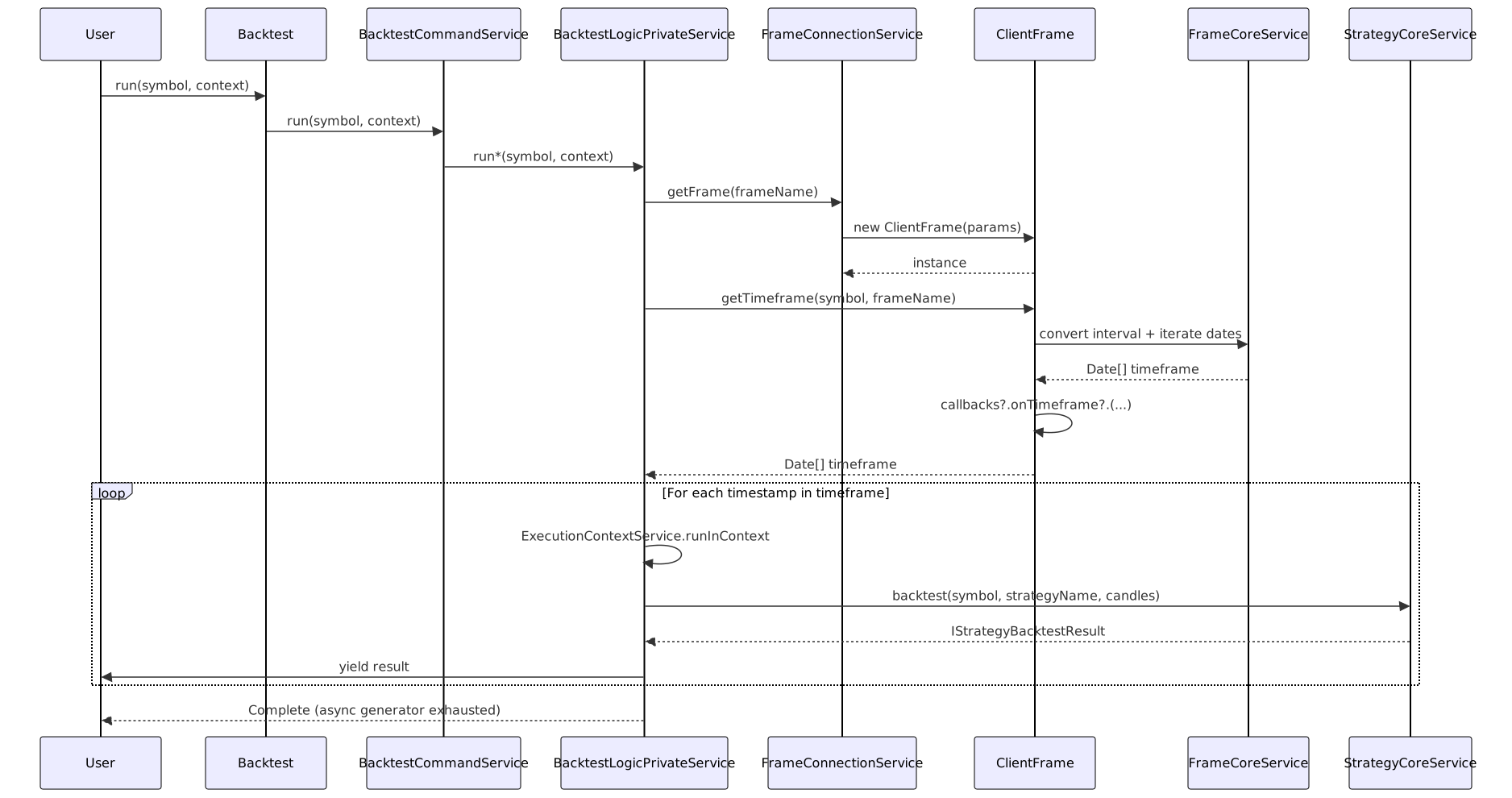
Execution Flow:
- User Invocation:
Backtest.run(symbol, {strategyName, exchangeName, frameName}) - Command Service: Routes to
BacktestCommandService.run() - Logic Service: Calls
BacktestLogicPrivateService.run()(async generator) - Frame Retrieval: Gets
ClientFrameinstance viaFrameConnectionService.getFrame(frameName) - Timeframe Generation:
ClientFrame.getTimeframe()producesDate[]array - Timestamp Iteration: Loop through each
Datein timeframe - Context Propagation: Wrap each iteration in
ExecutionContextService.runInContext({symbol, when: date, backtest: true}) - Strategy Execution: Call
StrategyCoreService.backtest()for current timestamp - Result Yielding:
yieldeach closed/cancelled signal to user - Completion: Generator exhausts when all timestamps processed
Temporal Isolation: Each timestamp iteration updates ExecutionContextService.context.when, ensuring strategies cannot access future data during getSignal() calls.
Usage Example
Frame Registration
import { addFrame } from "backtest-kit";
addFrame({
frameName: "1d-backtest",
interval: "1m", // 1-minute tick resolution
startDate: new Date("2024-01-01T00:00:00Z"),
endDate: new Date("2024-01-02T00:00:00Z"),
callbacks: {
onTimeframe: (timeframe, startDate, endDate, interval) => {
console.log(`Generated ${timeframe.length} timestamps`);
console.log(`Period: ${startDate} to ${endDate}`);
console.log(`Interval: ${interval}`);
}
}
});
Result: 1440 timestamps (24 hours × 60 minutes) spanning 2024-01-01 at 1-minute intervals.
Backtest Execution with Frame
import { Backtest } from "backtest-kit";
for await (const result of Backtest.run("BTCUSDT", {
strategyName: "my-strategy",
exchangeName: "binance",
frameName: "1d-backtest" // Uses frame defined above
})) {
if (result.action === "closed") {
console.log("Signal closed at:", result.closeTimestamp);
console.log("PNL:", result.pnl.pnlPercentage);
}
}
Execution: BacktestLogicPrivateService iterates through all 1440 timestamps, invoking strategy logic at each tick.
FrameCoreService Algorithms
Interval to Milliseconds Conversion
const INTERVAL_MS: Record<FrameInterval, number> = {
"1m": 60_000,
"3m": 180_000,
"5m": 300_000,
"15m": 900_000,
"30m": 1_800_000,
"1h": 3_600_000,
"2h": 7_200_000,
"4h": 14_400_000,
"6h": 21_600_000,
"8h": 28_800_000,
"12h": 43_200_000,
"1d": 86_400_000,
"3d": 259_200_000
};
function convertInterval(interval: FrameInterval): number {
return INTERVAL_MS[interval];
}
Date Range Generation
function generateTimeframe(
startDate: Date,
endDate: Date,
intervalMs: number
): Date[] {
const timeframe: Date[] = [];
let current = startDate.getTime();
const end = endDate.getTime();
while (current <= end) {
timeframe.push(new Date(current));
current += intervalMs;
}
return timeframe;
}
Edge Cases:
- Empty Range: If
startDate > endDate, returns[](empty array) - Single Timestamp: If
startDate === endDate, returns[startDate](one element) - Inclusive End: Final timestamp included if
endDatealigns with interval boundary
Symbol Parameter Usage
The getTimeframe() method signature includes a symbol parameter:
getTimeframe(symbol: string, frameName: FrameName): Promise<Date[]>
Current Implementation: The symbol parameter is currently unused by ClientFrame but maintained for API consistency with other client interfaces (ClientStrategy, ClientExchange, ClientRisk).
Rationale for Inclusion:
- Consistent method signature across all client implementations
- Future extensibility for symbol-specific timeframe customization
- Alignment with execution context pattern where symbol is always available
Future Use Cases:
- Symbol-specific trading hours (e.g., market open/close times)
- Exchange-specific interval restrictions
- Holiday calendar integration per market
Validation and Error Handling
Registration-Time Validation
// Performed by FrameValidationService during addFrame()
- frameName must be unique (no duplicates)
- interval must be valid FrameInterval string
- startDate must be valid Date instance
- endDate must be valid Date instance
- callbacks must conform to Partial<IFrameCallbacks> if provided
Runtime Validation
// Performed by BacktestUtils before execution
- Frame must be registered via addFrame()
- FrameValidationService.validate(frameName, methodName) called
- Throws error if frameName not found
Example Error:
Backtest.run("BTCUSDT", {
strategyName: "my-strategy",
exchangeName: "binance",
frameName: "non-existent-frame" // Error: frame not found
});
// Error: Frame "non-existent-frame" not registered
Relationship to Other Components
| Component | Relationship | Description |
|---|---|---|
| FrameSchemaService | Storage | Stores registered IFrameSchema configurations via ToolRegistry |
| FrameValidationService | Validation | Validates frame registration and runtime lookups |
| FrameConnectionService | Factory | Creates and caches ClientFrame instances |
| FrameCoreService | Logic | Provides interval conversion and date iteration algorithms |
| BacktestLogicPrivateService | Consumer | Iterates through generated timeframe arrays |
| ExecutionContextService | Context | Updates context.when for each timestamp iteration |
| MethodContextService | Routing | Provides frameName for frame instance lookup |
Performance Considerations
Memory Usage
- Timeframe Array Size:
(endDate - startDate) / intervalMs + 1Date objects - Example: 1-day backtest at 1-minute intervals = 1440 Date objects (~23KB)
- Large Backtests: Multi-month 1-minute backtests can generate 40,000+ timestamps
Optimization: Date objects created once during getTimeframe() call, then reused throughout backtest iteration.
Computational Complexity
- Generation Time: O(n) where n = number of timestamps
- Memoization:
FrameConnectionServicecaches ClientFrame instances, preventing regeneration - Callback Overhead: Single
onTimeframecallback invocation per generation
Recommendations
- Choose Appropriate Intervals: Use coarser intervals (1h, 1d) for long-term backtests
- Split Large Ranges: Break multi-year backtests into smaller frame periods
- Memory Monitoring: Monitor heap usage for 1-minute backtests > 3 months
Related Components
- Frame Schemas - Configuration interface for addFrame()
- Backtest Execution Flow - How timeframes are consumed during backtesting
- Timeframe Generation - FrameCoreService algorithms
- Connection Services - Factory pattern and memoization strategy
- Schema Services - ToolRegistry storage pattern