Custom Risk Validations
Purpose and Scope
This guide explains how to write custom risk validation functions for portfolio-level risk management in backtest-kit. Custom validations allow you to implement complex risk logic that evaluates signals before they are opened, providing fine-grained control over position acceptance based on portfolio state, market conditions, and custom business rules.
For information about risk schema structure and registration, see Risk Schemas. For the overall risk validation flow and position tracking, see Risk Validation and Position Tracking.
Validation Function Types
Risk validations can be provided in two formats when registering a risk profile via addRisk():
Format 1: Function Only
addRisk({
riskName: "my-risk",
validations: [
async ({ activePositionCount }) => {
if (activePositionCount >= 5) {
throw new Error("Maximum 5 positions allowed");
}
}
]
});
Format 2: Validation Object
addRisk({
riskName: "my-risk",
validations: [
{
validate: async ({ activePositionCount }) => {
if (activePositionCount >= 5) {
throw new Error("Maximum 5 positions allowed");
}
},
note: "Limit concurrent positions to prevent over-exposure"
}
]
});
Both formats are functionally equivalent. The object format allows you to attach documentation via the note field, which aids in understanding the validation's purpose during code review and maintenance.
Validation Function Signature

Validation Function Signature
The validation function must conform to IRiskValidationFn:
interface IRiskValidationFn {
(payload: IRiskValidationPayload): void | Promise<void>;
}
Execution Model:
- Success: Return
voidorPromise<void>to allow the signal - Rejection: Throw an
Errorto reject the signal - Both synchronous and asynchronous functions are supported
The IRiskValidationPayload Interface

IRiskValidationPayload Fields
The validation payload extends IRiskCheckArgs with portfolio-level data:
| Field | Type | Source | Description |
|---|---|---|---|
symbol |
string |
Passthrough | Trading pair symbol (e.g., "BTCUSDT") |
strategyName |
string |
Passthrough | Strategy requesting to open position |
exchangeName |
string |
Passthrough | Exchange name |
currentPrice |
number |
Passthrough | Current VWAP price |
timestamp |
number |
Passthrough | Current timestamp (milliseconds) |
activePositionCount |
number |
Portfolio State | Number of currently active positions across all strategies |
activePositions |
IRiskActivePosition[] |
Portfolio State | Array of all currently active positions |
Active Position Structure
Each element in activePositions contains:
signal: The signal details for the active positionstrategyName: Which strategy owns this positionexchangeName: Exchange nameopenTimestamp: When the position was opened (milliseconds)
Error Throwing Patterns
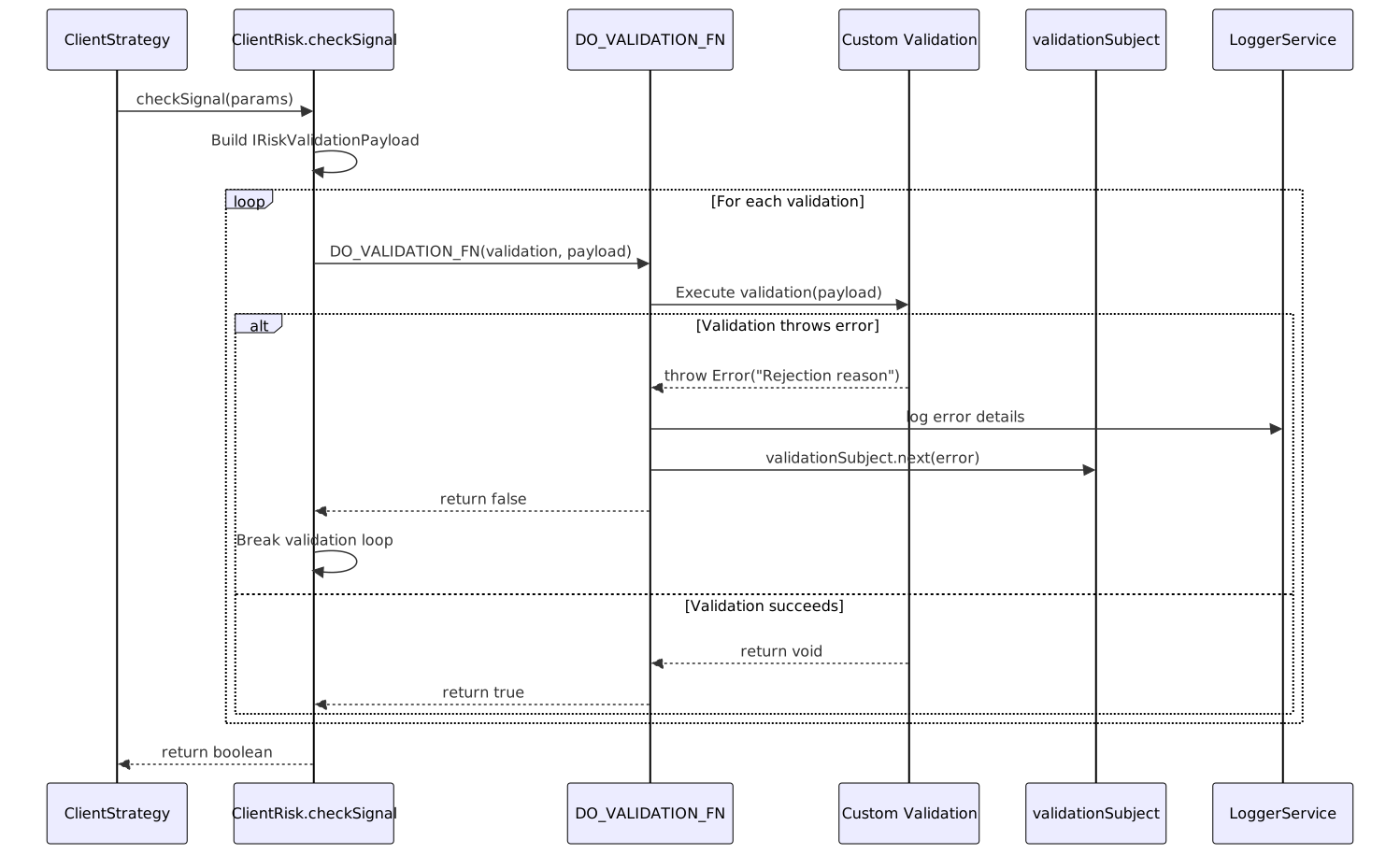
Error Handling Mechanism
- Validation Throws Error: When a validation function throws an error, it indicates rejection
- Wrapper Catches Error:
DO_VALIDATION_FNwraps each validation with try-catch - Error Emission: The error is emitted to
validationSubjectfor external monitoring - Logging: Error details are logged via
LoggerService.warn - Early Exit: The first validation failure stops execution of remaining validations
- Result: Returns
falseto indicate rejection
Example Error Throwing
// Simple rejection
throw new Error("Maximum positions exceeded");
// Rejection with context
throw new Error(`Symbol ${symbol} not allowed for trading`);
// Rejection with calculation details
throw new Error(`Position count ${activePositionCount} exceeds limit of 5`);
Common Validation Patterns
Maximum Concurrent Positions
addRisk({
riskName: "limit-positions",
validations: [
({ activePositionCount }) => {
if (activePositionCount >= 5) {
throw new Error("Maximum 5 concurrent positions allowed");
}
}
]
});
Symbol Filtering
addRisk({
riskName: "symbol-filter",
validations: [
({ symbol }) => {
const blacklist = ["DOGEUSDT", "SHIBUSDT"];
if (blacklist.includes(symbol)) {
throw new Error(`${symbol} is blacklisted`);
}
}
]
});
Position Per Symbol Limit
addRisk({
riskName: "per-symbol-limit",
validations: [
({ symbol, activePositions }) => {
const symbolCount = activePositions.filter(
pos => pos.signal.symbol === symbol
).length;
if (symbolCount >= 2) {
throw new Error(`Maximum 2 positions per symbol: ${symbol}`);
}
}
]
});
Position Per Strategy Limit
addRisk({
riskName: "per-strategy-limit",
validations: [
({ strategyName, activePositions }) => {
const strategyCount = activePositions.filter(
pos => pos.strategyName === strategyName
).length;
if (strategyCount >= 3) {
throw new Error(`Strategy ${strategyName} has reached limit of 3 positions`);
}
}
]
});
Time-Based Restrictions
addRisk({
riskName: "time-restrictions",
validations: [
({ timestamp }) => {
const hour = new Date(timestamp).getUTCHours();
// No trading between 22:00-02:00 UTC
if (hour >= 22 || hour < 2) {
throw new Error("Trading disabled during low liquidity hours");
}
}
]
});
Price-Based Validation
addRisk({
riskName: "price-validation",
validations: [
({ symbol, currentPrice }) => {
// Reject signals for low-priced assets (penny stocks)
if (currentPrice < 0.01) {
throw new Error(`Price too low for ${symbol}: ${currentPrice}`);
}
}
]
});
Position Age Limit
addRisk({
riskName: "stale-position-check",
validations: [
({ timestamp, activePositions }) => {
const MAX_POSITION_AGE_MS = 24 * 60 * 60 * 1000; // 24 hours
const stalePositions = activePositions.filter(
pos => (timestamp - pos.openTimestamp) > MAX_POSITION_AGE_MS
);
if (stalePositions.length > 0) {
throw new Error(
`Cannot open new position: ${stalePositions.length} positions older than 24h`
);
}
}
]
});
Multiple Validation Composition

Validations are executed sequentially in the order they are defined in the validations array. The validation process follows these rules:
- Sequential Execution: Validations run one at a time in array order
- Early Exit: First failure stops execution of remaining validations
- All Must Pass: All validations must succeed for the signal to be allowed
- Callback Execution:
onRejectedoronAllowedcallbacks are triggered based on the final result
Example: Layered Validation
addRisk({
riskName: "multi-layer",
validations: [
// Layer 1: Hard limits
({ activePositionCount }) => {
if (activePositionCount >= 10) {
throw new Error("Hard limit: 10 positions");
}
},
// Layer 2: Symbol restrictions
({ symbol }) => {
if (symbol.includes("PERP")) {
throw new Error("No perpetual contracts allowed");
}
},
// Layer 3: Portfolio composition
({ symbol, activePositions }) => {
const btcPositions = activePositions.filter(
pos => pos.signal.symbol === "BTCUSDT"
).length;
if (symbol === "BTCUSDT" && btcPositions >= 2) {
throw new Error("Maximum 2 BTC positions");
}
}
],
callbacks: {
onRejected: (symbol, params) => {
console.log(`Signal rejected for ${symbol}`);
},
onAllowed: (symbol, params) => {
console.log(`Signal allowed for ${symbol}`);
}
}
});
Asynchronous Validations
Both synchronous and asynchronous validation functions are supported. This allows you to perform external API calls, database queries, or other async operations during validation.
Example: External API Check
addRisk({
riskName: "external-check",
validations: [
async ({ symbol, currentPrice }) => {
// Fetch real-time volatility from external service
const response = await fetch(`https://api.example.com/volatility/${symbol}`);
const { volatility } = await response.json();
if (volatility > 0.5) {
throw new Error(`Volatility too high for ${symbol}: ${volatility}`);
}
}
]
});
Example: Database Query
addRisk({
riskName: "historical-check",
validations: [
async ({ strategyName, symbol }) => {
// Query database for recent losses on this strategy
const recentLosses = await db.query(
`SELECT COUNT(*) as count FROM trades
WHERE strategy = ? AND symbol = ?
AND pnl < 0 AND timestamp > ?`,
[strategyName, symbol, Date.now() - 86400000] // Last 24h
);
if (recentLosses.count >= 3) {
throw new Error(
`${strategyName} has 3+ losses on ${symbol} in last 24h`
);
}
}
]
});
Validation Context and Callbacks

Lifecycle Callbacks
Risk schemas support two lifecycle callbacks that are triggered based on validation results:
onRejected Callback
callbacks: {
onRejected: (symbol: string, params: IRiskCheckArgs) => {
console.log(`Signal rejected for ${symbol}`);
console.log(`Strategy: ${params.strategyName}`);
console.log(`Price: ${params.currentPrice}`);
}
}
onAllowed Callback
callbacks: {
onAllowed: (symbol: string, params: IRiskCheckArgs) => {
console.log(`Signal allowed for ${symbol}`);
// Could trigger notifications, logging, etc.
}
}
These callbacks receive:
symbol: The trading pair symbolparams: The fullIRiskCheckArgsobject (but NOT the portfolio state data)
Validation Isolation by Risk Profile

Each risk profile maintains its own isolated state:
- Separate ClientRisk Instance: Each
riskNamegets its ownClientRiskvia memoization inRiskConnectionService.getRisk - Independent Position Tracking: Each risk profile tracks its own
_activePositionsmap - Isolated Persistence: Position data is persisted separately per
riskName - Shared Across Strategies: Multiple strategies with the same
riskNameshare the same risk instance
Example: Isolation Test
// Risk profile 1: Conservative (max 3 positions)
addRisk({
riskName: "conservative",
validations: [
({ activePositionCount }) => {
if (activePositionCount >= 3) {
throw new Error("Conservative: max 3 positions");
}
}
]
});
// Risk profile 2: Aggressive (max 10 positions)
addRisk({
riskName: "aggressive",
validations: [
({ activePositionCount }) => {
if (activePositionCount >= 10) {
throw new Error("Aggressive: max 10 positions");
}
}
]
});
// Strategy A and B share conservative risk
addStrategy({
strategyName: "strategy-a",
riskName: "conservative" // Shares position count with strategy-b
});
addStrategy({
strategyName: "strategy-b",
riskName: "conservative" // Shares position count with strategy-a
});
// Strategy C uses aggressive risk (independent tracking)
addStrategy({
strategyName: "strategy-c",
riskName: "aggressive" // Independent position count
});
Error Monitoring
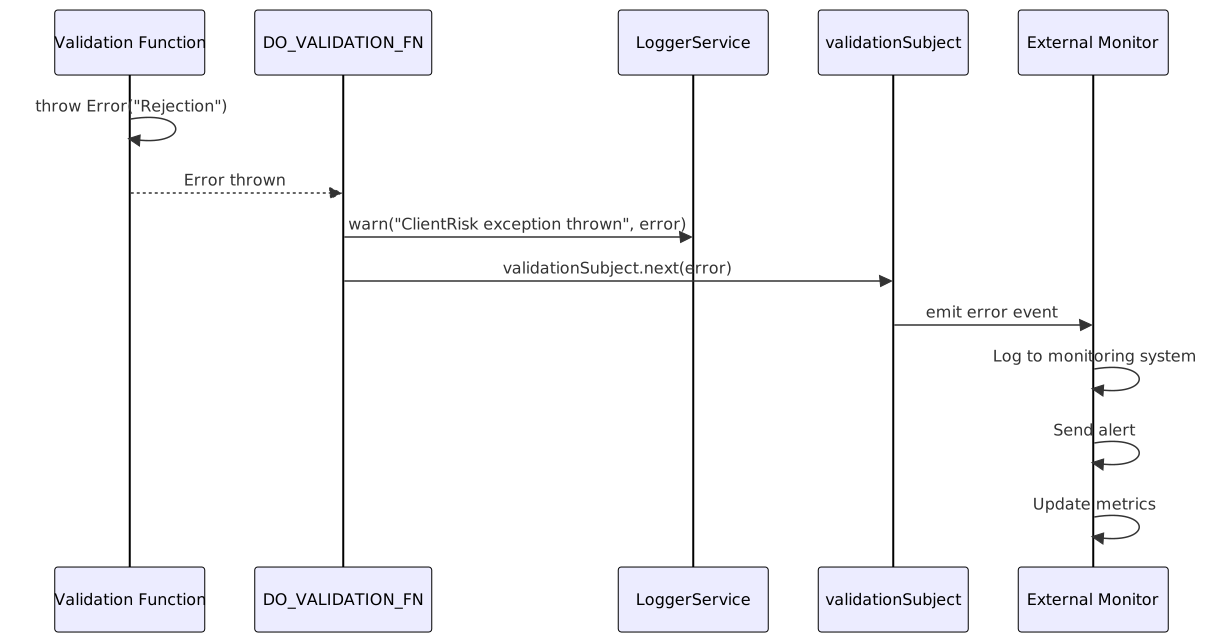
Listening to Validation Errors
The framework emits all validation errors to validationSubject, allowing external monitoring:
import { emitters } from 'backtest-kit';
// Subscribe to validation errors
const subscription = emitters.validationSubject.subscribe(error => {
console.error('Risk validation error:', error.message);
// Send to monitoring service
monitoring.trackError('risk_validation_error', {
message: error.message,
stack: error.stack
});
// Update metrics
metrics.increment('risk.validation.rejected');
});
// Clean up when done
subscription.unsubscribe();
Alternatively, use the convenience listener:
import { listenValidation } from 'backtest-kit';
listenValidation(error => {
console.error('Validation failed:', error.message);
});
Best Practices
1. Throw Descriptive Errors
// Good: Specific reason
throw new Error(`Maximum 5 positions exceeded (current: ${activePositionCount})`);
// Bad: Generic message
throw new Error("Too many positions");
2. Validate Early, Fail Fast
// Place cheap validations first
validations: [
// Fast: Simple counter check
({ activePositionCount }) => {
if (activePositionCount >= 10) throw new Error("Max positions");
},
// Expensive: Iterate through positions
({ activePositions, symbol }) => {
const count = activePositions.filter(p => p.signal.symbol === symbol).length;
if (count >= 2) throw new Error("Max per symbol");
}
]
3. Use Object Format for Documentation
validations: [
{
validate: ({ activePositionCount }) => {
if (activePositionCount >= 5) {
throw new Error("Maximum 5 positions");
}
},
note: "Limit concurrent positions to prevent portfolio over-concentration"
}
]
4. Handle Async Operations Safely
validations: [
async ({ symbol }) => {
try {
const volatility = await fetchVolatility(symbol);
if (volatility > 0.5) {
throw new Error(`High volatility: ${volatility}`);
}
} catch (error) {
// Allow signal if external API fails
console.warn('Volatility check failed:', error);
}
}
]
5. Combine Related Validations
// Good: Single validation checking multiple conditions
validations: [
({ symbol, currentPrice, activePositionCount }) => {
// Check all conditions in one function
if (activePositionCount >= 5) {
throw new Error("Max positions");
}
if (currentPrice < 0.01) {
throw new Error("Price too low");
}
if (symbol.includes("PERP")) {
throw new Error("No perpetuals");
}
}
]
// Less optimal: Multiple separate validations
validations: [
({ activePositionCount }) => {
if (activePositionCount >= 5) throw new Error("Max positions");
},
({ currentPrice }) => {
if (currentPrice < 0.01) throw new Error("Price too low");
},
({ symbol }) => {
if (symbol.includes("PERP")) throw new Error("No perpetuals");
}
]
6. Test Validation Logic
// Extract validation logic for testability
const validateMaxPositions = (count: number, limit: number) => {
if (count >= limit) {
throw new Error(`Maximum ${limit} positions exceeded`);
}
};
// Use in risk schema
addRisk({
riskName: "testable",
validations: [
({ activePositionCount }) => validateMaxPositions(activePositionCount, 5)
]
});
// Unit test
test('validateMaxPositions rejects when limit exceeded', () => {
expect(() => validateMaxPositions(6, 5)).toThrow('Maximum 5 positions exceeded');
});