Risk Validation
This page documents the risk validation flow in backtest-kit, specifically how custom validation functions are executed to approve or reject trading signals before they are opened. Risk validation occurs after signal generation but before position opening, providing portfolio-level risk controls.
For information about defining risk profiles and their structure, see Risk Profiles. For details on how active positions are tracked across strategies, see Position Tracking.
Overview
Risk validation is the process by which ClientRisk evaluates whether a new signal should be allowed to open based on custom validation logic. When a strategy generates a signal, the following sequence occurs:
- Signal Generation: Strategy's
getSignal()returns a signal DTO - Signal Validation: Framework validates price logic, distances, and lifetime
- Risk Check:
ClientRisk.checkSignal()executes custom validations with portfolio context - Decision: Signal is either approved (opens position) or rejected (returns to idle)
The risk validation system provides access to:
- Signal parameters (symbol, strategy, exchange, current price, timestamp)
- Portfolio state (active position count, list of all active positions)
- Ability to throw errors to reject signals with descriptive messages
Validation Flow

Validation Payload Structure
The IRiskValidationPayload interface extends IRiskCheckArgs with portfolio state information. This is the argument passed to every validation function.
IRiskCheckArgs (Base Context)
interface IRiskCheckArgs {
symbol: string; // Trading pair (e.g., "BTCUSDT")
strategyName: StrategyName;
exchangeName: ExchangeName;
currentPrice: number; // Current VWAP price
timestamp: number; // Current timestamp
}
These fields are passed directly from ClientStrategy context and represent the current signal request parameters.
IRiskValidationPayload (Full Context)
interface IRiskValidationPayload extends IRiskCheckArgs {
activePositionCount: number; // Total active positions
activePositions: IRiskActivePosition[]; // Full position details
}
The payload is constructed in ClientRisk.checkSignal() by augmenting IRiskCheckArgs with portfolio state:
| Field | Type | Description |
|---|---|---|
activePositionCount |
number |
Number of currently open positions across all strategies sharing this risk profile |
activePositions |
IRiskActivePosition[] |
Array of all active position objects with signal details, strategy names, and timestamps |
IRiskActivePosition Structure
interface IRiskActivePosition {
signal: ISignalRow; // Full signal details
strategyName: string; // Strategy owning this position
exchangeName: string; // Exchange for this position
openTimestamp: number; // When position opened
}
This allows validations to inspect individual positions, check per-strategy exposure, or implement complex portfolio logic.
Validation Function Types
Risk validations can be defined in two forms: as standalone functions or as objects with metadata.
Function Form
type IRiskValidationFn = (payload: IRiskValidationPayload) => void | Promise<void>;
// Example
addRisk({
riskName: "my-risk",
validations: [
async ({ activePositionCount }) => {
if (activePositionCount >= 5) {
throw new Error("Maximum 5 concurrent positions allowed");
}
}
]
});
Object Form (with note)
interface IRiskValidation {
validate: IRiskValidationFn;
note?: string;
}
// Example
addRisk({
riskName: "my-risk",
validations: [
{
validate: async ({ symbol, activePositionCount }) => {
if (activePositionCount >= 5) {
throw new Error("Max positions reached");
}
},
note: "Limit concurrent positions to 5"
}
]
});
The object form allows documentation of validation logic. The framework normalizes both forms internally.
DO_VALIDATION_FN Wrapper
The DO_VALIDATION_FN is a trycatch wrapper that executes validation functions with error handling and logging.

Implementation
The wrapper is defined at src/client/ClientRisk.ts:31-46:
const DO_VALIDATION_FN = trycatch(
async (validation: IRiskValidationFn, params: IRiskValidationPayload) => {
await validation(params);
return true;
},
{
defaultValue: false,
fallback: (error) => {
backtest.loggerService.warn("ClientRisk exception thrown", {
error: errorData(error),
message: getErrorMessage(error),
});
validationSubject.next(error);
},
}
);
Behavior
| Validation Result | Return Value | Side Effects |
|---|---|---|
| No error thrown | true |
None |
| Error thrown | false |
Logs warning, emits to validationSubject |
This ensures that validation errors never crash the system but are properly logged and observable via listenValidation().
ClientRisk.checkSignal Implementation
The checkSignal method is the core validation orchestration function in ClientRisk.
Method Signature
public checkSignal = async (params: IRiskCheckArgs): Promise<boolean>
Execution Steps
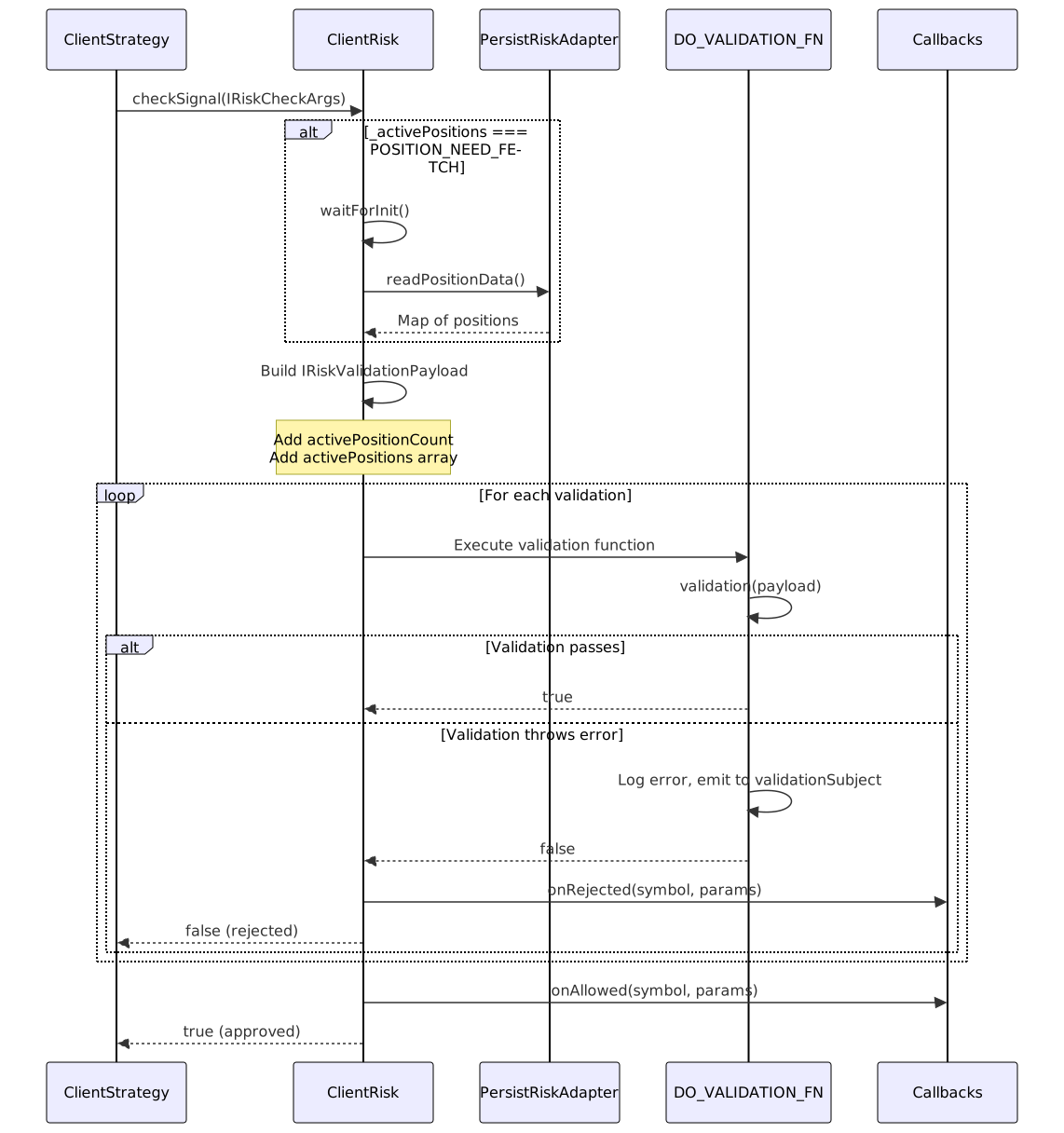
Code Walkthrough
1. Initialize Active Positions
if (this._activePositions === POSITION_NEED_FETCH) {
await this.waitForInit();
}
Lazy initialization loads persisted positions from disk on first use. See Position Tracking for details.
2. Build Validation Payload
const riskMap = <RiskMap>this._activePositions;
const payload: IRiskValidationPayload = {
...params,
activePositionCount: riskMap.size,
activePositions: Array.from(riskMap.values()),
};
The payload combines passthrough arguments from ClientStrategy with current portfolio state.
3. Execute Validations
let isValid = true;
if (this.params.validations) {
for (const validation of this.params.validations) {
if (
not(
await DO_VALIDATION_FN(
typeof validation === "function"
? validation
: validation.validate,
payload
)
)
) {
isValid = false;
break;
}
}
}
Validations execute sequentially. The loop breaks immediately on first failure (short-circuit evaluation). Both function and object forms are normalized to extract the validation function.
4. Handle Result
if (!isValid) {
if (this.params.callbacks?.onRejected) {
this.params.callbacks.onRejected(params.symbol, params);
}
return false;
}
// All checks passed
if (this.params.callbacks?.onAllowed) {
this.params.callbacks.onAllowed(params.symbol, params);
}
return true;
Callbacks fire based on validation result. The method returns true for approval, false for rejection.
Validation Patterns
Pattern 1: Position Count Limits
addRisk({
riskName: "max-positions",
validations: [
({ activePositionCount }) => {
if (activePositionCount >= 3) {
throw new Error("Maximum 3 concurrent positions allowed");
}
}
]
});
Most common pattern. Prevents excessive portfolio exposure by limiting total open positions.
Pattern 2: Symbol Filtering
addRisk({
riskName: "symbol-filter",
validations: [
({ symbol }) => {
if (symbol === "DOGEUSDT") {
throw new Error("DOGE trading not allowed");
}
}
]
});
Reject signals for specific trading pairs based on symbol name.
Pattern 3: Per-Strategy Position Tracking
addRisk({
riskName: "per-strategy-limit",
validations: [
({ strategyName, activePositions }) => {
const strategyPositions = activePositions.filter(
pos => pos.strategyName === strategyName
);
if (strategyPositions.length >= 2) {
throw new Error(`Strategy ${strategyName} already has 2 positions`);
}
}
]
});
Limit positions per individual strategy using the activePositions array.
Pattern 4: Time-Based Filtering
addRisk({
riskName: "time-filter",
validations: [
({ timestamp }) => {
const hour = new Date(timestamp).getHours();
if (hour < 8 || hour > 16) {
throw new Error("Trading only allowed during business hours");
}
}
]
});
Use the timestamp field to implement time-of-day restrictions.
Service Layer Routing
Risk validation requests flow through multiple service layers before reaching ClientRisk.

Service Responsibilities
| Service | File | Responsibility |
|---|---|---|
RiskGlobalService |
src/lib/services/global/RiskGlobalService.ts:15-114 | Public API, memoized validation |
RiskValidationService |
src/lib/services/validation/RiskValidationService.ts | Schema existence checks |
RiskConnectionService |
src/lib/services/connection/RiskConnectionService.ts:41-135 | Memoized ClientRisk instances |
ClientRisk |
src/client/ClientRisk.ts:73-218 | Validation execution, position tracking |
Callbacks
Risk schemas support two optional callbacks that fire based on validation results.
onRejected Callback
interface IRiskCallbacks {
onRejected: (symbol: string, params: IRiskCheckArgs) => void;
}
Fires when any validation throws an error. Receives:
symbol: Trading pair that was rejectedparams: FullIRiskCheckArgswith rejection context
Use case: Log rejected signals, track rejection reasons, send alerts.
onAllowed Callback
interface IRiskCallbacks {
onAllowed: (symbol: string, params: IRiskCheckArgs) => void;
}
Fires when all validations pass. Receives same parameters as onRejected.
Use case: Track approved signals, monitor validation pass rate, log portfolio changes.
Example Usage
addRisk({
riskName: "monitored-risk",
validations: [
({ activePositionCount }) => {
if (activePositionCount >= 5) {
throw new Error("Max positions");
}
}
],
callbacks: {
onRejected: (symbol, params) => {
console.log(`REJECTED: ${symbol} (${params.strategyName})`);
},
onAllowed: (symbol, params) => {
console.log(`APPROVED: ${symbol} (${params.strategyName})`);
}
}
});
Validation Error Handling
Validation errors are caught and emitted via the event system, allowing external monitoring.
Error Flow

Subscribing to Validation Errors
import { listenValidation } from 'backtest-kit';
const unsubscribe = listenValidation((error) => {
console.error('Risk validation error:', error.message);
// Send to monitoring system
sendAlert({
type: 'RISK_VALIDATION_ERROR',
message: error.message,
timestamp: Date.now()
});
});
The listenValidation function subscribes to the validationSubject emitter, receiving all validation errors across all risk profiles.
Testing Validation Logic
Risk validations are deterministic and testable by simulating portfolio state.
Example Test Pattern
test("Risk validation rejects when limit exceeded", async ({ pass, fail }) => {
let rejectedSymbol = null;
addRisk({
riskName: "test-risk",
validations: [
({ activePositionCount }) => {
if (activePositionCount >= 3) {
throw new Error("Max 3 positions");
}
}
],
callbacks: {
onRejected: (symbol) => {
rejectedSymbol = symbol;
}
}
});
const { riskGlobalService } = lib;
// Add 3 positions
await riskGlobalService.addSignal("BTCUSDT", {
strategyName: "test-strategy-1",
riskName: "test-risk"
});
await riskGlobalService.addSignal("ETHUSDT", {
strategyName: "test-strategy-2",
riskName: "test-risk"
});
await riskGlobalService.addSignal("BNBUSDT", {
strategyName: "test-strategy-3",
riskName: "test-risk"
});
// 4th signal should fail
const result = await riskGlobalService.checkSignal(
{
symbol: "SOLUSDT",
strategyName: "test-strategy-4",
exchangeName: "binance",
currentPrice: 100,
timestamp: Date.now()
},
{ riskName: "test-risk" }
);
if (!result && rejectedSymbol === "SOLUSDT") {
pass("Validation correctly rejected 4th position");
}
});
Validation Best Practices
1. Throw Descriptive Errors
// Good: Clear error message
throw new Error("Maximum 5 concurrent positions exceeded (current: 6)");
// Bad: Generic error
throw new Error("Failed");
Error messages appear in logs and validation events, aiding debugging.
2. Use Short-Circuit Evaluation
Validations execute sequentially and stop at first failure. Place most restrictive checks first:
validations: [
// Check count first (fast, common rejection)
({ activePositionCount }) => {
if (activePositionCount >= 5) {
throw new Error("Max positions");
}
},
// Then check complex portfolio logic (slower, rare rejection)
({ activePositions, symbol }) => {
// ... expensive calculation
}
]
3. Validate All Required Fields
({ symbol, activePositionCount, currentPrice }) => {
if (!symbol || typeof activePositionCount !== 'number') {
throw new Error("Invalid risk check payload");
}
// ... validation logic
}
4. Isolate Risk Profiles
Each riskName has independent position tracking. Use separate risk profiles for different strategies or portfolio sections:
addRisk({ riskName: "conservative", validations: [...] });
addRisk({ riskName: "aggressive", validations: [...] });
addStrategy({
strategyName: "safe-strategy",
riskName: "conservative"
});
addStrategy({
strategyName: "risky-strategy",
riskName: "aggressive"
});