Risk Validation
This page documents the risk validation system that ensures all signals meet safety and profitability requirements before execution. Risk validation operates as a two-tier system: built-in structural validation and user-defined custom risk rules.
For information about risk profiles and position tracking, see Risk Profiles. For signal lifecycle states, see Signal Lifecycle Overview.
Two-Tier Validation Architecture
The framework employs a two-tier validation system to ensure signal integrity and enforce risk management rules:
- Built-in Validation (
VALIDATE_SIGNAL_FNinClientStrategy) - Structural validation that prevents logic errors, infinite values, and dangerous price configurations - Custom Risk Validation (
ClientRisk.checkSignal) - User-defined business rules viaIRiskValidation[]chain
System Architecture

Built-in Signal Validation (VALIDATE_SIGNAL_FN)
The VALIDATE_SIGNAL_FN in ClientStrategy performs comprehensive structural validation before any signal is created. This validation is non-negotiable and cannot be disabled.
Validation Categories
| Category | Checks | Purpose |
|---|---|---|
| Required Fields | id, exchangeName, strategyName, symbol, position, _isScheduled |
Ensures signal has all mandatory properties |
| Type Validation | position must be "long" or "short" |
Prevents invalid position types |
| Finite Number Protection | currentPrice, priceOpen, priceTakeProfit, priceStopLoss must be finite |
Guards against NaN/Infinity crashes |
| Positive Price Validation | All prices must be > 0 | Prevents negative or zero prices |
| Price Logic (Long) | TP > Open > SL |
Ensures profitable long setup |
| Price Logic (Short) | TP < Open < SL |
Ensures profitable short setup |
| Immediate Close Protection | currentPrice between TP and SL |
Prevents signals that close instantly |
| Scheduled Signal Protection | priceOpen between TP and SL |
Prevents scheduled signals that cancel/close immediately |
| Minimum TP Distance | CC_MIN_TAKEPROFIT_DISTANCE_PERCENT |
Ensures TP covers trading fees |
| Minimum SL Distance | CC_MIN_STOPLOSS_DISTANCE_PERCENT |
Prevents instant stop-out from volatility |
| Maximum SL Distance | CC_MAX_STOPLOSS_DISTANCE_PERCENT |
Limits maximum loss per trade |
| Time Validation | minuteEstimatedTime must be positive integer |
Ensures valid time estimate |
| Maximum Lifetime | CC_MAX_SIGNAL_LIFETIME_MINUTES |
Prevents eternal signals that block strategy |
| Timestamp Validation | scheduledAt, pendingAt must be positive |
Ensures valid timestamps |
Price Logic Validation
The validation enforces strict price ordering based on position direction:

Distance Check Implementation
Distance checks ensure signals have adequate profit potential and risk buffers:
// Long Position Example (from VALIDATE_SIGNAL_FN)
// MINIMUM TP DISTANCE (must cover fees)
const tpDistancePercent = ((signal.priceTakeProfit - signal.priceOpen) / signal.priceOpen) * 100;
if (tpDistancePercent < GLOBAL_CONFIG.CC_MIN_TAKEPROFIT_DISTANCE_PERCENT) {
throw new Error(`TakeProfit too close (${tpDistancePercent.toFixed(3)}%)`);
}
// MINIMUM SL DISTANCE (avoid instant stop on volatility)
const slDistancePercent = ((signal.priceOpen - signal.priceStopLoss) / signal.priceOpen) * 100;
if (slDistancePercent < GLOBAL_CONFIG.CC_MIN_STOPLOSS_DISTANCE_PERCENT) {
throw new Error(`StopLoss too close (${slDistancePercent.toFixed(3)}%)`);
}
// MAXIMUM SL DISTANCE (capital protection)
if (slDistancePercent > GLOBAL_CONFIG.CC_MAX_STOPLOSS_DISTANCE_PERCENT) {
throw new Error(`StopLoss too far (${slDistancePercent.toFixed(3)}%)`);
}
Default Configuration Values:
| Parameter | Default | Purpose |
|---|---|---|
CC_MIN_TAKEPROFIT_DISTANCE_PERCENT |
0.5% | Minimum TP distance to cover trading fees (0.1% entry + 0.1% exit + slippage) |
CC_MIN_STOPLOSS_DISTANCE_PERCENT |
0.2% | Minimum SL buffer to prevent instant stop-out from market noise |
CC_MAX_STOPLOSS_DISTANCE_PERCENT |
10% | Maximum loss limit to protect capital |
CC_MAX_SIGNAL_LIFETIME_MINUTES |
43,200 (30 days) | Prevents eternal signals that block risk limits |
Immediate Close Protection
A critical protection prevents signals that would close immediately after opening:

Custom Risk Validation (ClientRisk.checkSignal)
After passing built-in validation, signals are evaluated against user-defined risk rules via ClientRisk.checkSignal() which executes the IRiskValidation[] chain.
Type Definitions and Relationships

Validation Chain Execution
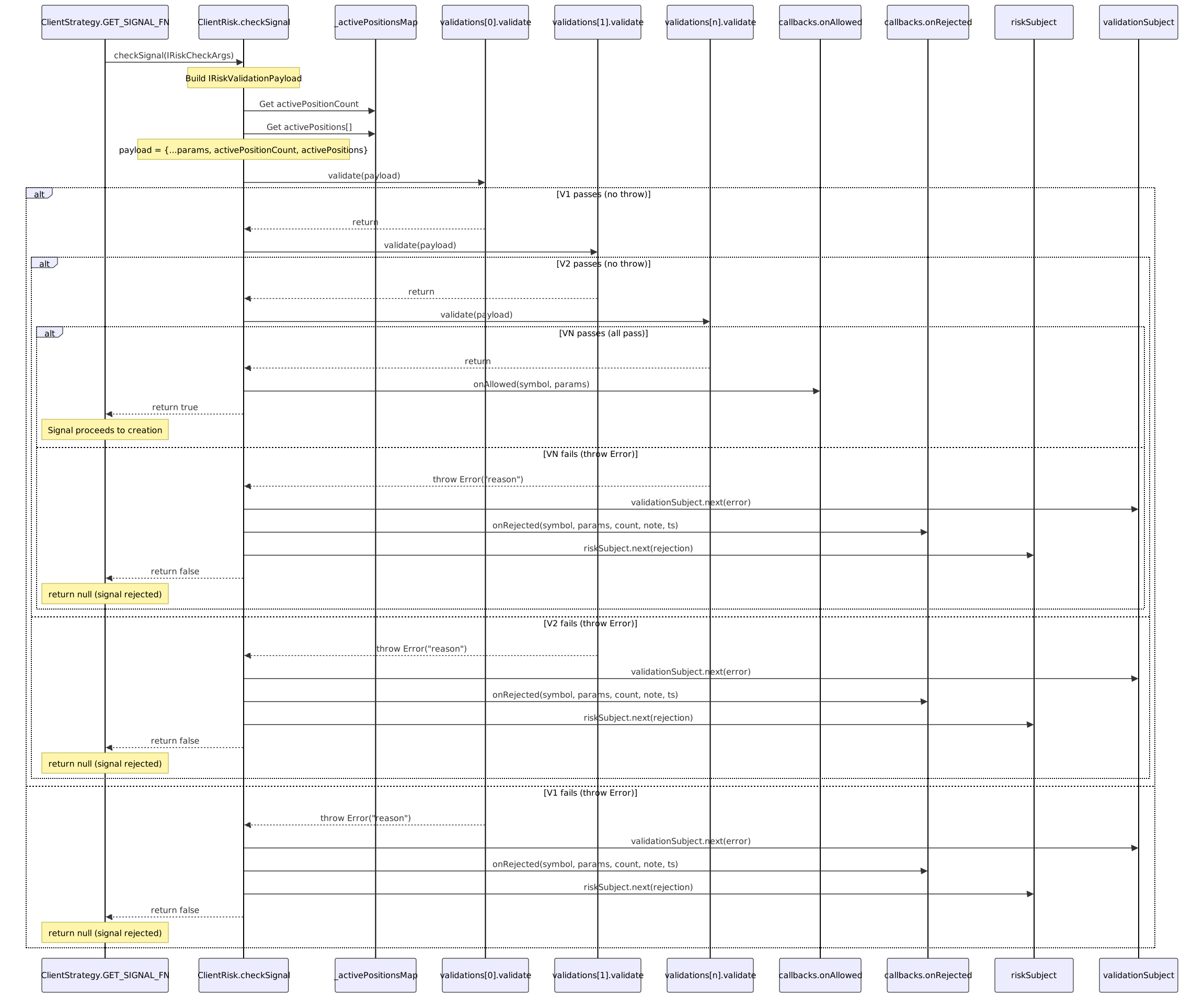
The ClientRisk.checkSignal() method executes custom risk validations sequentially in a fail-fast pattern. Each validation function receives IRiskValidationPayload and throws on rejection.
ClientRisk.checkSignal Implementation Flow
IRiskValidationPayload Structure
The validation payload extends IRiskCheckArgs with portfolio-level context:
Payload Fields
| Field | Type | Source | Description |
|---|---|---|---|
pendingSignal |
ISignalDto |
From IRiskCheckArgs |
Signal being validated (may not have id yet) |
symbol |
string |
From IRiskCheckArgs |
Trading pair (e.g., "BTCUSDT") |
strategyName |
string |
From IRiskCheckArgs |
Strategy identifier |
exchangeName |
string |
From IRiskCheckArgs |
Exchange identifier |
currentPrice |
number |
From IRiskCheckArgs |
Current market price (VWAP from exchange.getAveragePrice) |
timestamp |
number |
From IRiskCheckArgs |
Validation timestamp (ms since epoch) |
activePositionCount |
number |
Computed by ClientRisk |
Number of currently active positions across all strategies |
activePositions |
IRiskActivePosition[] |
From ClientRisk._activePositionsMap |
Array of all active positions with signal details |
IRiskActivePosition Structure
interface IRiskActivePosition {
signal: ISignalRow; // Full signal data
strategyName: string; // Strategy that owns this position
exchangeName: string; // Exchange identifier
openTimestamp: number; // When position was opened (ms)
}
Payload Construction Location: src/client/ClientRisk.ts
Example: Risk-Reward Ratio Validation
// IRiskValidation with note and validate function
{
validate: ({ pendingSignal, currentPrice }) => {
const { priceOpen = currentPrice, priceTakeProfit, priceStopLoss, position } = pendingSignal;
// Calculate reward (distance to TP)
const reward = position === "long"
? priceTakeProfit - priceOpen
: priceOpen - priceTakeProfit;
// Calculate risk (distance to SL)
const risk = position === "long"
? priceOpen - priceStopLoss
: priceStopLoss - priceOpen;
if (risk <= 0) {
throw new Error("Invalid SL: risk must be positive");
}
const rrRatio = reward / risk;
if (rrRatio < 2) {
throw new Error(`RR ratio ${rrRatio.toFixed(2)} < 2:1 required`);
}
},
note: "Risk-Reward ratio must be at least 1:2"
}
Example: Portfolio Position Limit Validation
// Using activePositionCount from payload
{
validate: ({ activePositionCount }) => {
if (activePositionCount >= 3) {
throw new Error(`Max 3 concurrent positions (current: ${activePositionCount})`);
}
},
note: "Limit portfolio to 3 concurrent positions"
}
Example: Position Correlation Check
// Using activePositions array from payload
{
validate: ({ pendingSignal, activePositions, symbol }) => {
const sameSymbolCount = activePositions.filter(pos => pos.signal.symbol === symbol).length;
if (sameSymbolCount >= 2) {
throw new Error(`Max 2 positions per symbol (${symbol} has ${sameSymbolCount})`);
}
const sameDirectionCount = activePositions.filter(
pos => pos.signal.position === pendingSignal.position
).length;
if (sameDirectionCount >= 5) {
throw new Error(`Max 5 ${pendingSignal.position} positions (current: ${sameDirectionCount})`);
}
},
note: "Limit symbol concentration and directional bias"
}
Validation Points in Signal Lifecycle
Risk validation occurs at two critical checkpoints in the signal lifecycle to ensure safety at generation and activation.
Checkpoint Locations in ClientStrategy

Checkpoint 1: Signal Generation
Location: src/client/ClientStrategy.ts:374-387
// Inside GET_SIGNAL_FN after VALIDATE_SIGNAL_FN passes
if (
await not(
self.params.risk.checkSignal({
pendingSignal: signal,
symbol: self.params.execution.context.symbol,
strategyName: self.params.method.context.strategyName,
exchangeName: self.params.method.context.exchangeName,
currentPrice,
timestamp: currentTime,
})
)
) {
return null; // Signal rejected by custom risk rules
}
Purpose: Validates signal against portfolio risk rules at generation time. If rejected, signal is never created and strategy remains idle.
Checkpoint 2: Scheduled Signal Activation
Location: src/client/ClientStrategy.ts:711-729
// Inside ACTIVATE_SCHEDULED_SIGNAL_FN before activating scheduled signal
if (
await not(
self.params.risk.checkSignal({
symbol: self.params.execution.context.symbol,
pendingSignal: scheduled,
strategyName: self.params.method.context.strategyName,
exchangeName: self.params.method.context.exchangeName,
currentPrice: scheduled.priceOpen,
timestamp: activationTime,
})
)
) {
self.params.logger.info("ClientStrategy scheduled signal rejected by risk", {
symbol: self.params.execution.context.symbol,
signalId: scheduled.id,
});
await self.setScheduledSignal(null);
return null; // Scheduled signal cancelled at activation
}
Purpose: Re-validates scheduled signals at activation time because market conditions may have changed since generation:
- Portfolio may now be full (reached
activePositionCountlimit) - New positions may have created unwanted correlation
- Risk parameters may have been updated
Key Difference: The currentPrice parameter differs between checkpoints:
- Checkpoint 1: Uses
currentPricefromexchange.getAveragePrice()at generation time - Checkpoint 2: Uses
scheduled.priceOpen(the activation price)
Fail-Fast Pattern
The validation system implements a fail-fast pattern where rejected signals immediately abort signal creation and emit rejection events for monitoring:

Rejection Event Structure:
interface IRiskEvent {
symbol: string;
strategyName: string;
exchangeName: string;
currentPrice: number;
timestamp: number;
pendingSignal: ISignalDto | ISignalRow;
error: Error;
}
Rejection events are emitted via riskEmitter for observability. Applications can subscribe using listenRisk() to track rejected signals for strategy tuning.
Configuration Parameters
Global configuration parameters control validation behavior:
Distance Parameters
| Parameter | Default | Configurable Via | Impact |
|---|---|---|---|
CC_MIN_TAKEPROFIT_DISTANCE_PERCENT |
0.5% | setConfig({ CC_MIN_TAKEPROFIT_DISTANCE_PERCENT: 1.0 }) |
Ensures TP covers trading fees and slippage |
CC_MIN_STOPLOSS_DISTANCE_PERCENT |
0.2% | setConfig({ CC_MIN_STOPLOSS_DISTANCE_PERCENT: 0.5 }) |
Prevents instant stop-out from market noise |
CC_MAX_STOPLOSS_DISTANCE_PERCENT |
10% | setConfig({ CC_MAX_STOPLOSS_DISTANCE_PERCENT: 5.0 }) |
Limits maximum loss per position |
Time Parameters
| Parameter | Default | Configurable Via | Impact |
|---|---|---|---|
CC_MAX_SIGNAL_LIFETIME_MINUTES |
43,200 (30 days) | setConfig({ CC_MAX_SIGNAL_LIFETIME_MINUTES: 10080 }) |
Prevents eternal signals that block strategy |
CC_SCHEDULE_AWAIT_MINUTES |
1,440 (24 hours) | setConfig({ CC_SCHEDULE_AWAIT_MINUTES: 720 }) |
Max time to wait for scheduled signal activation |
CC_MAX_SIGNAL_GENERATION_SECONDS |
30 | setConfig({ CC_MAX_SIGNAL_GENERATION_SECONDS: 60 }) |
Timeout for getSignal() execution |
Example Configuration
import { setConfig } from "backtest-kit";
setConfig({
// Tighter validation for scalping strategies
CC_MIN_TAKEPROFIT_DISTANCE_PERCENT: 0.8,
CC_MIN_STOPLOSS_DISTANCE_PERCENT: 0.3,
CC_MAX_STOPLOSS_DISTANCE_PERCENT: 3.0,
// Shorter timeouts for high-frequency trading
CC_MAX_SIGNAL_LIFETIME_MINUTES: 1440, // 1 day max
CC_SCHEDULE_AWAIT_MINUTES: 60, // 1 hour max wait
});
Common Validation Patterns
Pattern 1: Risk-Reward Ratio Enforcement
{
validate: ({ pendingSignal, currentPrice }) => {
const { priceOpen = currentPrice, priceTakeProfit, priceStopLoss, position } = pendingSignal;
const reward = position === "long"
? priceTakeProfit - priceOpen
: priceOpen - priceTakeProfit;
const risk = position === "long"
? priceOpen - priceStopLoss
: priceStopLoss - priceOpen;
const rrRatio = reward / risk;
if (rrRatio < 2) {
throw new Error(`RR ratio ${rrRatio.toFixed(2)} < 2:1 required`);
}
},
note: "Minimum 1:2 risk-reward ratio"
}
Pattern 2: Maximum Concurrent Positions
{
validate: async ({ symbol, strategyName }) => {
const activeCount = await getActiveSignalCount(strategyName);
if (activeCount >= 3) {
throw new Error(`Max 3 concurrent positions (current: ${activeCount})`);
}
},
note: "Limit concurrent positions per strategy"
}
Pattern 3: Minimum Take-Profit Percentage
{
validate: ({ pendingSignal, currentPrice }) => {
const { priceOpen = currentPrice, priceTakeProfit, position } = pendingSignal;
const tpDistance = position === "long"
? ((priceTakeProfit - priceOpen) / priceOpen) * 100
: ((priceOpen - priceTakeProfit) / priceOpen) * 100;
if (tpDistance < 1) {
throw new Error(`TP distance ${tpDistance.toFixed(2)}% < 1% minimum`);
}
},
note: "TP distance must be at least 1%"
}
Pattern 4: Symbol-Specific Rules
{
validate: ({ symbol, pendingSignal }) => {
if (symbol === "BTCUSDT" && pendingSignal.minuteEstimatedTime > 1440) {
throw new Error("BTC signals limited to 24h max");
}
if (symbol.includes("USD") && pendingSignal.minuteEstimatedTime < 60) {
throw new Error("USD pairs require minimum 1h timeframe");
}
},
note: "Symbol-specific time constraints"
}
Integration with Signal Lifecycle
Risk validation integrates seamlessly with the signal state machine:

Callback System (onAllowed / onRejected)
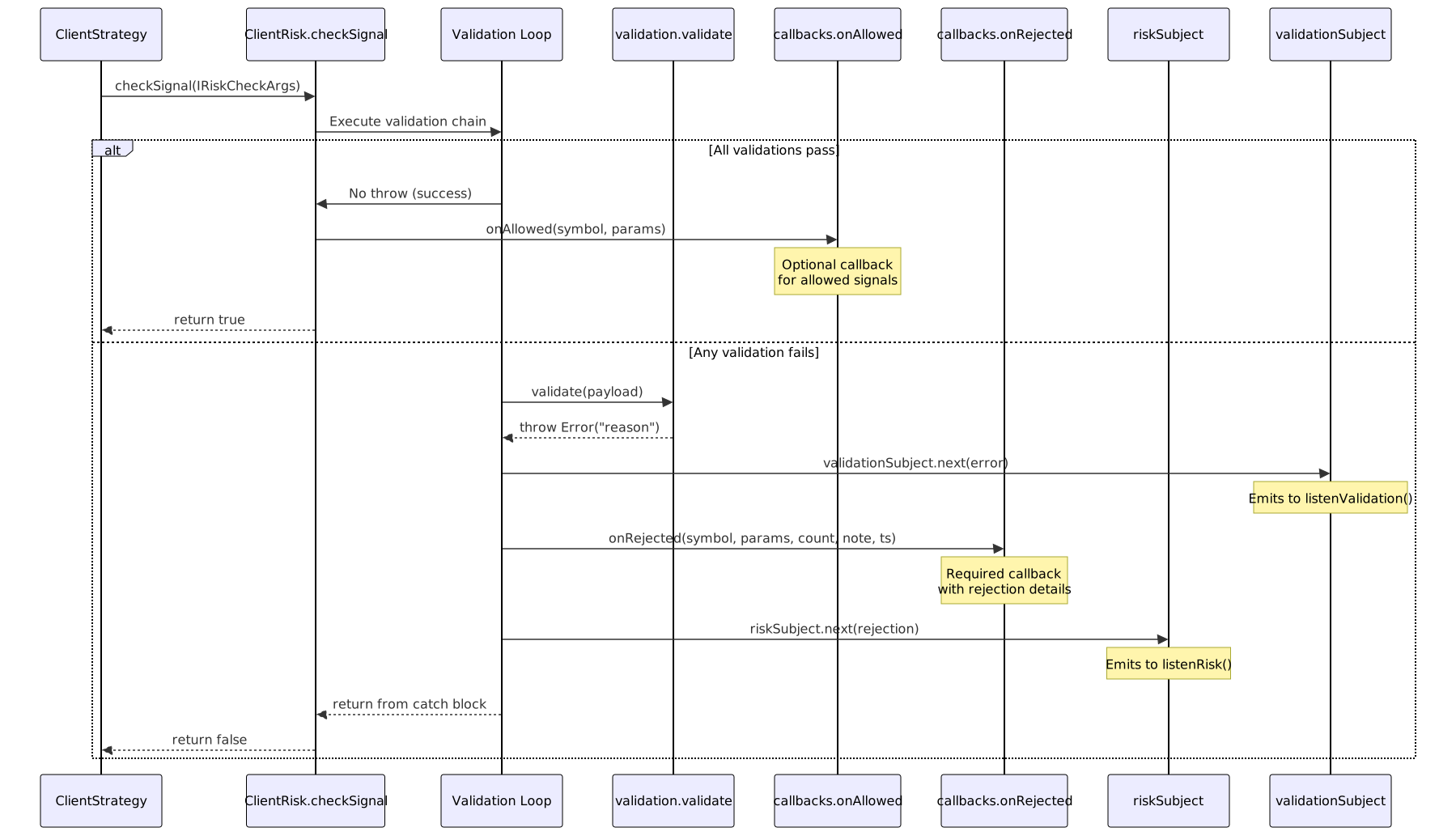
The IRiskCallbacks interface provides hooks for monitoring validation decisions in real-time.
IRiskCallbacks Interface Definition
interface IRiskCallbacks {
/** Called when a signal is rejected due to risk limits */
onRejected: (
symbol: string,
params: IRiskCheckArgs,
activePositionCount: number,
comment: string,
timestamp: number
) => void;
/** Called when a signal passes risk checks */
onAllowed: (
symbol: string,
params: IRiskCheckArgs
) => void;
}
Callback Invocation Flow
Example: Logging Allowed Signals
import { addRisk } from "backtest-kit";
addRisk({
riskName: "demo-risk",
validations: [
// ... validation functions
],
callbacks: {
onAllowed: (symbol, params) => {
console.log(`[ALLOWED] ${symbol} signal from ${params.strategyName}`);
console.log(` Position: ${params.pendingSignal.position}`);
console.log(` Price: ${params.currentPrice}`);
console.log(` TP: ${params.pendingSignal.priceTakeProfit}`);
console.log(` SL: ${params.pendingSignal.priceStopLoss}`);
},
onRejected: (symbol, params, activePositionCount, comment, timestamp) => {
console.error(`[REJECTED] ${symbol} signal from ${params.strategyName}`);
console.error(` Reason: ${comment}`);
console.error(` Active positions: ${activePositionCount}`);
console.error(` Price: ${params.currentPrice}`);
console.error(` Time: ${new Date(timestamp).toISOString()}`);
},
},
});
Example: Alerting on Risk Rejections
import { addRisk } from "backtest-kit";
import { sendAlert } from "./alerts.js";
addRisk({
riskName: "monitored-risk",
validations: [
// ... validation functions
],
callbacks: {
onRejected: async (symbol, params, activePositionCount, comment, timestamp) => {
// Send alert to monitoring system
await sendAlert({
level: "warning",
title: `Risk rejection on ${symbol}`,
message: `Strategy ${params.strategyName} rejected: ${comment}`,
metadata: {
symbol,
strategy: params.strategyName,
activePositions: activePositionCount,
price: params.currentPrice,
timestamp: new Date(timestamp).toISOString(),
},
});
},
},
});
Callback vs Event Emitters
The callback system provides three layers of observability:
| Layer | Mechanism | Scope | Use Case |
|---|---|---|---|
| Schema Callbacks | IRiskCallbacks.onRejected/onAllowed |
Per-risk profile | Risk-specific logging, custom actions |
| Event Emitters | riskSubject, validationSubject |
Global | Cross-strategy monitoring, dashboard updates |
| Report Generation | RiskMarkdownService |
Per-report dump | Post-execution analysis, debugging |
Event Emitters:
riskSubjectsrc/config/emitters.ts:127-131 - EmitsRiskContractfor risk rejectionsvalidationSubjectsrc/config/emitters.ts:109-112 - EmitsErrorfor validation failures
Subscription Example:
import { listenRisk } from "backtest-kit";
listenRisk((event) => {
console.log(`[RISK EVENT] ${event.symbol} rejected`);
console.log(` Strategy: ${event.strategyName}`);
console.log(` Reason: ${event.comment}`);
console.log(` Active: ${event.activePositionCount}`);
});
Summary
The risk validation system provides defense in depth through:
- Built-in Validation - Prevents structural errors, NaN/Infinity, dangerous price configurations
- Custom Risk Rules - Enforces business logic (RR ratios, position limits, portfolio rules)
- Fail-Fast Pattern - Rejects invalid signals immediately before position creation
- Double Validation - Re-validates scheduled signals at activation to account for market changes
- Comprehensive Observability - Emits events, logs warnings, generates reports for all rejections
This ensures that only high-quality, risk-managed signals reach execution, protecting capital and preventing strategy errors.