Interval Throttling
Purpose and Scope
This page documents the interval throttling system in backtest-kit, which prevents excessive getSignal() calls by enforcing minimum time delays between signal generation attempts. Interval throttling ensures strategies execute at defined timeframes (e.g., every 5 minutes) rather than on every tick, reducing computational overhead and aligning signal generation with strategy timeframes.
For information about the signal lifecycle after generation, see Signal Lifecycle Overview. For details on real-time monitoring loops, see Real-time Monitoring.
Interval Types
backtest-kit supports six predefined throttling intervals, each enforcing a minimum time between getSignal() invocations:
| Interval Value | Duration (Minutes) | Duration (Milliseconds) | Typical Use Case |
|---|---|---|---|
"1m" |
1 | 60,000 | High-frequency scalping, rapid signal updates |
"3m" |
3 | 180,000 | Short-term momentum strategies |
"5m" |
5 | 300,000 | Common intraday trading interval |
"15m" |
15 | 900,000 | Medium-term intraday strategies |
"30m" |
30 | 1,800,000 | Swing trading, position management |
"1h" |
60 | 3,600,000 | Long-term position strategies |
Throttling Mechanism
Architecture Diagram

Diagram: Interval Throttling Decision Flow
Implementation Details
Throttle Check Logic
The throttling check occurs in GET_SIGNAL_FN before invoking the user-defined getSignal() function:
// From ClientStrategy.ts:336-352
const currentTime = self.params.execution.context.when.getTime();
{
const intervalMinutes = INTERVAL_MINUTES[self.params.interval];
const intervalMs = intervalMinutes * 60 * 1000;
// Check if enough time has passed since last getSignal
if (
self._lastSignalTimestamp !== null &&
currentTime - self._lastSignalTimestamp < intervalMs
) {
return null;
}
self._lastSignalTimestamp = currentTime;
}
Key Implementation Points:
- Time Source: Uses
ExecutionContextService.context.whenfor temporal consistency - Null on First Call:
_lastSignalTimestampstarts asnull, allowing immediate first execution - Millisecond Precision: Converts minutes to milliseconds for accurate comparison
- Early Return: Returns
nullimmediately if throttled, preventing unnecessary computation - Timestamp Update: Updates
_lastSignalTimestamponly after throttle check passes
Interval Lookup Table
The INTERVAL_MINUTES constant maps SignalInterval string values to numeric minute durations:
| Constant | File Location | Type |
|---|---|---|
INTERVAL_MINUTES |
src/client/ClientStrategy.ts:34-41 | Record<SignalInterval, number> |
Configuration in Strategy Schemas
Schema Definition
Strategies specify their throttling interval via the interval field in IStrategySchema:
// From interfaces/Strategy.interface.ts
export interface IStrategySchema {
strategyName: StrategyName;
interval: SignalInterval; // Throttling interval
getSignal: (symbol: string, when: Date) => Promise<ISignalDto | null>;
// ... other fields
}
Registration Example
// Example from README.md
addStrategy({
strategyName: 'llm-strategy',
interval: '5m', // getSignal() called at most every 5 minutes
getSignal: async (symbol) => {
// Strategy logic here
},
});
Behavior Across Execution Modes
Backtest Mode
In backtest mode, ClientStrategy.tick() is called once per candle iteration. The throttle ensures getSignal() only executes when the time difference between candles exceeds the configured interval:
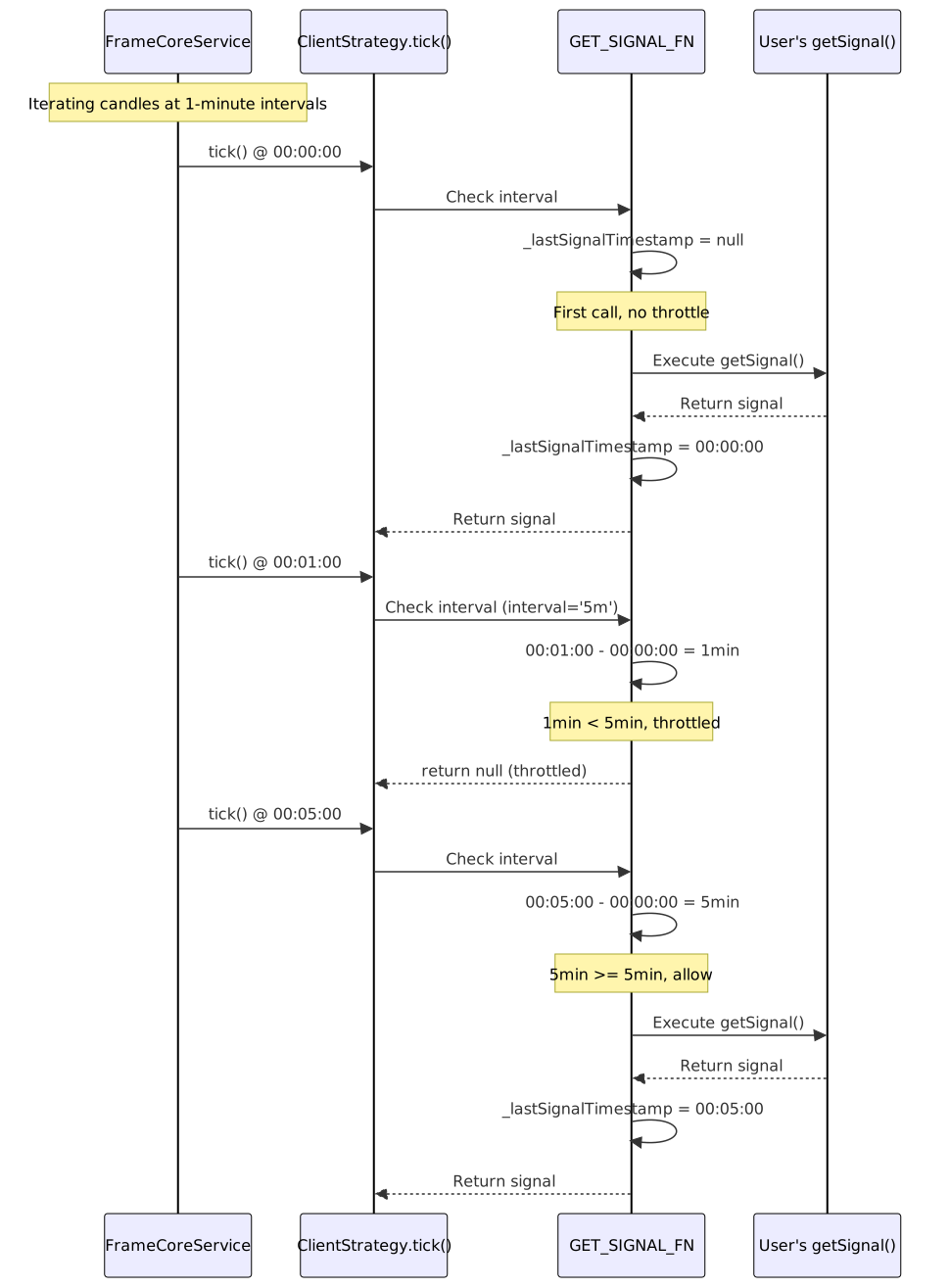
Diagram: Interval Throttling in Backtest Mode
Live Mode
In live mode, ClientStrategy.tick() is called continuously in a loop with TICK_TTL sleep intervals (typically 1 minute). The throttle prevents redundant getSignal() executions between meaningful time boundaries:

Diagram: Interval Throttling in Live Mode Loop
Per-Instance State Isolation
Each ClientStrategy instance maintains its own _lastSignalTimestamp:
// From ClientStrategy.ts class definition
export class ClientStrategy implements IStrategy {
private _lastSignalTimestamp: number | null = null;
private _isStopped = false;
private _pendingSignal: ISignalRow | null = null;
private _scheduledSignal: IScheduledSignalRow | null = null;
// ...
}
Instance Isolation Guarantees:
- Symbol-Strategy Pairs: Each symbol-strategy combination gets isolated throttle state
- Backtest vs Live: Separate instances for backtest and live modes via memoization key
symbol:strategyName:backtest - No Cross-Contamination: One strategy's throttle state never affects another
Relationship with Other Components
Integration Points
| Component | Relationship | File Reference |
|---|---|---|
IStrategySchema |
Defines interval configuration |
src/interfaces/Strategy.interface.ts:132-151 |
StrategyConnectionService |
Passes interval to ClientStrategy constructor |
src/lib/services/connection/StrategyConnectionService.ts:123-156 |
ExecutionContextService |
Provides context.when for time source |
src/lib/services/context/ExecutionContextService.ts |
GET_SIGNAL_FN |
Implements throttle logic wrapper | src/client/ClientStrategy.ts:332-476 |
Use Cases and Best Practices
Interval Selection Guidelines
| Strategy Type | Recommended Interval | Rationale |
|---|---|---|
| Scalping | "1m" |
High-frequency entries, rapid market changes |
| Day Trading | "5m" or "15m" |
Balance between responsiveness and noise reduction |
| Swing Trading | "30m" or "1h" |
Longer-term positions, reduced false signals |
| Position Trading | "1h" |
Weekly/monthly timeframes, minimal overhead |
Computational Efficiency
Longer intervals reduce:
- LLM API Calls: Fewer
getSignal()invocations mean fewer expensive LLM requests - Indicator Calculations: Reduced technical indicator recomputation
- Network Requests: Fewer
getCandles()fetches (when using live data sources) - CPU Usage: Less frequent strategy evaluation
Timing Precision
Timestamp Sources
The throttle compares timestamps from two sources:
-
Current Time:
ExecutionContextService.context.when.getTime()- Backtest: Candle timestamp from historical data
- Live:
Date.now()from system clock
-
Last Signal Time:
_lastSignalTimestamp(stored in milliseconds)
Boundary Behavior
The throttle uses strict inequality (<), meaning:
- Exactly Equal: If
currentTime - lastSignalTimestamp === intervalMs, the throttle allows execution - Example: With
interval='5m'andlastSignalTimestamp=00:00:00, the signal at00:05:00will execute (not throttled)
Testing Coverage
The throttle mechanism is validated by multiple test suites:
| Test Suite | Focus | File Reference |
|---|---|---|
timing.test.mjs |
Interval timing accuracy | test/e2e/timing.test.mjs |
defend.test.mjs |
Edge cases (boundary conditions, multiple signals) | test/e2e/defend.test.mjs |
scheduled.test.mjs |
Throttle with scheduled signals | test/e2e/scheduled.test.mjs |
Common Pitfalls
Pitfall 1: Confusing Interval with Signal Lifetime
- Interval: Controls how often
getSignal()is called (throttling) - minuteEstimatedTime: Controls how long an active signal lives before time expiration
These are independent parameters. A strategy with interval='5m' can have minuteEstimatedTime=120 (2 hours).
Pitfall 2: Expecting Sub-Interval Updates in Live Mode
In live mode with interval='5m', even though tick() runs every minute, getSignal() only executes every 5 minutes. Price checks for active signals still occur every minute (TP/SL monitoring), but new signal generation is throttled.
Summary
Interval throttling in backtest-kit enforces minimum time delays between getSignal() calls, preventing excessive strategy evaluations and aligning signal generation with meaningful timeframes. The system uses per-instance _lastSignalTimestamp tracking with temporal consistency via ExecutionContextService, ensuring identical behavior across backtest and live modes while maintaining symbol-strategy isolation.