Walker Execution Flow
Purpose and Scope
This page documents the execution flow of Walker mode, which orchestrates multiple backtest runs to compare strategies and select the best performer. Walker iterates through a list of strategies, runs each through the same backtest configuration, collects performance metrics, and ranks results.
For information about individual backtest execution, see Backtest Execution Flow. For details on how strategies are compared and metrics calculated, see Strategy Comparison. For report generation, see Walker Reports.
Overview
Walker mode provides multi-strategy comparison by:
- Sequential Execution - Running each strategy in the walker's strategy list through a full backtest
- Progressive Results - Emitting progress events after each strategy completes
- Metric-Based Ranking - Comparing strategies using a configured metric (Sharpe ratio, win rate, total PNL, etc.)
- Best Selection - Identifying the optimal strategy based on the comparison metric
Walker execution is deterministic and reproducible since it uses the same frame (timeframe) and exchange for all strategies.
Walker Schema Structure
A walker is defined using IWalkerSchema which specifies:
| Field | Type | Description |
|---|---|---|
walkerName |
string |
Unique identifier for this walker |
exchangeName |
string |
Exchange to use for all strategies |
frameName |
string |
Timeframe to use for all backtests |
strategies |
string[] |
Array of strategy names to compare |
metric |
string (optional) |
Comparison metric (default: "sharpeRatio") |
callbacks |
object (optional) |
Event handlers for lifecycle events |
Available Comparison Metrics
sharpeRatio- Risk-adjusted return (default)winRate- Win percentageavgPnl- Average PNL percentage per tradetotalPnl- Cumulative PNL percentagecertaintyRatio- Average win / |average loss|
High-Level Execution Flow
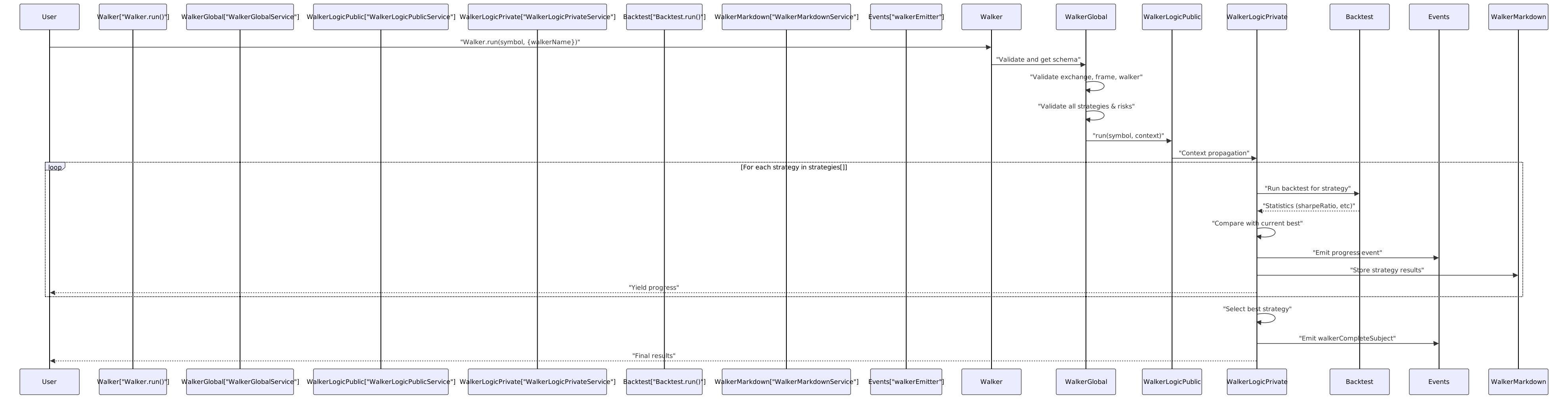
Service Layer Architecture
Walker execution flows through three service layers:

Validation and Preparation Phase
Before execution begins, Walker performs comprehensive validation:
1. Walker Validation
src/classes/Walker.ts:50-59 validates the walker schema exists and is well-formed.
2. Component Validation
src/lib/services/global/WalkerGlobalService.ts:64-84 validates:
- Exchange exists and is valid
- Frame exists and is valid
- Walker schema is valid
- All strategies exist and are valid
- All risk profiles (if specified) exist and are valid
3. Data Clearing
src/classes/Walker.ts:61-79 clears accumulated data for all strategies:
// Clear walker markdown data
backtest.walkerMarkdownService.clear(walkerName);
// Clear each strategy's data
for (const strategyName of strategies) {
backtest.backtestMarkdownService.clear(strategyName);
backtest.scheduleMarkdownService.clear(strategyName);
backtest.strategyGlobalService.clear(strategyName);
// Clear risk profile if used
const { riskName } = backtest.strategySchemaService.get(strategyName);
riskName && backtest.riskGlobalService.clear(riskName);
}
This ensures clean state for consistent comparisons.
Strategy Iteration Loop
The core of Walker execution is a sequential iteration through the strategies array:

Context Propagation Pattern
Walker uses the same context management pattern as Backtest and Live modes:
Method Context
The walker name, exchange name, and frame name are wrapped in a MethodContext:
// From Walker.run()
return backtest.walkerGlobalService.run(symbol, {
walkerName: context.walkerName,
exchangeName: walkerSchema.exchangeName,
frameName: walkerSchema.frameName,
});
This context flows through:
WalkerGlobalService.run()- Validates contextWalkerLogicPublicService.run()- Wraps withMethodContextService.runAsyncIterator()WalkerLogicPrivateService.run()- Core iteration logic with context access
Nested Backtest Context
For each strategy, Walker creates a nested backtest context:
// For each strategy in walker.strategies
for await (const result of Backtest.run(symbol, {
strategyName: currentStrategy,
exchangeName: walkerSchema.exchangeName,
frameName: walkerSchema.frameName
})) {
// Backtest runs in its own context
}
This creates a "context sandwich":
- Outer: Walker method context
- Inner: Backtest method context for current strategy
Progress Event Structure
Walker emits two types of events during execution:
1. Progress Events (Per Strategy)
Emitted via walkerEmitter after each strategy completes:
| Field | Type | Description |
|---|---|---|
walkerName |
string |
Walker identifier |
symbol |
string |
Trading pair |
strategyName |
string |
Strategy just completed |
strategiesTested |
number |
Count of strategies tested so far |
totalStrategies |
number |
Total strategies in walker |
bestStrategy |
string | null |
Current best strategy name |
bestMetric |
number |
Current best metric value |
metricValue |
number |
Metric value for completed strategy |
2. Completion Event
Emitted via walkerCompleteSubject when all strategies finish:
interface IWalkerResults {
bestStrategy: string | null;
bestMetric: number;
strategies: Array<{
strategyName: string;
stats: BacktestStatistics;
metric: number;
}>;
}
Event Subscription Patterns
Users can subscribe to walker events using multiple approaches:
Listen to Progress (During Execution)
import { listenWalker } from "backtest-kit";
const unsubscribe = listenWalker((event) => {
console.log(`Progress: ${event.strategiesTested}/${event.totalStrategies}`);
console.log(`Best: ${event.bestStrategy} (${event.bestMetric})`);
console.log(`Current: ${event.strategyName} (${event.metricValue})`);
});
Listen to Completion (Final Results)
import { listenWalkerComplete } from "backtest-kit";
listenWalkerComplete((results) => {
console.log(`Best strategy: ${results.bestStrategy}`);
console.log(`Best metric: ${results.bestMetric}`);
results.strategies.forEach(s => {
console.log(`${s.strategyName}: ${s.metric}`);
});
});
One-Time Listeners
import { listenWalkerOnce } from "backtest-kit";
// Wait for specific condition
listenWalkerOnce(
(event) => event.strategiesTested === 5,
(event) => console.log("5 strategies tested!")
);
Background Execution and Cancellation
Walker supports background execution with cancellation:
Background Mode
const stop = Walker.background("BTCUSDT", {
walkerName: "my-walker"
});
// Later: stop execution
stop();
Cancellation Mechanism
src/classes/Walker.ts:108-143 implements cancellation:
- Sets
isStoppedflag totrue - Calls
strategyGlobalService.stop()for each strategy - Breaks iteration loop on next strategy completion
- Emits
doneWalkerSubjectevent
The cancellation is graceful - it allows the current strategy's backtest to complete before stopping.
Integration with Markdown Services
Walker coordinates with multiple markdown services:

Data Flow
- During Strategy Backtest:
BacktestMarkdownServiceaccumulates closed signals automatically via event subscription - After Strategy Completion: Walker calls
BacktestMarkdownService.getData()to get statistics - Metric Extraction: Walker extracts the comparison metric from statistics
- Storage:
WalkerMarkdownServicestores the strategy result for final report generation
Comparison Table
Walker execution differs from individual Backtest runs:
| Aspect | Backtest.run() | Walker.run() |
|---|---|---|
| Scope | Single strategy | Multiple strategies |
| Context | {strategyName, exchangeName, frameName} |
{walkerName} (pulls exchange/frame from walker schema) |
| Iteration | Through timeframe | Through strategies array |
| Progress Events | Per frame/timestamp | Per strategy completion |
| Result | Closed signals with PNL | Best strategy + rankings |
| Duration | Single timeframe | Multiple full backtests |
| Event Emitter | signalBacktestEmitter |
walkerEmitter |
| Completion Event | doneBacktestSubject |
walkerCompleteSubject |
Error Handling
Walker execution handles errors at multiple levels:
Validation Errors (Pre-Execution)
Thrown synchronously before iteration begins:
- Invalid walker name
- Invalid exchange/frame/strategy names
- Missing risk profiles
Backtest Errors (During Execution)
Caught and propagated via errorEmitter:
- Strategy execution errors
- Exchange data fetch errors
- Signal validation errors
Background Error Propagation
src/classes/Walker.ts:135-137 catches errors and emits via errorEmitter:
task().catch((error) =>
errorEmitter.next(new Error(getErrorMessage(error)))
);
Users subscribe to errors:
import { listenError } from "backtest-kit";
listenError((error) => {
console.error("Walker error:", error.message);
});
Performance Considerations
Walker execution time is cumulative:
Total Time = Sum of Individual Backtest Times
For a walker with 10 strategies over a 1-month frame:
- If each backtest takes 5 seconds
- Total walker time: 10 × 5 = 50 seconds
Optimization Strategies
- Parallel Execution: Not currently supported (sequential by design for determinism)
- Frame Selection: Use shorter timeframes for faster initial testing
- Strategy Pre-filtering: Remove obviously poor strategies before walker
- Progress Monitoring: Use
listenWalker()to track execution progress
Summary
Walker execution orchestrates multi-strategy backtesting through:
- Schema Loading: Pulls walker configuration with strategies array, exchange, and frame
- Validation: Ensures all components exist and are valid
- Data Clearing: Resets state for clean comparisons
- Sequential Iteration: Runs each strategy through complete backtest
- Metric Extraction: Collects comparison metric from backtest statistics
- Progressive Ranking: Maintains best strategy as iteration proceeds
- Event Emission: Provides progress updates and final results
- Report Generation: Aggregates results into comparison table
The walker provides a systematic approach to strategy optimization by ensuring all strategies are tested under identical conditions.