Strategy Comparison
This page explains how Walker mode compares multiple trading strategies and selects the best performer based on configurable metrics. For information about running individual backtests, see Backtest Execution Flow. For details about the Walker API methods, see Walker API.
Comparison Metrics
Walker mode ranks strategies using one of several performance metrics. The metric is specified in the IWalkerSchema.metric field and defaults to sharpeRatio if not provided.
Available Metrics
| Metric | Description | Calculation | Interpretation |
|---|---|---|---|
sharpeRatio |
Risk-adjusted return | avgPnl / stdDev |
Higher is better. Measures return per unit of risk. |
annualizedSharpeRatio |
Annualized Sharpe Ratio | sharpeRatio × √365 |
Higher is better. Sharpe ratio scaled to yearly timeframe. |
winRate |
Win percentage | (winCount / totalSignals) × 100 |
Higher is better. Percentage of profitable trades. |
avgPnl |
Average PNL per trade | sum(pnlPercentage) / totalSignals |
Higher is better. Mean profit/loss percentage. |
totalPnl |
Cumulative PNL | sum(pnlPercentage) |
Higher is better. Total profit/loss across all trades. |
certaintyRatio |
Win/loss magnitude ratio | avgWin / abs(avgLoss) |
Higher is better. Average winning size vs average losing size. |
Each metric is extracted from BacktestStatistics after running a complete backtest for the strategy. Metrics return null when calculations are unsafe (NaN, Infinity), and null values are excluded from comparison ranking.
Walker Execution Architecture
Walker orchestrates multiple sequential backtest runs and accumulates results for comparison.
Execution Flow Diagram

Key Components
Walker.run() Method:
- Entry point for strategy comparison
- Validates all strategies, exchange, frame, and risk profiles upfront
- Clears accumulated backtest data before starting
- Located at src/classes/Walker.ts:39-86
WalkerGlobalService:
- Performs validation orchestration for all walker dependencies
- Validates
exchangeNameandframeNamefrom walker schema - Iterates through
walkerSchema.strategiesarray and validates each strategy - Validates
riskNameif present in strategy schema - Located at src/lib/services/global/WalkerGlobalService.ts:52-86
Sequential Backtest Execution: Walker does not run strategies in parallel. Each strategy completes its full backtest before the next begins. This ensures:
- Deterministic results (same order every time)
- Resource isolation (one backtest's memory footprint at a time)
- Progressive result availability (can monitor best strategy mid-execution)
Data Accumulation and Storage
Walker uses WalkerMarkdownService to accumulate strategy results during execution. The service subscribes to walkerEmitter and stores comparison data per walker instance.
Storage Architecture

Key Methods:
Walker.getData(symbol, walkerName):
- Retrieves accumulated comparison results from
WalkerMarkdownService - Returns
IWalkerResultscontaining all strategy statistics and ranking - Located at src/classes/Walker.ts:159-178
Walker.getReport(symbol, walkerName):
- Generates markdown report with comparison table
- Shows all strategies ranked by the selected metric
- Located at src/classes/Walker.ts:194-213
Walker.dump(symbol, walkerName, path?):
- Saves markdown report to disk (default:
./logs/walker/) - Creates directory if it doesn't exist
- Filename format:
{walkerName}.md - Located at src/classes/Walker.ts:232-254
Results Structure
IWalkerResults Interface
The results returned by Walker.getData() follow this structure:
interface IWalkerResults {
/** Name of the best performing strategy based on selected metric */
bestStrategy: string;
/** Best metric value achieved by any strategy */
bestMetric: number;
/** Array of all strategy results, sorted by metric value (descending) */
strategies: IWalkerStrategyResult[];
}
interface IWalkerStrategyResult {
/** Strategy name */
strategyName: string;
/** Full backtest statistics for this strategy */
stats: BacktestStatistics;
/** Extracted metric value used for comparison */
metric: number;
}
Example usage:
const results = await Walker.getData("BTCUSDT", "my-walker");
console.log(`Best strategy: ${results.bestStrategy}`);
console.log(`Best Sharpe Ratio: ${results.bestMetric}`);
results.strategies.forEach((result, index) => {
console.log(`Rank ${index + 1}: ${result.strategyName}`);
console.log(` Metric: ${result.metric}`);
console.log(` Win Rate: ${result.stats.winRate}%`);
console.log(` Total PNL: ${result.stats.totalPnl}%`);
});
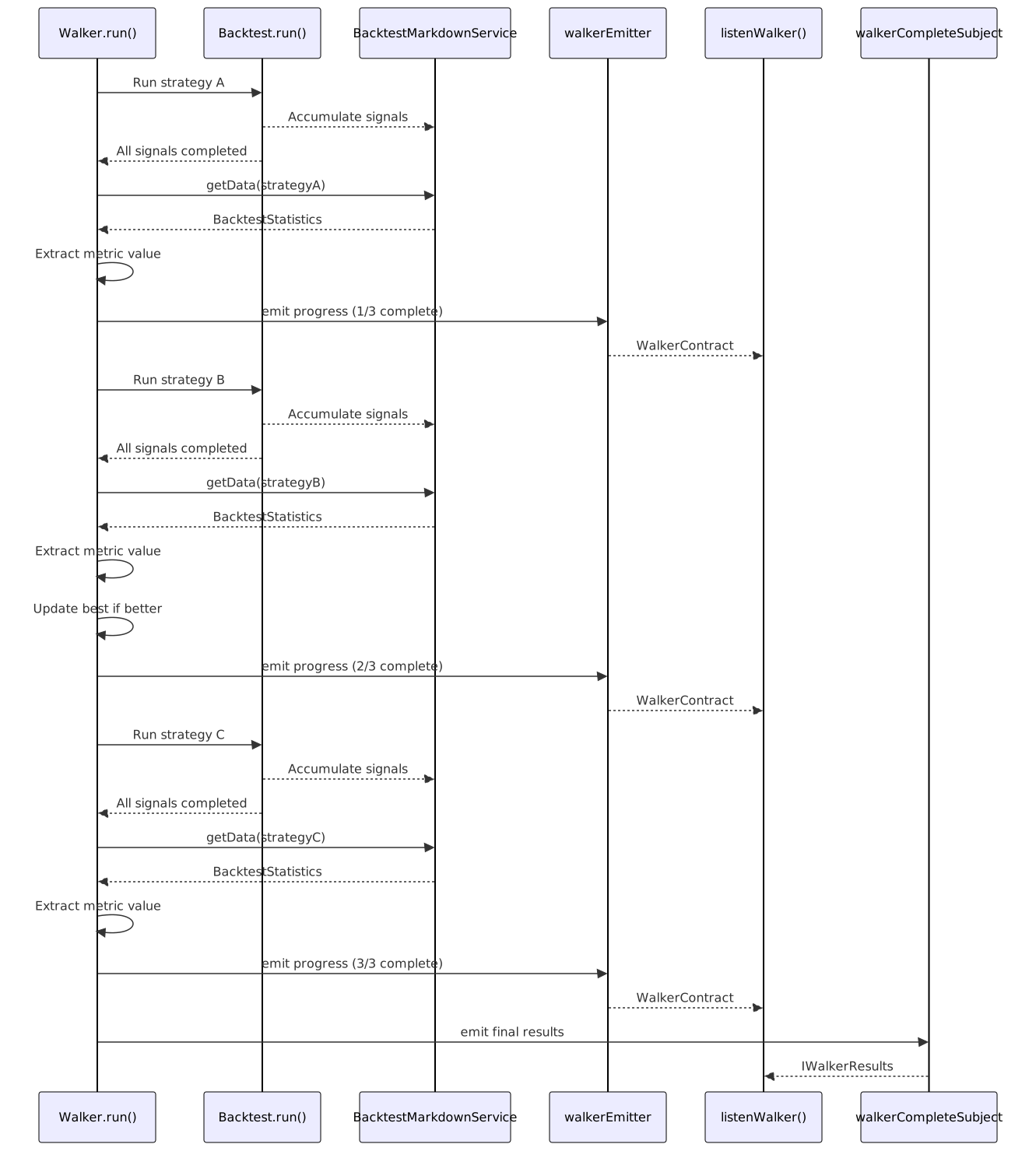
Progress Tracking and Events
Walker emits two types of events for monitoring execution progress:
Event Types
walkerEmitter (Progress Updates):
Emitted after each strategy completes its backtest. Provides incremental progress.
interface WalkerContract {
/** Current symbol being tested */
symbol: string;
/** Walker name */
walkerName: string;
/** Current strategy that just completed */
strategyName: string;
/** Metric value for current strategy */
metricValue: number;
/** Number of strategies tested so far */
strategiesTested: number;
/** Total strategies to test */
totalStrategies: number;
/** Current best strategy name */
bestStrategy: string;
/** Current best metric value */
bestMetric: number;
}
walkerCompleteSubject (Final Results):
Emitted once when all strategies finish testing. Contains complete results.
interface IWalkerResults {
bestStrategy: string;
bestMetric: number;
strategies: IWalkerStrategyResult[];
}
Event Listeners
import { listenWalker, listenWalkerComplete } from "backtest-kit";
// Track progress during execution
listenWalker((event) => {
const progress = (event.strategiesTested / event.totalStrategies) * 100;
console.log(`Progress: ${progress.toFixed(1)}%`);
console.log(`Tested: ${event.strategyName} - Metric: ${event.metricValue}`);
console.log(`Best so far: ${event.bestStrategy} - ${event.bestMetric}`);
});
// Get final results when complete
listenWalkerComplete((results) => {
console.log(`Comparison complete!`);
console.log(`Winner: ${results.bestStrategy}`);
console.log(`Best metric: ${results.bestMetric}`);
// Access ranked list
results.strategies.forEach((strategy, rank) => {
console.log(`${rank + 1}. ${strategy.strategyName}: ${strategy.metric}`);
});
});
Progress Tracking Flow
Validation and Data Clearing
Before walker execution begins, extensive validation and data clearing occurs to ensure clean results.
Validation Steps
- Walker Schema Validation - Confirms
walkerNameis registered - Exchange Validation - Confirms
exchangeNameexists and is valid - Frame Validation - Confirms
frameNameexists and has valid timeframe - Strategy Validation - Each strategy in
walkerSchema.strategiesis validated - Risk Validation - If any strategy has
riskName, that risk profile is validated
All validation occurs at src/classes/Walker.ts:50-59 and src/lib/services/global/WalkerGlobalService.ts:64-84
Data Clearing
Before walker starts, all accumulated data is cleared for each strategy:
for (const strategyName of walkerSchema.strategies) {
// Clear backtest results
backtest.backtestMarkdownService.clear(strategyName);
// Clear scheduled signal tracking
backtest.scheduleMarkdownService.clear(strategyName);
// Clear strategy internal state
backtest.strategyGlobalService.clear(strategyName);
// Clear risk profile active positions
const { riskName } = backtest.strategySchemaService.get(strategyName);
riskName && backtest.riskGlobalService.clear(riskName);
}
This ensures each strategy starts with clean state and no leftover data from previous runs.
Markdown Report Generation
Walker generates comprehensive comparison reports in markdown format.
Report Structure
The generated report includes:
- Header - Walker name, symbol, metric used
- Summary - Best strategy and its metric value
- Comparison Table - All strategies ranked by metric
- Strategy Details - Full statistics for each strategy
Example Report
# Walker Comparison Report: my-walker
**Symbol:** BTCUSDT
**Metric:** sharpeRatio
**Best Strategy:** strategy-b (1.85)
## Strategy Comparison
| Rank | Strategy | Metric | Total PNL | Win Rate | Avg PNL | Std Dev | Trades |
|------|----------|--------|-----------|----------|---------|---------|--------|
| 1 | strategy-b | 1.85 | +15.5% | 72.3% | +0.45% | 0.24% | 45 |
| 2 | strategy-a | 1.23 | +12.1% | 68.5% | +0.35% | 0.28% | 38 |
| 3 | strategy-c | 0.98 | +8.3% | 65.2% | +0.28% | 0.29% | 25 |
## Detailed Statistics
### strategy-b
- **Total Signals:** 45
- **Win Rate:** 72.3% (32W / 13L)
- **Average PNL:** +0.45%
- **Total PNL:** +15.5%
- **Sharpe Ratio:** 1.85
- **Certainty Ratio:** 2.15
...
Generating Reports
// Get raw data
const results = await Walker.getData("BTCUSDT", "my-walker");
// Generate markdown string
const markdown = await Walker.getReport("BTCUSDT", "my-walker");
// Save to disk (default: ./logs/walker/my-walker.md)
await Walker.dump("BTCUSDT", "my-walker");
// Save to custom path
await Walker.dump("BTCUSDT", "my-walker", "./custom/reports");
Background Execution
Walker supports background execution mode for non-blocking operation.
Background Mode
const stop = Walker.background("BTCUSDT", {
walkerName: "my-walker"
});
// Listen to progress without blocking
listenWalker((event) => {
console.log(`Testing ${event.strategyName}...`);
});
// Listen to completion
listenDoneWalker((event) => {
console.log("Walker completed!");
Walker.dump(event.symbol, event.strategyName);
});
// Later: stop execution early if needed
stop();
Background Execution Details:
Walker.background()consumes the async generator internally- Returns a cancellation function that stops execution
- Emits
doneWalkerSubjectevent when complete - Errors are caught and emitted to
errorEmitter
The cancellation function calls strategyGlobalService.stop() for each strategy to gracefully terminate any ongoing backtests.
Metric Selection Best Practices
Choosing the Right Metric
| Use Case | Recommended Metric | Rationale |
|---|---|---|
| Risk-adjusted performance | sharpeRatio or annualizedSharpeRatio |
Balances returns with volatility |
| Maximum profitability | totalPnl |
Ignores risk, focuses on absolute returns |
| Consistency | winRate |
Prioritizes trade success frequency |
| Average trade quality | avgPnl |
Good for comparing per-trade efficiency |
| Win/loss ratio | certaintyRatio |
Shows if wins outweigh losses in magnitude |
Multi-Metric Analysis
While walker compares strategies using a single metric, you can perform multi-metric analysis manually:
const results = await Walker.getData("BTCUSDT", "my-walker");
// Rank by different metrics
const bySharpe = [...results.strategies].sort((a, b) =>
(b.stats.sharpeRatio || 0) - (a.stats.sharpeRatio || 0)
);
const byWinRate = [...results.strategies].sort((a, b) =>
(b.stats.winRate || 0) - (a.stats.winRate || 0)
);
const byTotalPnl = [...results.strategies].sort((a, b) =>
(b.stats.totalPnl || 0) - (a.stats.totalPnl || 0)
);
// Find consensus winner
const rankings = new Map();
[bySharpe, byWinRate, byTotalPnl].forEach((ranking, metricIndex) => {
ranking.forEach((strategy, rank) => {
const current = rankings.get(strategy.strategyName) || 0;
rankings.set(strategy.strategyName, current + rank);
});
});
const consensusWinner = Array.from(rankings.entries())
.sort((a, b) => a[1] - b[1])[0][0];
Comparison with Manual Testing
Walker vs Manual Backtest Loop
Manual approach:
const strategies = ["strategy-a", "strategy-b", "strategy-c"];
const results = [];
for (const strategyName of strategies) {
for await (const _ of Backtest.run("BTCUSDT", {
strategyName,
exchangeName: "binance",
frameName: "1d-backtest"
})) {}
const stats = await Backtest.getData(strategyName);
results.push({ strategyName, stats });
}
// Manually compare results
const best = results.reduce((best, current) =>
current.stats.sharpeRatio > best.stats.sharpeRatio ? current : best
);
Walker approach:
addWalker({
walkerName: "my-walker",
exchangeName: "binance",
frameName: "1d-backtest",
strategies: ["strategy-a", "strategy-b", "strategy-c"],
metric: "sharpeRatio"
});
for await (const progress of Walker.run("BTCUSDT", {
walkerName: "my-walker"
})) {
console.log(`Best: ${progress.bestStrategy}`);
}
const results = await Walker.getData("BTCUSDT", "my-walker");
Walker advantages:
- Automatic metric extraction - No manual calculation needed
- Progress tracking - Built-in events for monitoring
- Report generation - Automatic markdown reports
- Data isolation - Automatic clearing between runs
- Validation - Upfront validation of all dependencies