Global Services
Global Services form Layer 1 of the service architecture, serving as public API entry points that orchestrate validation and delegate operations to lower-level services. These services provide a consistent interface for component registration, validation, and execution across the framework.
For information about the overall service layer organization, see Service Architecture Overview. For details on the services that Global Services delegate to, see Connection Services, Schema Services, Validation Services, and Logic Services.
Service Categories
The framework provides two categories of Global Services, each serving distinct purposes in the architecture.
Component Global Services
Component Global Services manage the lifecycle and access patterns for registered components (strategies, exchanges, frames, risk profiles, sizing configurations, walkers). Each component type has a corresponding Global Service:
| Global Service Class | Component Type | Primary Responsibilities |
|---|---|---|
StrategyGlobalService |
Trading strategies | Validation orchestration, delegation to StrategyConnectionService |
ExchangeGlobalService |
Market data sources | Validation orchestration, delegation to ExchangeConnectionService |
FrameGlobalService |
Backtest timeframes | Validation orchestration, delegation to FrameConnectionService |
RiskGlobalService |
Risk profiles | Validation orchestration, position tracking delegation |
SizingGlobalService |
Position sizing | Validation orchestration, sizing calculation delegation |
WalkerGlobalService |
Strategy comparisons | Validation orchestration, multi-strategy execution |
Execution Mode Global Services
Execution Mode Global Services provide entry points for running backtests and live trading:
| Global Service Class | Execution Mode | Primary Responsibilities |
|---|---|---|
BacktestGlobalService |
Historical simulation | Delegates to BacktestLogicPublicService |
LiveGlobalService |
Real-time trading | Delegates to LiveLogicPublicService |
WalkerGlobalService |
Strategy comparison | Also serves as execution mode service |
Global Service Architecture

Purpose: This diagram illustrates how Global Services act as an intermediary layer between public APIs and lower-level services. Component Global Services orchestrate validation and delegate to Connection Services, while Execution Global Services delegate to Logic Services.
Component Global Service Pattern
Component Global Services follow a consistent implementation pattern with three key responsibilities: dependency injection, validation orchestration, and operation delegation.
Standard Structure

Purpose: This diagram shows the standard implementation pattern for Component Global Services using RiskGlobalService as an example. All public methods follow the log-validate-delegate sequence.
Dependency Injection Pattern
Component Global Services inject three types of dependencies:
// Pattern from RiskGlobalService
private readonly loggerService = inject<LoggerService>(TYPES.loggerService);
private readonly riskConnectionService = inject<RiskConnectionService>(
TYPES.riskConnectionService
);
private readonly riskValidationService = inject<RiskValidationService>(
TYPES.riskValidationService
);
| Dependency Type | Purpose | Usage Pattern |
|---|---|---|
LoggerService |
Operation logging | Every public method logs entry with context |
*ConnectionService |
Client instance management | Delegate actual operations after validation |
*ValidationService |
Schema validation | Called by memoized validate() method |
Validation Orchestration
The validation pattern uses memoization to avoid redundant schema checks:
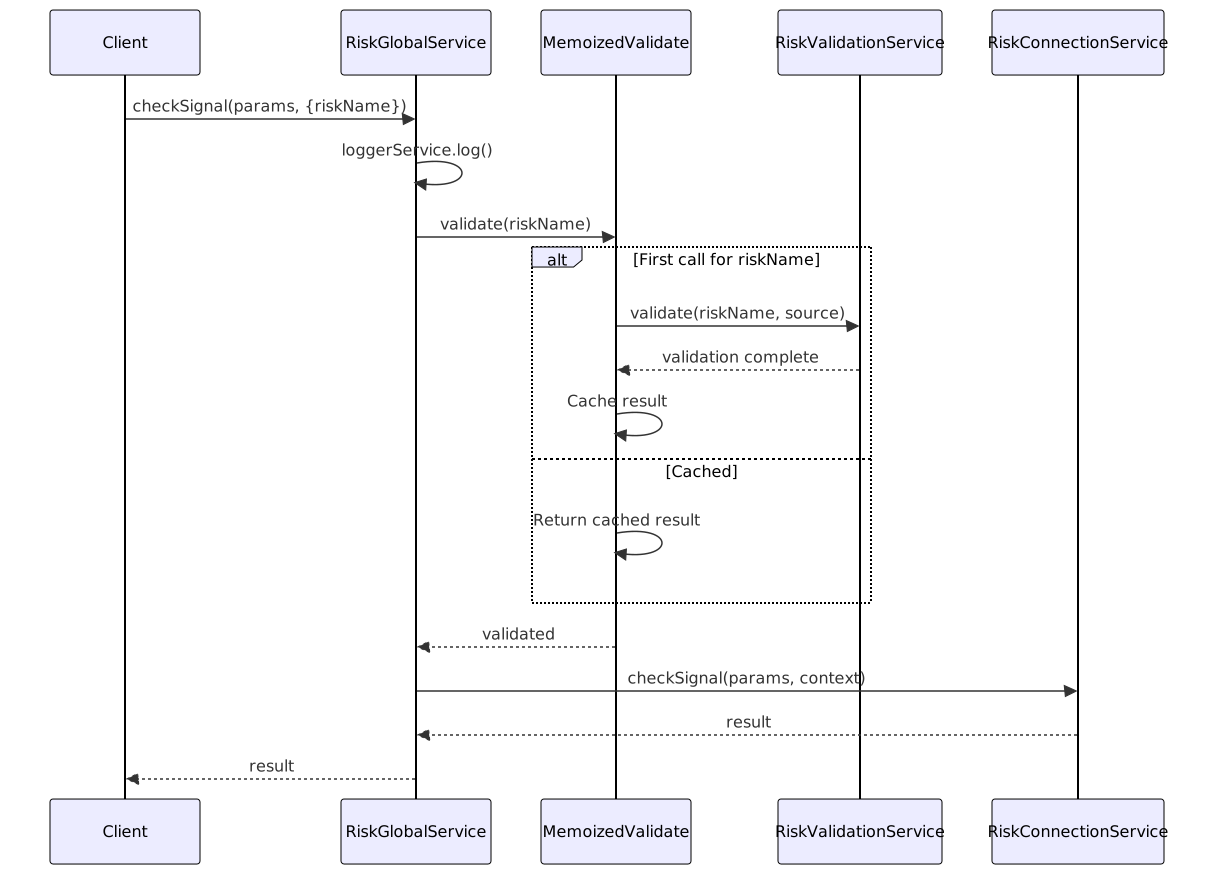
Purpose: This sequence diagram demonstrates the validation orchestration pattern. The first call to validate() for a given component name performs validation and caches the result. Subsequent calls return immediately from cache.
Implementation Example: RiskGlobalService
The RiskGlobalService exemplifies the Component Global Service pattern:
src/lib/services/global/RiskGlobalService.ts:15-114
Key methods:
| Method | Parameters | Behavior |
|---|---|---|
validate() |
riskName: RiskName |
Memoized validation call to RiskValidationService.validate() |
checkSignal() |
params: IRiskCheckArgs, context: {riskName} |
Log → Validate → Delegate to RiskConnectionService.checkSignal() |
addSignal() |
symbol: string, context: {strategyName, riskName} |
Log → Validate → Delegate to RiskConnectionService.addSignal() |
removeSignal() |
symbol: string, context: {strategyName, riskName} |
Log → Validate → Delegate to RiskConnectionService.removeSignal() |
clear() |
riskName?: RiskName |
Optional validation → Delegate to RiskConnectionService.clear() |
Validation flow:
- Public method receives component name (e.g.,
riskName) - Calls
this.validate(riskName)before operation - Memoized
validate()checks if validation already performed - First call: delegates to
riskValidationService.validate(riskName, source) - Subsequent calls: returns immediately (no-op)
- After validation: delegates operation to Connection Service
Integration with Public API
Global Services are used internally by the framework but can also be accessed directly through the exported lib object for advanced use cases.
Direct Access Pattern

Purpose: This diagram shows how Global Services fit into the public API. The add* and list* functions bypass Global Services and access Validation/Schema services directly, while test code and advanced users can access Global Services through the lib export.
Test Usage Example
Tests demonstrate direct Global Service usage:
// Direct access via lib export
const { riskGlobalService } = lib;
// Add positions
await riskGlobalService.addSignal("BTCUSDT", {
strategyName: "test-strategy-1",
riskName: "test-max-positions"
});
// Check risk limits
const result = await riskGlobalService.checkSignal(
{
symbol: "SOLUSDT",
strategyName: "test-strategy-4",
exchangeName: "binance",
currentPrice: 100,
timestamp: Date.now(),
},
{ riskName: "test-max-positions" }
);
This pattern is useful for:
- Unit testing individual services
- Building custom orchestration logic
- Debugging component behavior
- Implementing advanced workflows
Execution Mode Global Services
Execution Mode Global Services differ from Component Global Services by delegating to Logic Services rather than Connection Services.
BacktestGlobalService and LiveGlobalService
These services provide the entry points for Backtest.run() and Live.run() operations:

Purpose: This diagram illustrates the delegation chain from Execution Mode Global Services through Logic Services. Unlike Component Global Services that delegate to Connection Services, these delegate to Logic Services which manage context propagation and execution orchestration.
WalkerGlobalService Dual Role
WalkerGlobalService serves both as a Component Global Service (for walker registration) and an Execution Mode Global Service (for multi-strategy comparison):
| Role | Methods | Delegation Target |
|---|---|---|
| Component Service | validate() |
WalkerValidationService |
| Execution Service | run() |
WalkerLogicPublicService |
Service Registration and Discovery
Global Services are registered in the dependency injection container and made available through the backtest export.
Registration Pattern
{
provide(TYPES.exchangeGlobalService, () => new ExchangeGlobalService());
provide(TYPES.strategyGlobalService, () => new StrategyGlobalService());
provide(TYPES.frameGlobalService, () => new FrameGlobalService());
provide(TYPES.liveGlobalService, () => new LiveGlobalService());
provide(TYPES.backtestGlobalService, () => new BacktestGlobalService());
provide(TYPES.walkerGlobalService, () => new WalkerGlobalService());
provide(TYPES.sizingGlobalService, () => new SizingGlobalService());
provide(TYPES.riskGlobalService, () => new RiskGlobalService());
}
Export Pattern
const globalServices = {
exchangeGlobalService: inject<ExchangeGlobalService>(
TYPES.exchangeGlobalService
),
strategyGlobalService: inject<StrategyGlobalService>(
TYPES.strategyGlobalService
),
frameGlobalService: inject<FrameGlobalService>(
TYPES.frameGlobalService
),
liveGlobalService: inject<LiveGlobalService>(
TYPES.liveGlobalService
),
backtestGlobalService: inject<BacktestGlobalService>(
TYPES.backtestGlobalService
),
walkerGlobalService: inject<WalkerGlobalService>(
TYPES.walkerGlobalService
),
sizingGlobalService: inject<SizingGlobalService>(
TYPES.sizingGlobalService
),
riskGlobalService: inject<RiskGlobalService>(
TYPES.riskGlobalService
),
};
All services are included in the backtest export object src/lib/index.ts:152-162, making them accessible as backtest.riskGlobalService, backtest.strategyGlobalService, etc.
Key Characteristics
Global Services exhibit these consistent patterns across the framework:
Stateless Operation
Global Services maintain no state themselves. They delegate state management to:
- Schema Services (component configurations)
- Connection Services (memoized client instances)
- Client Classes (signal state, position tracking)
Memoized Validation
Validation is memoized by component name to avoid redundant schema checks:
// Pattern from RiskGlobalService
private validate = memoize(
([riskName]) => `${riskName}`, // Cache key
async (riskName: RiskName) => {
this.loggerService.log("riskGlobalService validate", {
riskName,
});
this.riskValidationService.validate(
riskName,
"riskGlobalService validate"
);
}
);
The cache key is the component name string. First invocation performs validation, subsequent calls return immediately.
Consistent Logging
Every public method logs its invocation with context:
public checkSignal = async (
params: IRiskCheckArgs,
context: { riskName: RiskName }
) => {
this.loggerService.log("riskGlobalService checkSignal", {
symbol: params.symbol,
context,
});
await this.validate(context.riskName);
return await this.riskConnectionService.checkSignal(params, context);
};
Log entries include:
- Service and method name (e.g.,
"riskGlobalService checkSignal") - Operation-specific context (symbol, component names)
- Structured data for debugging
Single Responsibility
Each Global Service manages exactly one component type or execution mode:
RiskGlobalService→ Risk profiles onlyStrategyGlobalService→ Strategies onlyBacktestGlobalService→ Backtest execution onlyWalkerGlobalService→ Both walker components AND walker execution (special case)
Delegation Flow Summary

Purpose: This diagram summarizes the complete delegation flow for both Component and Execution Global Services. Both types perform validation first, but Component services delegate to Connection Services while Execution services delegate to Logic Services.