Schema Services
Schema Services implement the registry pattern for storing configuration schemas in the backtest-kit framework. These services act as in-memory storage for strategy, exchange, and frame configurations registered at application startup via addStrategy(), addExchange(), and addFrame() functions. They provide lookup capabilities for Connection Services (see 5.1) which create runtime instances based on registered schemas.
For information about how registered schemas are instantiated into client objects, see Connection Services. For details on schema interfaces and registration functions, see Configuration Functions.
Overview
The framework provides six schema services, each managing a specific domain's configuration registry:
| Service | Purpose | Schema Interface | Registration Function | Storage Key |
|---|---|---|---|---|
StrategySchemaService |
Stores strategy configurations | IStrategySchema |
addStrategy() |
strategyName |
ExchangeSchemaService |
Stores exchange configurations | IExchangeSchema |
addExchange() |
exchangeName |
FrameSchemaService |
Stores frame configurations | IFrameSchema |
addFrame() |
frameName |
WalkerSchemaService |
Stores walker configurations | IWalkerSchema |
addWalker() |
walkerName |
SizingSchemaService |
Stores sizing configurations | ISizingSchema |
addSizing() |
sizingName |
RiskSchemaService |
Stores risk configurations | IRiskSchema |
addRisk() |
riskName |
All schema services follow identical patterns: singleton registration, ToolRegistry-based storage (from functools-kit), and name-based lookup. They are instantiated once during framework initialization and shared across all execution contexts.
Schema Service Architecture
The following diagram illustrates the relationship between registration functions, schema services, and connection services:

Diagram: Schema Service Registry Pattern
This architecture separates registration (startup time) from instantiation (runtime). Users register schemas once during application initialization using add*() functions. Connection Services query these registries on-demand using get() methods to create memoized client instances. All schema services use ToolRegistry from functools-kit for type-safe storage and retrieval.
StrategySchemaService
StrategySchemaService manages the registry of strategy configurations. Each strategy is identified by a unique strategyName and contains signal generation logic and lifecycle callbacks.
Storage Structure
The service uses a Map<StrategyName, IStrategySchema> to store registered strategies. The map key is the strategy name, and the value is the complete schema object.
IStrategySchema Interface
The strategy schema interface defines:
interface IStrategySchema {
strategyName: StrategyName; // Unique identifier
interval: SignalInterval; // Throttling interval (1m, 5m, 1h, etc.)
getSignal: (symbol: string) => Promise<ISignalDto | null>; // Signal generator
callbacks?: Partial<IStrategyCallbacks>; // Optional lifecycle hooks
}
Field Descriptions:
| Field | Type | Purpose |
|---|---|---|
strategyName |
string |
Unique identifier used for registry lookup and routing |
interval |
SignalInterval |
Minimum time between getSignal() calls for throttling |
getSignal |
async function |
Signal generation logic, returns null or validated ISignalDto |
callbacks |
object (optional) |
Lifecycle hooks: onTick, onOpen, onActive, onIdle, onClose |
Registration via addStrategy()
The addStrategy() function registers a strategy schema into StrategySchemaService:
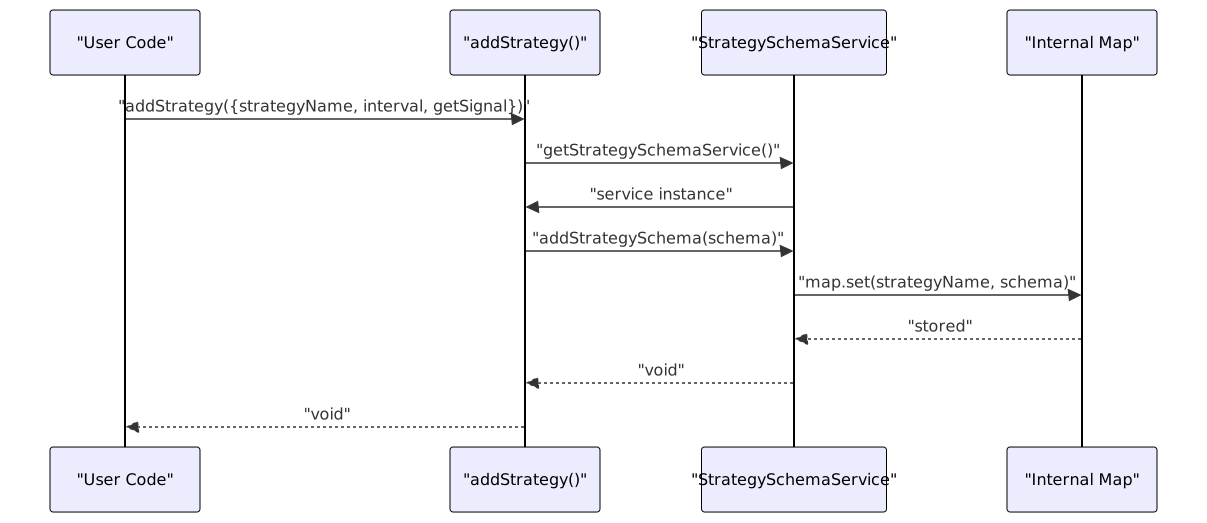
Diagram: Strategy Schema Registration Flow
The registration process validates that strategyName is unique and stores the schema for later retrieval by StrategyConnectionService.
ExchangeSchemaService
ExchangeSchemaService manages the registry of exchange data sources. Each exchange provides candle data fetching, price formatting, and quantity formatting logic.
Storage Structure
The service uses a Map<ExchangeName, IExchangeSchema> to store registered exchanges. The map key is the exchange name, and the value is the complete schema object.
IExchangeSchema Interface
The exchange schema interface defines:
interface IExchangeSchema {
exchangeName: ExchangeName; // Unique identifier
getCandles: (symbol: string, interval: CandleInterval, since: Date, limit: number)
=> Promise<ICandleData[]>;
formatQuantity: (symbol: string, quantity: number) => Promise<string>;
formatPrice: (symbol: string, price: number) => Promise<string>;
callbacks?: Partial<IExchangeCallbacks>; // Optional onCandleData hook
}
Field Descriptions:
| Field | Type | Purpose |
|---|---|---|
exchangeName |
string |
Unique identifier used for registry lookup and routing |
getCandles |
async function |
Fetches historical OHLCV candle data from exchange/database |
formatQuantity |
async function |
Formats quantity values to exchange precision rules |
formatPrice |
async function |
Formats price values to exchange precision rules |
callbacks |
object (optional) |
Lifecycle hooks: onCandleData for logging/monitoring |
Registration via addExchange()
The addExchange() function registers an exchange schema into ExchangeSchemaService:
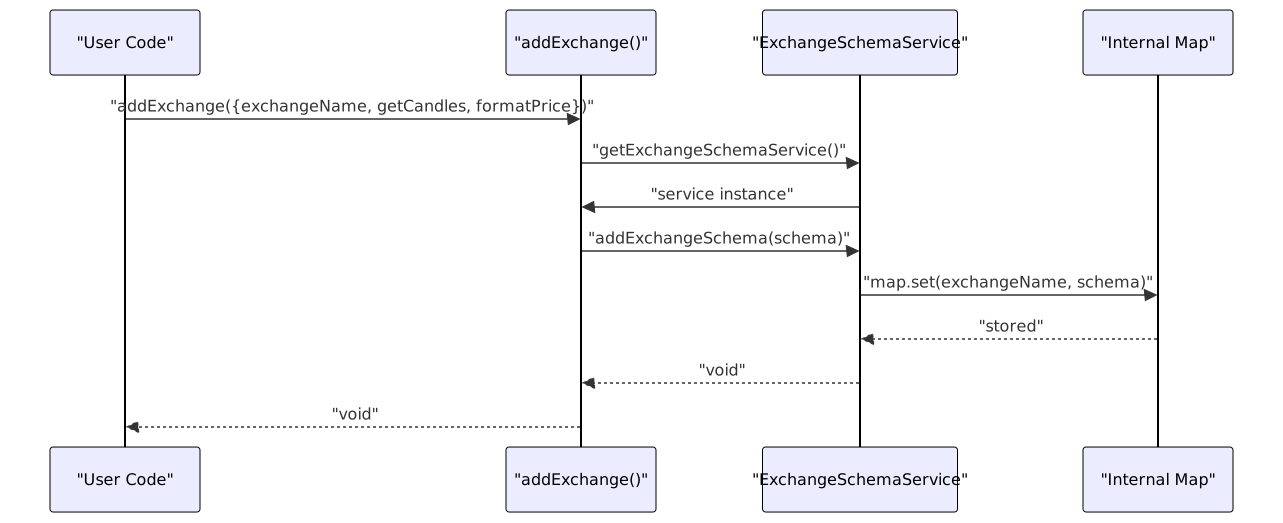
Diagram: Exchange Schema Registration Flow
The registration process validates that exchangeName is unique and stores the schema for later retrieval by ExchangeConnectionService.
FrameSchemaService
FrameSchemaService manages the registry of timeframe configurations for backtesting. Each frame defines the start date, end date, and interval for timestamp generation.
Storage Structure
The service uses a Map<FrameName, IFrameSchema> to store registered frames. The map key is the frame name, and the value is the complete schema object.
IFrameSchema Interface
The frame schema interface defines:
interface IFrameSchema {
frameName: FrameName; // Unique identifier
interval: FrameInterval; // Timestamp interval (1m, 1h, 1d, etc.)
startDate: Date; // Backtest period start (inclusive)
endDate: Date; // Backtest period end (inclusive)
callbacks?: Partial<IFrameCallbacks>; // Optional onTimeframe hook
}
Field Descriptions:
| Field | Type | Purpose |
|---|---|---|
frameName |
string |
Unique identifier used for registry lookup and routing |
interval |
FrameInterval |
Time spacing between generated timestamps |
startDate |
Date |
Beginning of backtest period (inclusive boundary) |
endDate |
Date |
End of backtest period (inclusive boundary) |
callbacks |
object (optional) |
Lifecycle hooks: onTimeframe called after generation |
Registration via addFrame()
The addFrame() function registers a frame schema into FrameSchemaService:
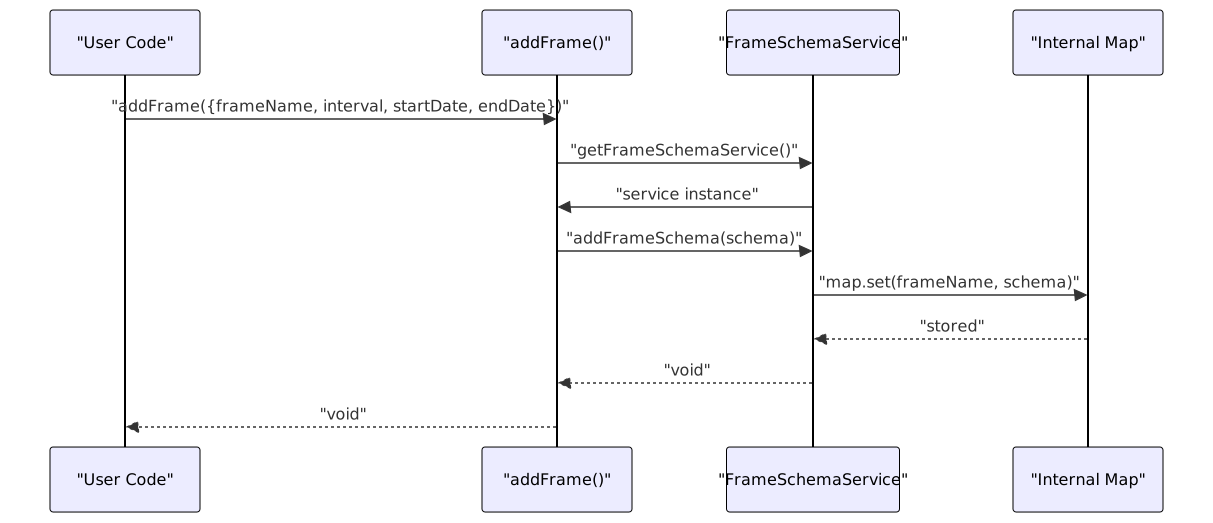
Diagram: Frame Schema Registration Flow
The registration process validates that frameName is unique and stores the schema for later retrieval by FrameConnectionService.
WalkerSchemaService
WalkerSchemaService manages the registry of walker configurations for strategy comparison. Each walker defines a list of strategies to compare, the exchange and frame to use, and the metric for ranking.
Storage Structure
The service uses ToolRegistry<IWalkerSchema> from functools-kit to store registered walkers. The registry is keyed by walkerName.
IWalkerSchema Interface
The walker schema interface defines:
interface IWalkerSchema {
walkerName: WalkerName; // Unique identifier
exchangeName: ExchangeName; // Exchange to use for all strategies
frameName: FrameName; // Frame to use for all strategies
strategies: StrategyName[]; // Array of strategy names to compare
metric?: WalkerMetric; // Ranking metric (default: "sharpeRatio")
callbacks?: Partial<IWalkerCallbacks>; // Optional lifecycle hooks
}
Field Descriptions:
| Field | Type | Purpose |
|---|---|---|
walkerName |
string |
Unique identifier used for registry lookup and routing |
exchangeName |
string |
Exchange name to use for all strategy backtests |
frameName |
string |
Frame name to use for all strategy backtests |
strategies |
string[] |
List of strategy names to execute and compare |
metric |
string (optional) |
Metric for ranking strategies (sharpeRatio, totalPnl, winRate, etc.) |
callbacks |
object (optional) |
Lifecycle hooks: onStrategyComplete, onComplete |
Registration via addWalker()
The addWalker() function registers a walker schema into WalkerSchemaService:
// src/function/add.ts
export function addWalker(walkerSchema: IWalkerSchema) {
backtest.loggerService.info(ADD_WALKER_METHOD_NAME, { walkerSchema });
backtest.walkerValidationService.addWalker(
walkerSchema.walkerName,
walkerSchema
);
backtest.walkerSchemaService.register(
walkerSchema.walkerName,
walkerSchema
);
}
The registration process validates that walkerName is unique and stores the schema for later retrieval by WalkerLogicPrivateService.
SizingSchemaService
SizingSchemaService manages the registry of position sizing configurations. Each sizing schema defines the method and parameters for calculating position sizes.
Storage Structure
The service uses ToolRegistry<ISizingSchema> from functools-kit to store registered sizing configurations. The registry is keyed by sizingName.
ISizingSchema Interface
The sizing schema is a discriminated union based on the method field:
type ISizingSchema =
| IFixedPercentageSizing
| IKellyCriterionSizing
| IAtrBasedSizing;
interface IFixedPercentageSizing {
method: "fixed-percentage";
sizingName: SizingName;
riskPercentage: number; // % of account to risk per trade
maxPositionPercentage?: number;
minPositionSize?: number;
maxPositionSize?: number;
}
interface IKellyCriterionSizing {
method: "kelly-criterion";
sizingName: SizingName;
kellyMultiplier?: number; // Default: 0.25 (quarter Kelly)
maxPositionPercentage?: number;
minPositionSize?: number;
maxPositionSize?: number;
}
interface IAtrBasedSizing {
method: "atr-based";
sizingName: SizingName;
riskPercentage: number;
atrMultiplier?: number; // Default: 2
maxPositionPercentage?: number;
minPositionSize?: number;
maxPositionSize?: number;
}
Registration via addSizing()
The addSizing() function registers a sizing schema into SizingSchemaService:
// src/function/add.ts
export function addSizing(sizingSchema: ISizingSchema) {
backtest.loggerService.info(ADD_SIZING_METHOD_NAME, { sizingSchema });
backtest.sizingValidationService.addSizing(
sizingSchema.sizingName,
sizingSchema
);
backtest.sizingSchemaService.register(
sizingSchema.sizingName,
sizingSchema
);
}
RiskSchemaService
RiskSchemaService manages the registry of risk management configurations. Each risk schema defines position limits and custom validation functions.
Storage Structure
The service uses ToolRegistry<IRiskSchema> from functools-kit to store registered risk configurations. The registry is keyed by riskName.
IRiskSchema Interface
The risk schema interface defines:
interface IRiskSchema {
riskName: RiskName; // Unique identifier
maxConcurrentPositions?: number; // Optional position limit
validations?: IRiskValidation[]; // Optional custom checks
callbacks?: Partial<IRiskCallbacks>; // Optional lifecycle hooks
}
interface IRiskValidation {
validate: (payload: IRiskValidationPayload) => Promise<void>;
docDescription?: string;
}
Field Descriptions:
| Field | Type | Purpose |
|---|---|---|
riskName |
string |
Unique identifier used for registry lookup |
maxConcurrentPositions |
number (optional) |
Maximum open positions across all strategies sharing this risk profile |
validations |
array (optional) |
Custom validation functions with access to portfolio state |
callbacks |
object (optional) |
Lifecycle hooks: onRejected, onAllowed |
Registration via addRisk()
The addRisk() function registers a risk schema into RiskSchemaService:
// src/function/add.ts
export function addRisk(riskSchema: IRiskSchema) {
backtest.loggerService.info(ADD_RISK_METHOD_NAME, { riskSchema });
backtest.riskValidationService.addRisk(
riskSchema.riskName,
riskSchema
);
backtest.riskSchemaService.register(
riskSchema.riskName,
riskSchema
);
}
Risk schemas enable portfolio-level risk management where multiple strategies can share the same risk limits. The ClientRisk class tracks active positions across all strategies using the same riskName.
Schema Lookup and Retrieval
Schema Services provide lookup methods that Connection Services call to retrieve registered configurations. The lookup pattern is identical across all three services.
Lookup Pattern

Diagram: Schema Lookup Flow
The MethodContextService (see 2.3) provides the schema name as a routing key. Connection Services query Schema Services by name, retrieve the schema, and pass it to client constructors for instantiation.
Common Schema Service Methods
All schema services use ToolRegistry from functools-kit and implement these methods:
| Method | Parameters | Return Type | Purpose |
|---|---|---|---|
register() |
name: string, schema: ISchema |
void |
Registers a new schema in the ToolRegistry |
get() |
name: string |
ISchema |
Retrieves a registered schema by name |
has() |
name: string |
boolean |
Checks if a schema name is registered |
override() |
name: string, partial: Partial<ISchema> |
void |
Updates an existing schema with partial changes |
validateShallow() |
schema: ISchema |
void |
Validates required fields before registration |
The ToolRegistry pattern from functools-kit provides type-safe storage with built-in validation. It ensures that:
- Schema names are unique (duplicate registrations throw errors)
- Retrieved schemas exist (missing schemas throw errors)
- Type safety is maintained throughout the registration and retrieval process
Error Handling: If get() is called with an unregistered name, ToolRegistry throws an error indicating the missing configuration. This fail-fast behavior ensures configuration errors are detected early in the application lifecycle.
Integration with Dependency Injection
Schema Services are registered in the DI container as singletons, ensuring a single registry instance is shared across the entire application.
Service Registration
The provide.ts file registers all six schema services in the DI container:
// src/lib/core/provide.ts (lines 62-67)
{
provide(TYPES.exchangeSchemaService, () => new ExchangeSchemaService());
provide(TYPES.strategySchemaService, () => new StrategySchemaService());
provide(TYPES.frameSchemaService, () => new FrameSchemaService());
provide(TYPES.walkerSchemaService, () => new WalkerSchemaService());
provide(TYPES.sizingSchemaService, () => new SizingSchemaService());
provide(TYPES.riskSchemaService, () => new RiskSchemaService());
}
Each factory function creates a new service instance. The DI container (di-kit) ensures these factories are called only once, implementing the singleton pattern.
Symbol Definitions
The types.ts file defines unique symbols for each schema service:
// src/lib/core/types.ts (lines 18-25)
const schemaServices = {
exchangeSchemaService: Symbol('exchangeSchemaService'),
strategySchemaService: Symbol('strategySchemaService'),
frameSchemaService: Symbol('frameSchemaService'),
walkerSchemaService: Symbol('walkerSchemaService'),
sizingSchemaService: Symbol('sizingSchemaService'),
riskSchemaService: Symbol('riskSchemaService'),
}
These symbols serve as keys in the DI container, preventing naming collisions and enabling type-safe injection.
Service Injection
The index.ts file injects all schema services into the backtest aggregator object:
// src/lib/index.ts (lines 80-90)
const schemaServices = {
exchangeSchemaService: inject<ExchangeSchemaService>(TYPES.exchangeSchemaService),
strategySchemaService: inject<StrategySchemaService>(TYPES.strategySchemaService),
frameSchemaService: inject<FrameSchemaService>(TYPES.frameSchemaService),
walkerSchemaService: inject<WalkerSchemaService>(TYPES.walkerSchemaService),
sizingSchemaService: inject<SizingSchemaService>(TYPES.sizingSchemaService),
riskSchemaService: inject<RiskSchemaService>(TYPES.riskSchemaService),
};
export const backtest = {
...schemaServices,
// ... other services
};
This makes all schema services accessible via backtest.*SchemaService for advanced use cases requiring direct registry access.
Complete Registration and Instantiation Flow
The following diagram shows the complete lifecycle from user registration to client instantiation:
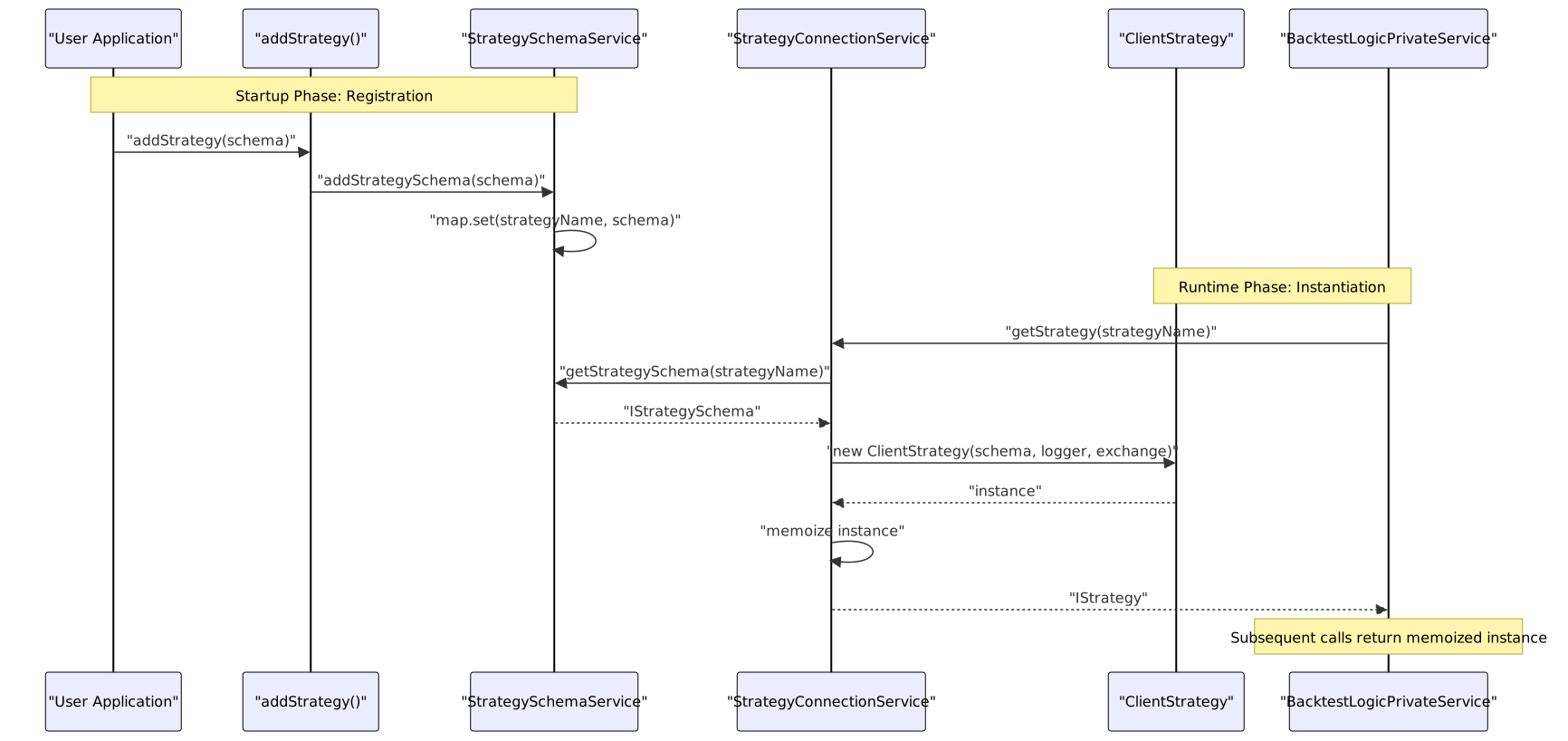
Diagram: Complete Schema Registration and Instantiation Flow
The registration phase occurs at application startup, storing schemas in the registry. The instantiation phase occurs at runtime when Logic Services require client instances. Connection Services query Schema Services, create clients, and memoize them for reuse.
Design Rationale
Registry Pattern Benefits
The registry pattern provides several architectural advantages:
- Separation of Configuration and Execution: Schemas are registered at startup, instances created on-demand at runtime
- Multiple Configurations: Multiple strategies/exchanges/frames can coexist without conflicts
- Dynamic Routing:
MethodContextServiceprovides routing keys to select the correct schema at runtime - Testability: Services can be instantiated with mock schemas for unit testing
- Hot-Swapping: New schemas can be registered without restarting (though not currently exposed)
Singleton Registry Instances
Schema Services are singletons because:
- Global State: Configuration registries must be shared across all execution contexts
- Performance: Single Map instance avoids redundant storage overhead
- Consistency: All Connection Services see the same registered schemas
- Thread Safety: JavaScript's single-threaded model ensures no race conditions
Map Data Structure
The Map<string, ISchema> data structure is chosen because:
- O(1) Lookup: Fast retrieval by name during runtime execution
- Key Type Safety: String keys match schema name types
- Iteration Support:
getAllSchemas()can iterate over values - Uniqueness Guarantee: Map keys enforce unique schema names
Usage Patterns
Basic Schema Registration
Register schemas during application initialization before calling Backtest.run() or Live.run():
// Register exchange data source
addExchange({
exchangeName: "binance",
getCandles: async (symbol, interval, since, limit) => {
// Fetch from API or database
return candleData;
},
formatPrice: async (symbol, price) => price.toFixed(2),
formatQuantity: async (symbol, quantity) => quantity.toFixed(8),
});
// Register strategy
addStrategy({
strategyName: "momentum",
interval: "5m",
getSignal: async (symbol) => {
// Signal generation logic
return signalDto;
},
});
// Register backtest frame
addFrame({
frameName: "jan-2024",
interval: "1m",
startDate: new Date("2024-01-01"),
endDate: new Date("2024-01-31"),
});
Multi-Strategy Pattern with Walker
Register multiple strategies and use a walker to compare them:
addStrategy({
strategyName: "momentum-long",
interval: "5m",
getSignal: async (symbol) => {
// Long-only momentum logic
},
});
addStrategy({
strategyName: "momentum-short",
interval: "5m",
getSignal: async (symbol) => {
// Short-only momentum logic
},
});
// Compare strategies using walker
addWalker({
walkerName: "momentum-comparison",
exchangeName: "binance",
frameName: "jan-2024",
strategies: ["momentum-long", "momentum-short"],
metric: "sharpeRatio",
});
// Walker automatically backtests both and ranks them
for await (const result of Walker.run("BTCUSDT", {
walker: "momentum-comparison",
})) {
console.log(result); // Contains rankings and performance metrics
}
Multi-Exchange Pattern
Register multiple exchanges for different data sources:
addExchange({
exchangeName: "binance",
getCandles: async (...) => fetchFromBinance(...),
// ...
});
addExchange({
exchangeName: "coinbase",
getCandles: async (...) => fetchFromCoinbase(...),
// ...
});
// Compare strategy performance across exchanges
for await (const result of Backtest.run("BTCUSDT", {
strategy: "momentum",
exchange: "binance",
frame: "jan-2024",
})) {
// Binance results
}
for await (const result of Backtest.run("BTCUSDT", {
strategy: "momentum",
exchange: "coinbase",
frame: "jan-2024",
})) {
// Coinbase results
}
Position Sizing and Risk Management
Register sizing and risk schemas for portfolio management:
// Register position sizing method
addSizing({
sizingName: "conservative",
method: "fixed-percentage",
riskPercentage: 1, // Risk 1% of account per trade
maxPositionPercentage: 10,
});
// Register risk limits shared across strategies
addRisk({
riskName: "portfolio-risk",
maxConcurrentPositions: 5, // Max 5 open positions
validations: [
{
validate: async ({ params }) => {
const portfolio = await getPortfolioState();
if (portfolio.drawdown > 20) {
throw new Error("Portfolio drawdown exceeds 20%");
}
},
docDescription: "Prevents trading during high drawdown",
},
],
});
// Strategies reference sizing and risk by name
addStrategy({
strategyName: "momentum",
interval: "5m",
sizingName: "conservative",
riskName: "portfolio-risk",
getSignal: async (symbol) => {
// Signal generation logic
},
});
Error Handling
Schema Services implement validation to prevent common configuration errors:
Duplicate Name Detection
Attempting to register a schema with an existing name throws an error:
addStrategy({
strategyName: "momentum",
// ...
});
// Error: Strategy "momentum" already registered
addStrategy({
strategyName: "momentum", // Duplicate name
// ...
});
Missing Schema Detection
Attempting to instantiate a client with an unregistered schema name throws an error:
// No strategy registered with name "nonexistent"
for await (const result of Backtest.run("BTCUSDT", {
strategy: "nonexistent", // Error thrown here
exchange: "binance",
frame: "jan-2024",
})) {
// ...
}
Schema Validation
Each schema service's validateShallow() method validates required fields during registration:
StrategySchemaService: ValidatesstrategyName,interval,getSignalare presentExchangeSchemaService: ValidatesexchangeName,getCandles,formatPrice,formatQuantityare presentFrameSchemaService: ValidatesframeName,interval,startDate,endDateare present and dates are validWalkerSchemaService: ValidateswalkerName,exchangeName,frameName,strategiesarray are presentSizingSchemaService: ValidatessizingName,method, and method-specific parameters are presentRiskSchemaService: ValidatesriskNameis present and custom validations are functions
The validateShallow() method performs type checking and ensures required fields exist before allowing registration. Deeper validation (e.g., verifying referenced strategies exist) is performed by Validation Services (see 7.4).
Relationship with Other Services
Schema Services interact with multiple layers of the architecture:
| Service Layer | Relationship | Direction |
|---|---|---|
| Connection Services | Consumers of schema registries | Connection Services query Schema Services |
| Public API Functions | Producers to schema registries | add*() functions register schemas |
| Logic Services | Indirect consumers via Connection layer | Logic Services use Connection Services, which query Schema Services |
| Global Services | Indirect consumers via Connection layer | Global Services use Connection Services, which query Schema Services |
Schema Services have no dependencies on other services—they are pure registries with no outbound calls to other components. This makes them the foundational layer of the service architecture.
For more information:
- Connection Services usage: Connection Services
- Registration API details: Configuration Functions
- Runtime orchestration: Logic Services