Component Types
Purpose and Scope
This page provides a comprehensive overview of the six component types that can be registered in backtest-kit. Each component type serves a distinct role in the trading system architecture: Strategy (signal generation logic), Exchange (market data access), Frame (backtest timeframe generation), Risk (portfolio-level risk management), Sizing (position size calculation), and Walker (multi-strategy comparison).
For detailed implementation guidance on individual component types, see their respective subsections: Strategy Schemas, Exchange Schemas, Frame Schemas, Risk Schemas, Sizing Schemas, and Walker Schemas. For information about registering components via the public API, see Component Registration Functions. For information about the service layer that manages these components, see Schema Services.
Component-Based Architecture
backtest-kit uses a schema-based registration system where users define component configurations as TypeScript objects and register them via add* functions. Each component type has:
- Schema Interface - TypeScript interface defining required and optional fields
- Registration Function - Public API function (
addStrategy,addExchange, etc.) for schema registration - Schema Service - Internal storage using
ToolRegistrypattern for schema retrieval by name - Validation Service - Runtime validation logic ensuring schema correctness and preventing duplicate registration
- Connection Service - Memoized factory for creating client instances from schemas
This architecture enables separation of concerns: schemas define "what" components do, while the framework handles "how" they integrate with execution modes (Backtest, Live, Walker).
Registration Pattern
All component registration follows the same pattern implemented in src/function/add.ts:1-342:
// 1. User calls public registration function
addStrategy(schema); // or addExchange, addFrame, addRisk, addSizing, addWalker
// 2. Framework validates schema
backtest.strategyValidationService.addStrategy(schema.strategyName, schema);
// 3. Framework stores schema in registry
backtest.strategySchemaService.register(schema.strategyName, schema);
The validation step performs:
- Duplicate name detection - Throws error if component name already registered
- Required field validation - Ensures all mandatory schema fields are present
- Type checking - Validates field types match interface definitions
- Memoization - Stores validation result to avoid redundant checks
Component Type Overview
Comparison Table
| Component Type | Schema Interface | Registration Function | Primary Responsibility | Used In Modes |
|---|---|---|---|---|
| Strategy | IStrategySchema |
addStrategy() |
Signal generation logic with getSignal() function |
Backtest, Live, Walker |
| Exchange | IExchangeSchema |
addExchange() |
Market data access via getCandles(), price/quantity formatting |
Backtest, Live, Walker |
| Frame | IFrameSchema |
addFrame() |
Timeframe generation for historical backtesting periods | Backtest, Walker |
| Risk | IRiskSchema |
addRisk() |
Portfolio-level risk validation and position tracking | Backtest, Live, Walker |
| Sizing | ISizingSchema |
addSizing() |
Position size calculation (fixed, Kelly, ATR-based methods) | Backtest, Live, Walker |
| Walker | IWalkerSchema |
addWalker() |
Multi-strategy comparison orchestration | Walker only |
Component Registration Flow Diagram

Schema Storage and Retrieval
Schema Service Pattern
Each component type has a corresponding *SchemaService class that implements the ToolRegistry pattern for name-based storage and retrieval:

Validation Services
Each component type has a *ValidationService class responsible for:
- Registration-time validation - Called by
add*functions before schema storage - Duplicate detection - Prevents registering the same component name twice
- Schema validation - Ensures required fields are present and valid
- List functionality - Returns all registered schemas for introspection
Validation Service Architecture
| Service Class | Purpose | Registered Via | Retrieved Via |
|---|---|---|---|
StrategyValidationService |
Validates IStrategySchema fields (strategyName, interval, getSignal) |
addStrategy() |
listStrategies() |
ExchangeValidationService |
Validates IExchangeSchema fields (exchangeName, getCandles, formatPrice, formatQuantity) |
addExchange() |
listExchanges() |
FrameValidationService |
Validates IFrameSchema fields (frameName, interval, startDate, endDate) |
addFrame() |
listFrames() |
RiskValidationService |
Validates IRiskSchema fields (riskName, validations array) |
addRisk() |
listRisks() |
SizingValidationService |
Validates ISizingSchema discriminated union (method-specific fields) |
addSizing() |
listSizings() |
WalkerValidationService |
Validates IWalkerSchema fields (walkerName, strategies array, metric) |
addWalker() |
listWalkers() |
Connection Services and Client Instantiation
Memoized Instance Pattern
*ConnectionService classes act as memoized factories that create and cache Client* instances. Each component name gets exactly one client instance, created lazily on first use:
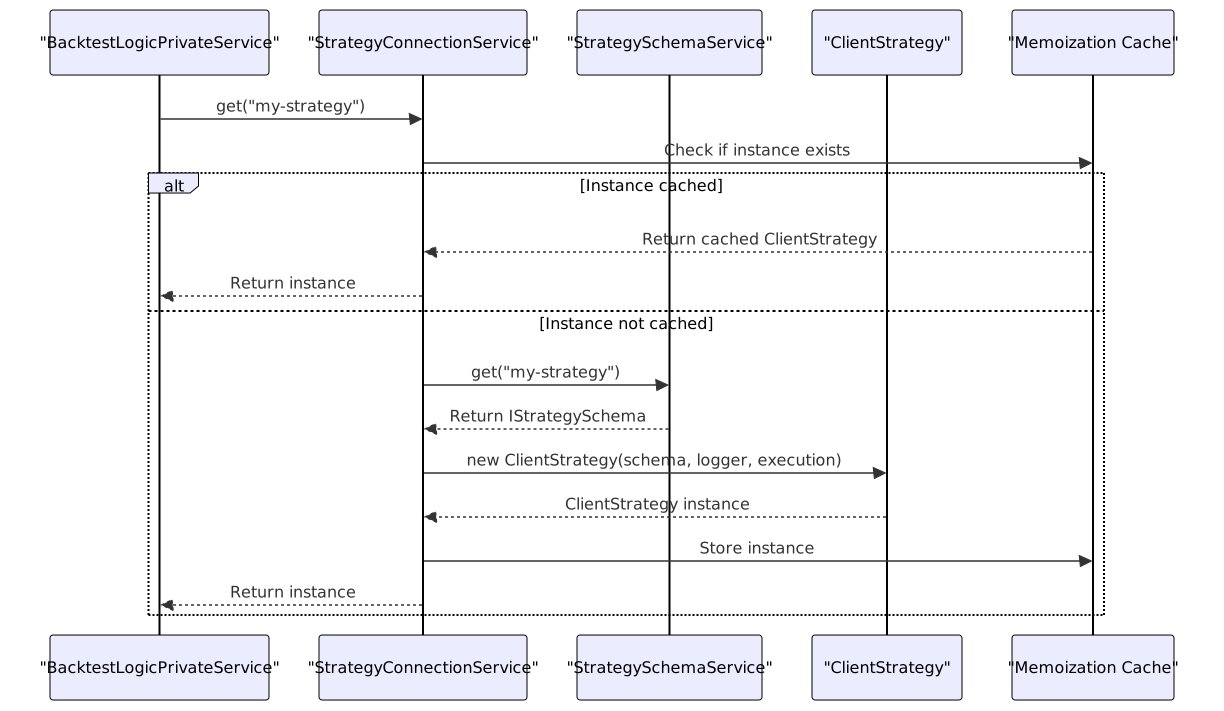
Component Lifecycle States

Dependency Injection Tokens
The framework uses Symbol-based tokens for dependency injection, defined in src/lib/core/types.ts:1-81:
Schema Service Tokens
const schemaServices = {
exchangeSchemaService: Symbol('exchangeSchemaService'),
strategySchemaService: Symbol('strategySchemaService'),
frameSchemaService: Symbol('frameSchemaService'),
walkerSchemaService: Symbol('walkerSchemaService'),
sizingSchemaService: Symbol('sizingSchemaService'),
riskSchemaService: Symbol('riskSchemaService'),
}
Validation Service Tokens
const validationServices = {
exchangeValidationService: Symbol('exchangeValidationService'),
strategyValidationService: Symbol('strategyValidationService'),
frameValidationService: Symbol('frameValidationService'),
walkerValidationService: Symbol('walkerValidationService'),
sizingValidationService: Symbol('sizingValidationService'),
riskValidationService: Symbol('riskValidationService'),
}
Connection Service Tokens
const connectionServices = {
exchangeConnectionService: Symbol('exchangeConnectionService'),
strategyConnectionService: Symbol('strategyConnectionService'),
frameConnectionService: Symbol('frameConnectionService'),
sizingConnectionService: Symbol('sizingConnectionService'),
riskConnectionService: Symbol('riskConnectionService'),
}
Component Name Types
Each component type has a corresponding string-based name type for type-safe registration and retrieval:
| Component | Name Type | Example Value |
|---|---|---|
| Strategy | StrategyName (alias of string) |
"my-strategy" |
| Exchange | ExchangeName (alias of string) |
"binance" |
| Frame | FrameName (alias of string) |
"1d-backtest" |
| Risk | RiskName (alias of string) |
"conservative" |
| Sizing | SizingName (alias of string) |
"fixed-1-percent" |
| Walker | WalkerName (alias of string) |
"llm-optimizer" |
These type aliases provide semantic clarity while maintaining string compatibility for runtime lookup.
Cross-Component Dependencies
Some component types reference other components by name, creating a dependency graph:

List Functions for Introspection
The framework provides list* functions defined in src/function/list.ts:1-218 for retrieving all registered component schemas:
| Function | Returns | Purpose |
|---|---|---|
listStrategies() |
Promise<IStrategySchema[]> |
All registered strategies |
listExchanges() |
Promise<IExchangeSchema[]> |
All registered exchanges |
listFrames() |
Promise<IFrameSchema[]> |
All registered frames |
listRisks() |
Promise<IRiskSchema[]> |
All registered risk profiles |
listSizings() |
Promise<ISizingSchema[]> |
All registered sizing configurations |
listWalkers() |
Promise<IWalkerSchema[]> |
All registered walkers |
These functions are useful for:
- Debugging - Inspecting what components are registered
- Documentation - Generating component lists dynamically
- UI Generation - Building dropdowns/selectors of available components
- Testing - Verifying registration state
Common Schema Fields
All component schemas share these common optional fields:
| Field | Type | Purpose |
|---|---|---|
note |
string | undefined |
Optional developer documentation for the component |
callbacks |
Partial<I*Callbacks> | undefined |
Optional lifecycle event handlers for debugging/logging |
The callbacks field provides hooks into component lifecycle events without requiring custom code. Each component type has its own callback interface (e.g., IStrategyCallbacks, IExchangeCallbacks) with event-specific methods.
Service Layer Summary
For each component type, the framework maintains three service classes:

This consistent three-layer pattern (Validation → Schema → Connection → Client) applies to all component types, providing predictable behavior and code organization.