Component Registration Functions
Purpose and Scope
This page documents the public API functions used to register components in backtest-kit. These functions (addStrategy, addExchange, addFrame, addRisk, addSizing, addWalker, addOptimizer) provide the primary interface for configuring trading strategies, data sources, risk management, and optimization workflows.
For detailed schema interface definitions, see Component Schemas. For information about the registration pattern and schema storage mechanism, see Component Registration. For the underlying schema service implementations, see Schema Services.
Registration Flow Architecture
All component registration functions follow a uniform three-step pattern: logging, validation, and schema storage. This ensures consistent behavior and error handling across all component types.
Common Registration Pattern

Component Registration Functions
addStrategy
Registers a trading strategy that generates signals at specified intervals. Strategies are validated for signal correctness, interval throttling, and persistence configuration.
Function Signature:
function addStrategy(strategySchema: IStrategySchema): void
Parameters:
| Parameter | Type | Description |
|---|---|---|
strategySchema.strategyName |
string |
Unique identifier for the strategy |
strategySchema.interval |
"1m" | "3m" | "5m" | "15m" | "30m" | "1h" |
Signal generation interval (throttling) |
strategySchema.getSignal |
(symbol: string) => Promise<ISignalDto> |
Async function that generates trading signals |
strategySchema.riskName |
string (optional) |
Single risk profile to apply |
strategySchema.riskList |
string[] (optional) |
Multiple risk profiles (all must pass) |
strategySchema.callbacks |
IStrategyCallbacks (optional) |
Lifecycle event handlers |
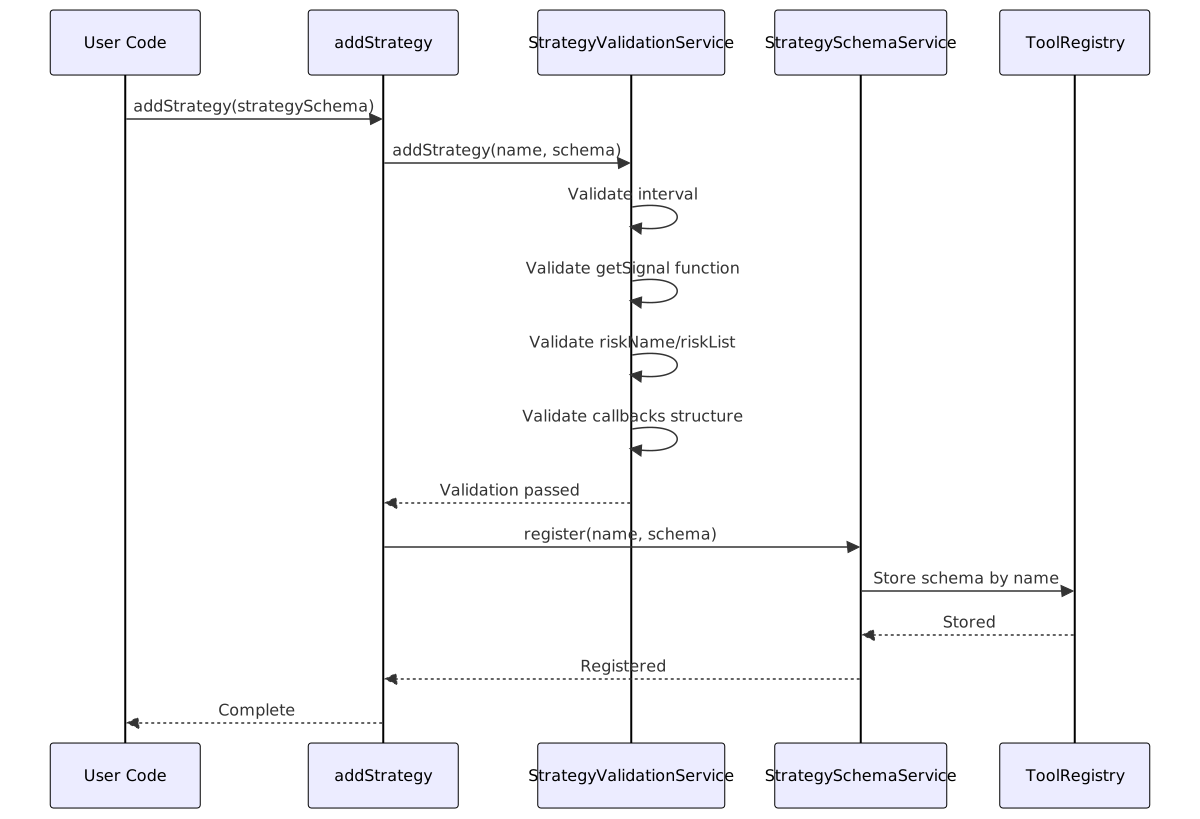
Registration Flow:
Usage Example:
addStrategy({
strategyName: "test_strategy",
interval: "5m",
riskName: "demo_risk",
getSignal: async (symbol) => ({
position: "long",
priceOpen: 50000,
priceTakeProfit: 51000,
priceStopLoss: 49000,
minuteEstimatedTime: 60,
timestamp: Date.now(),
}),
callbacks: {
onOpen: (symbol, signal, currentPrice, backtest) => {
console.log("Position opened");
},
onClose: (symbol, signal, priceClose, backtest) => {
console.log("Position closed");
},
},
});
Validation Performed:
- Strategy name uniqueness
- Valid interval value
getSignalis an async function- Either
riskNameorriskListprovided (not both) - Callback functions have correct signatures
addExchange
Registers an exchange data source that provides candle data and price formatting. Exchanges must implement temporal isolation to prevent look-ahead bias in backtesting.
Function Signature:
function addExchange(exchangeSchema: IExchangeSchema): void
Parameters:
| Parameter | Type | Description |
|---|---|---|
exchangeSchema.exchangeName |
string |
Unique identifier for the exchange |
exchangeSchema.getCandles |
(symbol: string, interval: string, since: Date, limit: number) => Promise<ICandle[]> |
Fetches historical candle data |
exchangeSchema.formatPrice |
(symbol: string, price: number) => Promise<string> |
Formats prices for display |
exchangeSchema.formatQuantity |
(symbol: string, quantity: number) => Promise<string> |
Formats quantities for display |
exchangeSchema.callbacks |
IExchangeCallbacks (optional) |
Event handlers for candle fetching |
Integration with CCXT:

Usage Example:
addExchange({
exchangeName: "test_exchange",
getCandles: async (symbol, interval, since, limit) => {
const exchange = new ccxt.binance();
const ohlcv = await exchange.fetchOHLCV(
symbol,
interval,
since.getTime(),
limit
);
return ohlcv.map(([timestamp, open, high, low, close, volume]) => ({
timestamp, open, high, low, close, volume
}));
},
formatPrice: async (symbol, price) => price.toFixed(2),
formatQuantity: async (symbol, quantity) => quantity.toFixed(8),
});
Validation Performed:
- Exchange name uniqueness
getCandlesis an async functionformatPriceis an async functionformatQuantityis an async function- Callback functions have correct signatures
addFrame
Registers a timeframe generator for backtesting. Frames define the start/end dates and interval for historical simulation.
Function Signature:
function addFrame(frameSchema: IFrameSchema): void
Parameters:
| Parameter | Type | Description |
|---|---|---|
frameSchema.frameName |
string |
Unique identifier for the frame |
frameSchema.interval |
string |
Timeframe generation interval ("1m", "5m", "1h", "1d", etc.) |
frameSchema.startDate |
Date |
Beginning of backtest period |
frameSchema.endDate |
Date |
End of backtest period |
frameSchema.callbacks |
IFrameCallbacks (optional) |
Event handlers for timeframe generation |
Timeframe Generation Flow:

Usage Example:
addFrame({
frameName: "test_frame",
interval: "1m",
startDate: new Date("2025-12-01T00:00:00.000Z"),
endDate: new Date("2025-12-01T23:59:59.000Z"),
callbacks: {
onTimeframe: (timeframe, startDate, endDate, interval) => {
console.log(`Generated ${timeframe.length} timeframes`);
},
},
});
Validation Performed:
- Frame name uniqueness
- Valid interval format
startDateis beforeendDate- Dates are valid Date objects
- Callback functions have correct signatures
addRisk
Registers a risk management profile with portfolio-level constraints and custom validation functions. Risk profiles are shared across multiple strategies.
Function Signature:
function addRisk(riskSchema: IRiskSchema): void
Parameters:
| Parameter | Type | Description |
|---|---|---|
riskSchema.riskName |
string |
Unique identifier for risk profile |
riskSchema.maxConcurrentPositions |
number (optional) |
Maximum open positions across all strategies |
riskSchema.validations |
IRiskValidation[] (optional) |
Custom validation functions |
riskSchema.callbacks |
IRiskCallbacks (optional) |
Event handlers for risk events |
Risk Validation Structure:

IRiskValidation Types:
| Type | Structure | Description |
|---|---|---|
| Function | (payload: IRiskValidationPayload) => void | Promise<void> |
Inline validation function |
| Object | { validate: Function, note?: string } |
Validation with documentation |
Usage Example:
addRisk({
riskName: "demo_risk",
maxConcurrentPositions: 5,
validations: [
{
validate: ({ pendingSignal, currentPrice }) => {
const { priceOpen = currentPrice, priceTakeProfit, position } = pendingSignal;
const tpDistance = position === "long"
? ((priceTakeProfit - priceOpen) / priceOpen) * 100
: ((priceOpen - priceTakeProfit) / priceOpen) * 100;
if (tpDistance < 1) {
throw new Error(`TP distance ${tpDistance.toFixed(2)}% < 1%`);
}
},
note: "TP distance must be at least 1%",
},
({ pendingSignal, currentPrice }) => {
const { priceOpen = currentPrice, priceTakeProfit, priceStopLoss, position } = pendingSignal;
const reward = position === "long"
? priceTakeProfit - priceOpen
: priceOpen - priceTakeProfit;
const risk = position === "long"
? priceOpen - priceStopLoss
: priceStopLoss - priceOpen;
const rrRatio = reward / risk;
if (rrRatio < 2) {
throw new Error(`RR ratio ${rrRatio.toFixed(2)} < 2:1`);
}
},
],
callbacks: {
onRejected: (symbol, reason, limit, params) => {
console.log(`[RISK] Signal rejected: ${reason}`);
},
onAllowed: (symbol, params) => {
console.log(`[RISK] Signal allowed`);
},
},
});
Validation Performed:
- Risk name uniqueness
maxConcurrentPositionsis positive integer (if provided)- Validation functions have correct signatures
- Callback functions have correct signatures
addSizing
Registers a position sizing configuration. Sizing schemas are discriminated unions based on the method field.
Function Signature:
function addSizing(sizingSchema: ISizingSchema): void
Discriminated Union Structure:

Parameters by Method:
| Method | Required Fields | Optional Fields |
|---|---|---|
fixed-percentage |
sizingName, method, riskPercentage |
maxPositionPercentage, minPositionSize, maxPositionSize, callbacks |
kelly-criterion |
sizingName, method |
kellyMultiplier (default: 0.25), maxPositionPercentage, minPositionSize, maxPositionSize, callbacks |
atr-based |
sizingName, method, riskPercentage |
atrMultiplier (default: 2), maxPositionPercentage, minPositionSize, maxPositionSize, callbacks |
Usage Example:
// Fixed percentage sizing
addSizing({
sizingName: "conservative",
method: "fixed-percentage",
riskPercentage: 1,
maxPositionPercentage: 10,
minPositionSize: 0.001,
});
// Kelly Criterion sizing
addSizing({
sizingName: "kelly",
method: "kelly-criterion",
kellyMultiplier: 0.25,
maxPositionPercentage: 20,
});
// ATR-based sizing
addSizing({
sizingName: "atr-dynamic",
method: "atr-based",
riskPercentage: 2,
atrMultiplier: 2,
callbacks: {
onCalculate: (quantity, params) => {
console.log(`Calculated size: ${quantity}`);
},
},
});
Validation Performed:
- Sizing name uniqueness
- Valid method value
- Method-specific required fields present
- Numeric fields are positive
- Callback functions have correct signatures
addWalker
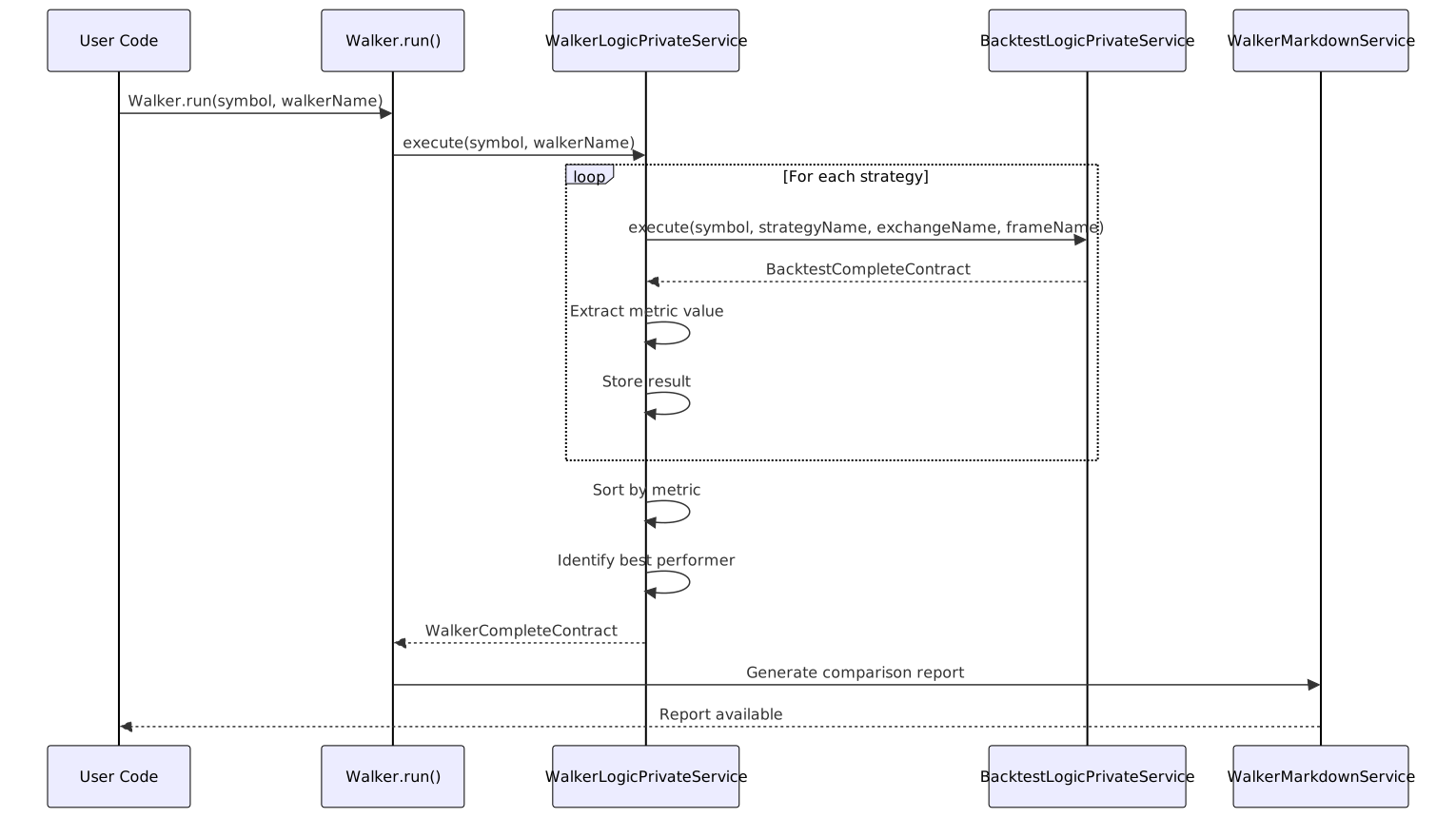
Registers a walker configuration for comparing multiple strategies on the same historical data. Walkers orchestrate sequential backtests and rank results by a specified metric.
Function Signature:
function addWalker(walkerSchema: IWalkerSchema): void
Parameters:
| Parameter | Type | Description |
|---|---|---|
walkerSchema.walkerName |
string |
Unique identifier for walker |
walkerSchema.exchangeName |
string |
Exchange to use for all strategies |
walkerSchema.frameName |
string |
Timeframe to use for all strategies |
walkerSchema.strategies |
string[] |
Array of strategy names to compare |
walkerSchema.metric |
string (optional) |
Metric for ranking (default: "sharpeRatio") |
walkerSchema.callbacks |
IWalkerCallbacks (optional) |
Event handlers for walker progress |
Walker Execution Flow:
Available Metrics:
| Metric | Description |
|---|---|
sharpeRatio |
Risk-adjusted return (default) |
totalPnl |
Total profit/loss |
winRate |
Percentage of profitable trades |
maxDrawdown |
Maximum portfolio decline |
totalTrades |
Number of completed trades |
Usage Example:
addWalker({
walkerName: "llm-prompt-optimizer",
exchangeName: "binance",
frameName: "1d-backtest",
strategies: [
"my-strategy-v1",
"my-strategy-v2",
"my-strategy-v3"
],
metric: "sharpeRatio",
callbacks: {
onStrategyComplete: (strategyName, symbol, stats, metric) => {
console.log(`${strategyName}: Sharpe ${metric.toFixed(2)}`);
},
onComplete: (results) => {
console.log(`Best: ${results.bestStrategy}`);
},
},
});
Validation Performed:
- Walker name uniqueness
- Exchange exists in registry
- Frame exists in registry
- All strategy names exist in registry
- Strategies array is non-empty
- Callback functions have correct signatures
addOptimizer
Registers an optimizer configuration for LLM-based strategy generation. Optimizers collect historical data, build conversation history, generate strategy prompts, and produce executable code.
Function Signature:
function addOptimizer(optimizerSchema: IOptimizerSchema): void
Parameters:
| Parameter | Type | Description |
|---|---|---|
optimizerSchema.optimizerName |
string |
Unique identifier for optimizer |
optimizerSchema.rangeTrain |
IOptimizerRange[] |
Training time ranges (each generates a strategy variant) |
optimizerSchema.rangeTest |
IOptimizerRange |
Testing time range for validation |
optimizerSchema.source |
IOptimizerSource[] |
Data sources for LLM context |
optimizerSchema.getPrompt |
(symbol: string, messages: MessageModel[]) => Promise<string> |
Generates strategy prompt from conversation |
optimizerSchema.template |
IOptimizerTemplate (optional) |
Custom code generation templates |
optimizerSchema.callbacks |
IOptimizerCallbacks (optional) |
Event handlers for optimizer stages |
Optimizer Data Collection Flow:

IOptimizerSource Types:
| Type | Structure | Description |
|---|---|---|
| Function | (params: IOptimizerSourceParams) => Promise<any[]> |
Simple data fetcher |
| Object | { name, fetch, user?, assistant? } |
Data fetcher with custom message formatters |
Usage Example:
addOptimizer({
optimizerName: "llm-strategy-generator",
rangeTrain: [
{
note: "Bull market period",
startDate: new Date("2024-01-01"),
endDate: new Date("2024-01-31"),
},
{
note: "Bear market period",
startDate: new Date("2024-02-01"),
endDate: new Date("2024-02-28"),
},
],
rangeTest: {
note: "Validation period",
startDate: new Date("2024-03-01"),
endDate: new Date("2024-03-31"),
},
source: [
{
name: "historical-backtests",
fetch: async ({ symbol, startDate, endDate, limit, offset }) => {
return await db.backtests.find({
symbol,
date: { $gte: startDate, $lte: endDate },
})
.skip(offset)
.limit(limit);
},
user: async (symbol, data, name) => {
return `Analyze ${data.length} backtests for ${symbol}:\n${JSON.stringify(data)}`;
},
assistant: async (symbol, data, name) => {
return "Historical data analyzed successfully";
},
},
],
getPrompt: async (symbol, messages) => {
return `Analyze ${symbol} using RSI and MACD. Enter LONG when RSI < 30.`;
},
callbacks: {
onData: (symbol, strategyData) => {
console.log(`Generated ${strategyData.length} strategies`);
},
onCode: (symbol, code) => {
console.log(`Generated ${code.length} chars of code`);
},
},
});
Validation Performed:
- Optimizer name uniqueness
rangeTrainarray is non-empty- All date ranges are valid
rangeTesthas valid datessourcearray is non-emptygetPromptis an async function- Callback functions have correct signatures
Registration Dependencies
Components must be registered in a specific order due to inter-component references. The dependency graph ensures that referenced components exist before dependent components are registered.

Registration Order Requirements:
| Component | Must Register Before | Reason |
|---|---|---|
| Exchange | Strategy (if used) | Strategy may reference exchange for data |
| Frame | Walker | Walker references frame for timeframe |
| Risk | Strategy | Strategy requires risk profile |
| Sizing | Strategy (if used) | Strategy may reference sizing configuration |
| Strategy | Walker | Walker references strategies for comparison |
Validation Pipeline
Component registration performs validation in two phases: registration-time validation (immediate) and runtime validation (during execution).
Registration-Time Validation

Registration-Time Checks:
| Component | Validation Performed |
|---|---|
| Strategy | strategyName unique, valid interval, getSignal is async function, risk profile exists |
| Exchange | exchangeName unique, getCandles is async function, format functions are async |
| Frame | frameName unique, valid interval, startDate < endDate |
| Risk | riskName unique, maxConcurrentPositions > 0, validation functions are functions |
| Sizing | sizingName unique, valid method, method-specific fields present |
| Walker | walkerName unique, exchange/frame exist, all strategies exist |
| Optimizer | optimizerName unique, non-empty rangeTrain, getPrompt is async function |
Runtime Validation

Runtime Checks:
| Stage | Validation Performed |
|---|---|
| Type | position is valid enum, prices are numbers, timestamps valid |
| Price | TP/SL direction correct for position type, TP ≠ SL |
| Distance | TP distance ≥ CC_MIN_TAKEPROFIT_DISTANCE_PERCENT, SL within bounds |
| Time | minuteEstimatedTime within limits, signal not expired |
| Risk | Custom validation functions pass, concurrent position limit not exceeded |
Schema Storage Mechanism
All registered schemas are stored in ToolRegistry instances within their respective schema services. The registry provides in-memory storage with validation and override capabilities.
ToolRegistry Pattern

ToolRegistry Methods:
| Method | Purpose |
|---|---|
register(name, tool) |
Store schema by unique name |
has(name) |
Check if schema exists |
get(name) |
Retrieve schema by name |
keys() |
Get all registered names |
values() |
Get all registered schemas |
Schema Service Implementation Pattern:
All schema services follow identical structure:
class *SchemaService {
private registry = new ToolRegistry<*Schema>();
register(name: string, schema: *Schema): void {
this.registry.register(name, schema);
}
has(name: string): boolean {
return this.registry.has(name);
}
get(name: string): *Schema {
return this.registry.get(name);
}
}
Schema Service Instances:
| Service | Stores | Injected As |
|---|---|---|
StrategySchemaService |
IStrategySchema |
TYPES.strategySchemaService |
ExchangeSchemaService |
IExchangeSchema |
TYPES.exchangeSchemaService |
FrameSchemaService |
IFrameSchema |
TYPES.frameSchemaService |
RiskSchemaService |
IRiskSchema |
TYPES.riskSchemaService |
SizingSchemaService |
ISizingSchema |
TYPES.sizingSchemaService |
WalkerSchemaService |
IWalkerSchema |
TYPES.walkerSchemaService |
OptimizerSchemaService |
IOptimizerSchema |
TYPES.optimizerSchemaService |