Layer Responsibilities
This document describes the service architecture of backtest-kit and the responsibilities of each layer. The framework follows a clean architecture pattern with strict separation of concerns, dependency injection, and unidirectional data flow from public API down to business logic.
For information about how dependency injection works across these layers, see Dependency Injection System. For details on how context flows through the layers, see Context Propagation.
Architecture Overview
The backtest-kit framework organizes services into distinct functional layers. Services are bound via dependency injection using Symbol-based tokens defined in src/lib/core/types.ts:1-81.
Complete Layer Architecture

Layer 1: API Layer
The API Layer provides user-facing classes and functions that serve as entry points to the framework. This layer has no business logic and delegates immediately to Command Services.
Execution Classes
Execution classes in src/classes/Backtest.ts, src/classes/Live.ts, and src/classes/Walker.ts provide the primary user interface:
| Class | Key Methods | Delegates To |
|---|---|---|
Backtest |
run(), background(), getData(), getReport(), dump() |
BacktestCommandService |
Live |
run(), background(), getData(), getReport(), dump() |
LiveCommandService |
Walker |
run(), background(), getData(), getReport(), dump() |
WalkerCommandService |
API Layer Delegation Pattern

Each execution class:
- Logs the operation via
backtest.loggerService - Clears relevant markdown services and strategy caches
- Delegates to the corresponding Command Service
Registration Functions
Component registration functions in src/function/add.ts provide schema registration:
| Function | Purpose | Delegates To |
|---|---|---|
addStrategy() |
Register strategy schema | StrategyValidationService, StrategySchemaService |
addExchange() |
Register exchange schema | ExchangeValidationService, ExchangeSchemaService |
addFrame() |
Register frame schema | FrameValidationService, FrameSchemaService |
addRisk() |
Register risk profile | RiskValidationService, RiskSchemaService |
addSizing() |
Register sizing method | SizingValidationService, SizingSchemaService |
addWalker() |
Register walker comparison | WalkerValidationService, WalkerSchemaService |
addOptimizer() |
Register optimizer configuration | OptimizerValidationService, OptimizerSchemaService |
Layer 2: Command Services
Command Services validate component configurations and delegate to Logic Services. They act as validation gateways before execution.
Command Service Responsibilities
Command Service Architecture

| Service | Validates | Delegates To |
|---|---|---|
BacktestCommandService |
strategyName, exchangeName, frameName, riskName | BacktestLogicPublicService |
LiveCommandService |
strategyName, exchangeName, riskName | LiveLogicPublicService |
WalkerCommandService |
walkerName, exchangeName, frameName, all strategy names | WalkerLogicPublicService |
Command Service Pattern
Each Command Service follows a consistent pattern:
- Log operation - Record method call with parameters
- Validate components - Check that all referenced components are registered
- Validate dependencies - If strategy has
riskName, validate risk profile exists - Delegate execution - Pass validated parameters to Logic Service
Example from BacktestCommandService:
The service validates all components before delegating:
run(symbol, context) {
// Validate strategy exists
strategyValidationService.validate(context.strategyName)
// Validate exchange exists
exchangeValidationService.validate(context.exchangeName)
// Validate frame exists
frameValidationService.validate(context.frameName)
// Get strategy schema and validate risk if present
const schema = strategySchemaService.get(context.strategyName)
if (schema.riskName) {
riskValidationService.validate(schema.riskName)
}
// Delegate to logic service
return backtestLogicPublicService.run(symbol, context)
}
Layer 3: Logic Services
Logic Services orchestrate execution flow. They are split into Public and Private services to separate context management from execution logic.
Public Logic Services
Public Logic Services wrap Private Logic Services with MethodContextService to inject component names into execution context:
Logic Service Context Injection

Each Public Logic Service:
- Receives context parameters (strategyName, exchangeName, frameName)
- Wraps Private Logic Service call with
MethodContextService.runAsyncIterator() - Returns AsyncGenerator from Private Logic Service
The MethodContextService uses scoped dependency injection to make context available to downstream services without explicit parameter passing.
Private Logic Services
Private Logic Services implement the core execution algorithms:
| Service | Responsibility | Key Operations |
|---|---|---|
BacktestLogicPrivateService |
Sequential timeframe iteration | Load frames, iterate dates, call strategyGlobalService.tick(), fetch future candles, call strategyGlobalService.backtest(), skip timeframes, emit to signalBacktestEmitter |
LiveLogicPrivateService |
Infinite real-time loop | Enter while(true) loop, call strategyGlobalService.tick() with new Date(), sleep for TICK_TTL (61s), emit to signalLiveEmitter |
WalkerLogicPrivateService |
Strategy comparison | Iterate walker strategies, run BacktestLogicPublicService for each, collect statistics, compare metrics, track best strategy, emit to walkerEmitter |
BacktestLogicPrivateService Execution Flow

LiveLogicPrivateService Execution Flow

Layer 4: Global Services
Global Services wrap Connection Services with ExecutionContextService to inject runtime parameters (symbol, when, backtest flag) into execution scope.
Global Service Pattern
Global Service Wrapper Architecture

| Service | Wraps | Injects Context For |
|---|---|---|
StrategyGlobalService |
StrategyConnectionService |
Strategy operations |
ExchangeGlobalService |
ExchangeConnectionService |
Market data fetching |
FrameGlobalService |
FrameConnectionService |
Timeframe generation |
RiskGlobalService |
RiskConnectionService |
Risk validation |
SizingGlobalService |
SizingConnectionService |
Position sizing |
Each Global Service:
- Validates component - Memoized validation check
- Wraps in ExecutionContext - Calls
ExecutionContextService.runInContext() - Delegates to Connection Service - Passes call to underlying connection service
The ExecutionContextService makes symbol, when, and backtest flag available to Client Classes without parameter drilling.
Layer 5: Connection Services
Connection Services manage memoized client instances, ensuring a single instance exists per component-symbol pair.
Layer 1: Public API
The Public API layer provides the user-facing functions for component registration and execution. These functions have no business logic and immediately delegate to Global Services.
Registration Functions
Component registration functions are exposed in src/function/add.ts:1-342:
| Function | Purpose | Delegates To |
|---|---|---|
addStrategy() |
Register strategy schema | StrategyValidationService.addStrategy()StrategySchemaService.register() |
addExchange() |
Register exchange schema | ExchangeValidationService.addExchange()ExchangeSchemaService.register() |
addFrame() |
Register timeframe schema | FrameValidationService.addFrame()FrameSchemaService.register() |
addRisk() |
Register risk profile | RiskValidationService.addRisk()RiskSchemaService.register() |
addSizing() |
Register sizing method | SizingValidationService.addSizing()SizingSchemaService.register() |
addWalker() |
Register strategy comparison | WalkerValidationService.addWalker()WalkerSchemaService.register() |
Query Functions
Component listing functions are exposed in src/function/list.ts:1-218:
| Function | Purpose | Delegates To |
|---|---|---|
listStrategies() |
Get all strategy schemas | StrategyValidationService.list() |
listExchanges() |
Get all exchange schemas | ExchangeValidationService.list() |
listFrames() |
Get all frame schemas | FrameValidationService.list() |
listRisks() |
Get all risk schemas | RiskValidationService.list() |
listSizings() |
Get all sizing schemas | SizingValidationService.list() |
listWalkers() |
Get all walker schemas | WalkerValidationService.list() |
Execution Classes
Execution entry points provide static methods for running backtests and live trading:
Backtest.run()/Backtest.background()- Historical simulationLive.run()/Live.background()- Real-time tradingWalker.run()/Walker.background()- Multi-strategy comparison
These delegate to corresponding Global Services which wrap Logic Services with validation.
Layer 2: Logic Services
Logic Services orchestrate the core execution flow. They are split into Public and Private services to separate context management from core logic.
Public Logic Services
Public logic services wrap execution in context and provide the public interface:
Logic Service Responsibilities

Each public service:
- Accepts context parameters (strategyName, exchangeName, frameName)
- Wraps private service call with
MethodContextService.runAsyncIterator() - Returns async generator from private service
Example from BacktestLogicPublicService:
The public service receives context and wraps the private service:
run(symbol, { strategyName, exchangeName, frameName }) {
return methodContextService.runAsyncIterator(
() => backtestLogicPrivateService.run(symbol),
{ strategyName, exchangeName, frameName }
)
}
Private Logic Services
Private logic services contain the core execution orchestration:
| Service | Responsibility | Key Methods |
|---|---|---|
BacktestLogicPrivateService |
Iterate timeframes, call strategy.tick(), yield signals | run(), emits to signalBacktestEmitter |
LiveLogicPrivateService |
Infinite loop, Date.now() progression, persistence | run(), emits to signalLiveEmitter |
WalkerLogicPrivateService |
Run multiple strategies, compare metrics | run(), emits to walkerEmitter |
These services have dependencies on:
StrategyGlobalService- Strategy operationsExchangeGlobalService- Market data (backtest only)FrameGlobalService- Timeframe generation (backtest only)- Markdown services - Report generation
Layer 3: Connection Services
Connection Services manage memoized client instances. Each service creates and caches client instances by component name, ensuring only one instance exists per registered component.
Service Registry
Connection services are defined in src/lib/core/types.ts:10-16:
| Service | Manages Instances Of | Cache Key |
|---|---|---|
StrategyConnectionService |
ClientStrategy |
${symbol}:${strategyName} |
ExchangeConnectionService |
ClientExchange |
${symbol}:${exchangeName} |
RiskConnectionService |
ClientRisk |
${riskName} |
FrameConnectionService |
ClientFrame |
${symbol}:${exchangeName}:${frameName} |
SizingConnectionService |
ClientSizing |
${sizingName} |
Memoization Pattern
StrategyConnectionService Architecture

The getStrategy method in src/lib/services/connection/StrategyConnectionService.ts:78-98 uses memoize from functools-kit to cache instances:
private getStrategy = memoize(
([symbol, strategyName]) => `${symbol}:${strategyName}`,
(symbol, strategyName) => {
const { riskName, getSignal, interval, callbacks } =
this.strategySchemaService.get(strategyName);
return new ClientStrategy({
symbol,
interval,
execution: this.executionContextService,
method: this.methodContextService,
logger: this.loggerService,
partial: this.partialConnectionService,
exchange: this.exchangeConnectionService,
risk: riskName ? this.riskConnectionService.getRisk(riskName) : NOOP_RISK,
riskName,
strategyName,
getSignal,
callbacks,
});
}
);
Connection Service Operations
Each Connection Service provides operation methods that delegate to cached client instances:
StrategyConnectionService Operations
| Method | Purpose | Delegates To |
|---|---|---|
tick(symbol, strategyName) |
Execute live trading tick | ClientStrategy.tick() |
backtest(symbol, strategyName, candles) |
Execute fast backtest | ClientStrategy.backtest() |
getPendingSignal(symbol, strategyName) |
Retrieve active signal | ClientStrategy.getPendingSignal() |
stop({symbol, strategyName}) |
Stop signal generation | ClientStrategy.stop() |
clear(ctx?) |
Clear memoized instances | Memoization cache |
Connection Services also emit to appropriate event emitters after operations complete. For example, src/lib/services/connection/StrategyConnectionService.ts:129-147 emits signals to three channels:
const tick = await strategy.tick(symbol, strategyName);
{
if (this.executionContextService.context.backtest) {
await signalBacktestEmitter.next(tick);
}
if (!this.executionContextService.context.backtest) {
await signalLiveEmitter.next(tick);
}
await signalEmitter.next(tick);
}
Layer 6: Client Classes
Client Classes contain pure business logic without dependency injection. They receive dependencies via constructor parameters and implement core algorithms.
Client Responsibilities
| Client Class | Primary Responsibility | Key Methods |
|---|---|---|
ClientStrategy |
Signal lifecycle management | tick(), backtest(), stop(), getPendingSignal(), waitForInit() |
ClientExchange |
Market data and VWAP calculation | getCandles(), getNextCandles(), getAveragePrice(), formatPrice() |
ClientRisk |
Position tracking and validation | checkSignal(), addSignal(), removeSignal() |
ClientFrame |
Timeframe generation | getTimeframe() |
ClientSizing |
Position size calculation | calculateQuantity() |
ClientStrategy State Management

Client Classes have no knowledge of:
- Dependency injection framework
- Service layer architecture
- Memoization caching
- Event emission (handled by Connection Services)
They receive all dependencies as constructor parameters and expose simple method interfaces.
Layer 7: Schema Services
Schema Services store component configurations using the ToolRegistry pattern and provide runtime schema retrieval.
Layer 4: Client Classes
Client Classes contain pure business logic without dependency injection dependencies. They implement the core algorithms and state management.
Client Responsibilities
Client Class Hierarchy

| Client Class | Primary Responsibility | Key State |
|---|---|---|
ClientStrategy |
Signal lifecycle management, tick/backtest execution | _pendingSignal, _lastSignalTimestamp |
ClientExchange |
Market data fetching, VWAP calculation, formatting | Stateless (delegates to schema functions) |
ClientRisk |
Position tracking, custom validation execution | _activePositions Map |
ClientFrame |
Timeframe generation for backtesting | Stateless |
ClientSizing |
Position size calculation | Stateless |
Pure Business Logic
Client classes have NO direct dependency injection. Instead:
- Constructor parameters are simple values or functions from schemas
- Service dependencies are passed via Connection Service injection
- Prototype methods are used for memory efficiency (not arrow functions)
Example: ClientStrategy receives schema functions and other clients as constructor parameters, not DI symbols.
Layer 5: Schema & Validation Services
Schema and Validation Services manage component registration and runtime validation. They use a parallel service structure with distinct responsibilities.
Schema Services
Schema Services store component configurations using the ToolRegistry pattern:
Schema Service Pattern

Each Schema Service provides:
| Method | Purpose |
|---|---|
register(name, schema) |
Store component configuration |
get(name) |
Retrieve configuration by name |
validateShallow(schema) |
Check schema structure and types |
override(name, partial) |
Update existing schema |
Schema services are defined in src/lib/core/types.ts:18-25:
const schemaServices = {
exchangeSchemaService: Symbol('exchangeSchemaService'),
strategySchemaService: Symbol('strategySchemaService'),
frameSchemaService: Symbol('frameSchemaService'),
walkerSchemaService: Symbol('walkerSchemaService'),
sizingSchemaService: Symbol('sizingSchemaService'),
riskSchemaService: Symbol('riskSchemaService'),
}
Validation Services
Validation Services perform runtime existence checks with memoization:
Validation Service Pattern

Each Validation Service provides:
| Method | Purpose |
|---|---|
addStrategy(name, schema) |
Register component for validation |
validate(name) |
Check existence and dependencies |
list() |
Return all registered schemas |
Validation services are defined in src/lib/core/types.ts:59-66:
const validationServices = {
exchangeValidationService: Symbol('exchangeValidationService'),
strategyValidationService: Symbol('strategyValidationService'),
frameValidationService: Symbol('frameValidationService'),
walkerValidationService: Symbol('walkerValidationService'),
sizingValidationService: Symbol('sizingValidationService'),
riskValidationService: Symbol('riskValidationService'),
}
Example Validation Flow:
When BacktestLogicPublicService starts execution:
- Calls
StrategyValidationService.validate(strategyName) - Calls
ExchangeValidationService.validate(exchangeName) - Calls
FrameValidationService.validate(frameName) - If strategy has
riskName, validates viaRiskValidationService.validate(riskName)
Layer 6: Markdown Services
Markdown Services subscribe to event emitters and accumulate data for report generation. Each execution mode has a dedicated markdown service.
Service Registry
Markdown services are defined in src/lib/core/types.ts:50-57:
const markdownServices = {
backtestMarkdownService: Symbol('backtestMarkdownService'),
liveMarkdownService: Symbol('liveMarkdownService'),
scheduleMarkdownService: Symbol('scheduleMarkdownService'),
performanceMarkdownService: Symbol('performanceMarkdownService'),
walkerMarkdownService: Symbol('walkerMarkdownService'),
heatMarkdownService: Symbol('heatMarkdownService'),
}
Event Subscription Pattern
Markdown Service Data Flow

Each Markdown Service:
- Subscribes to emitter during initialization
- Accumulates events in memoized storage by strategy/walker name
- Limits event queue (e.g.,
LiveMarkdownServicemax 250 events) - Calculates statistics on demand via
getData() - Formats markdown via
getReport() - Writes to disk via
dump()
Report Storage
Storage is memoized per component:
BacktestMarkdownService- One storage per (strategyName, exchangeName, frameName)LiveMarkdownService- One storage per (strategyName, exchangeName)WalkerMarkdownService- One storage per walkerName
Cross-Cutting Services
Three services span all layers and provide infrastructure concerns.
LoggerService
The LoggerService provides logging infrastructure with automatic context injection:

Injected into nearly every service via src/lib/core/types.ts:1-3:
const baseServices = {
loggerService: Symbol('loggerService'),
}
ExecutionContextService
The ExecutionContextService manages execution-time parameters using di-scoped:
| Property | Purpose |
|---|---|
symbol |
Trading pair (e.g., "BTCUSDT") |
when |
Current timestamp (Date for live, historical for backtest) |
backtest |
Boolean flag indicating execution mode |
Used by client classes to access current execution context without explicit parameter passing.
MethodContextService
The MethodContextService manages component selection using di-scoped:
| Property | Purpose |
|---|---|
strategyName |
Active strategy identifier |
exchangeName |
Active exchange identifier |
frameName |
Active frame identifier (backtest only) |
Used by Connection Services to resolve which component instance to return.
Layer Interaction Patterns
Registration Flow
Component Registration Pattern
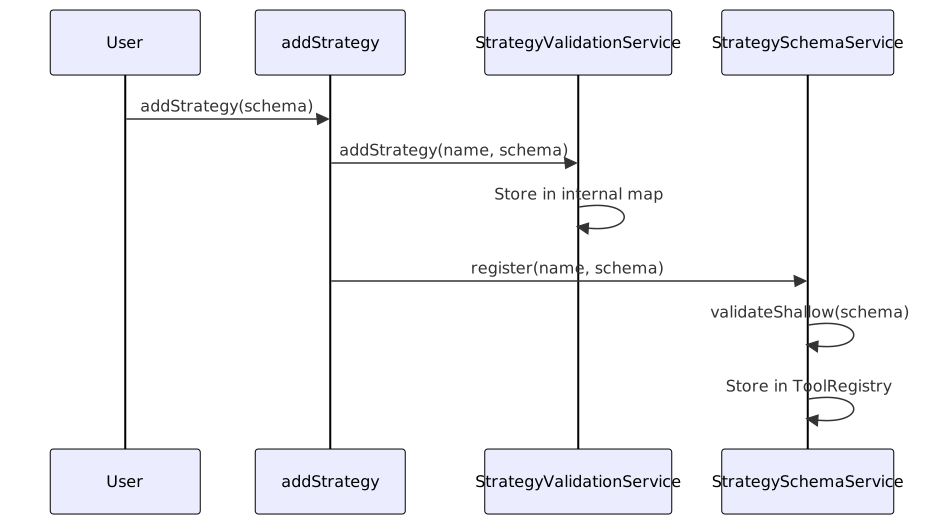
- Public API function receives schema
- Validation Service stores for runtime checks
- Schema Service validates structure and stores in registry
Execution Flow
Backtest Execution Pattern
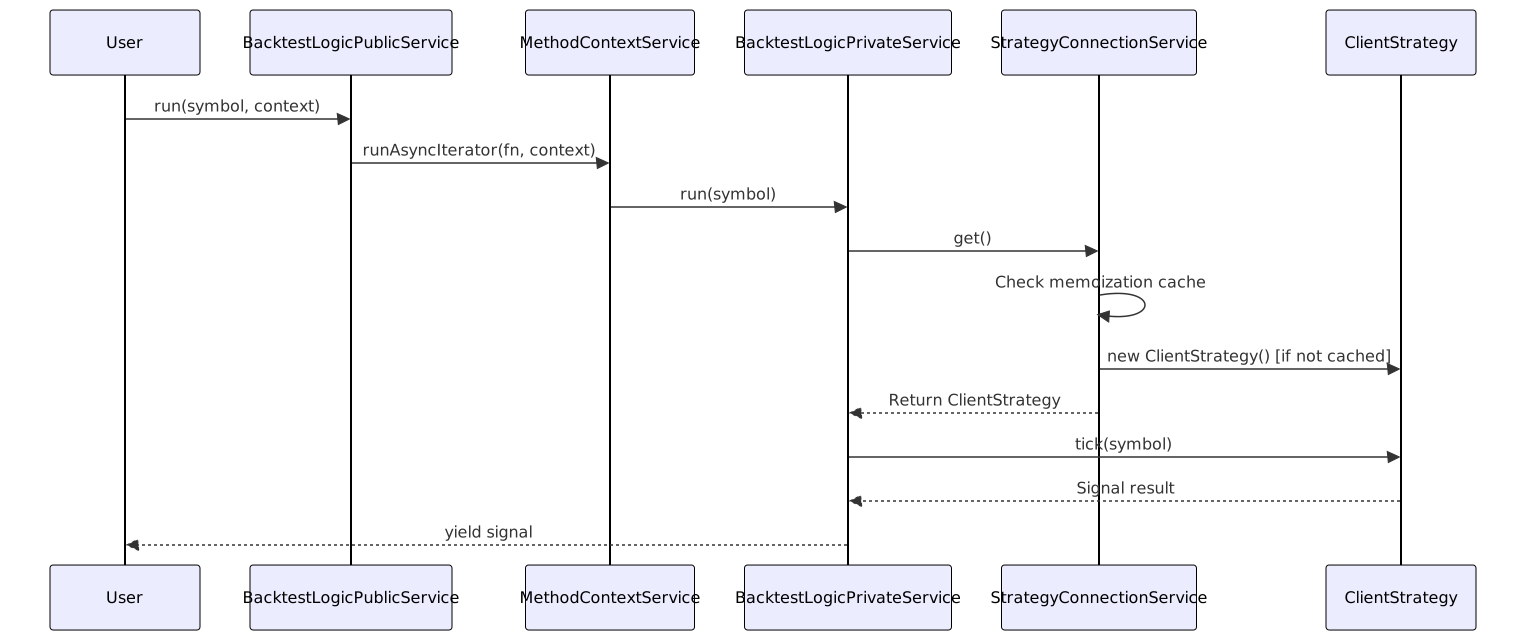
- Public service wraps with MethodContext
- Private service gets client from Connection Service
- Connection Service returns memoized instance
- Private service calls client methods
- Results yielded to user
Data Flow Direction
All data flows unidirectionally down the layers:
Layer 1 (Public API)
↓ Delegates
Layer 2 (Logic Services)
↓ Requests Instances
Layer 3 (Connection Services)
↓ Creates/Returns
Layer 4 (Client Classes)
↓ Uses
Layer 5 (Schemas)
Events flow horizontally to Layer 6 (Markdown Services) for reporting.
Service Binding
All services are bound in src/lib/core/provide.ts:1-111 using the provide() function from the DI container. Services are organized in blocks matching their layer:
// Base Services (Cross-cutting)
provide(TYPES.loggerService, () => new LoggerService());
// Context Services (Cross-cutting)
provide(TYPES.executionContextService, () => new ExecutionContextService());
provide(TYPES.methodContextService, () => new MethodContextService());
// Connection Services (Layer 3)
provide(TYPES.strategyConnectionService, () => new StrategyConnectionService());
provide(TYPES.exchangeConnectionService, () => new ExchangeConnectionService());
// Schema Services (Layer 5)
provide(TYPES.strategySchemaService, () => new StrategySchemaService());
// Global Services (Layer 2 wrappers)
provide(TYPES.strategyGlobalService, () => new StrategyGlobalService());
// Logic Services (Layer 2)
provide(TYPES.backtestLogicPrivateService, () => new BacktestLogicPrivateService());
provide(TYPES.backtestLogicPublicService, () => new BacktestLogicPublicService());
// Markdown Services (Layer 6)
provide(TYPES.backtestMarkdownService, () => new BacktestMarkdownService());
// Validation Services (Layer 5)
provide(TYPES.strategyValidationService, () => new StrategyValidationService());
All services are then exported as a single object in src/lib/index.ts:152-162:
export const backtest = {
...baseServices,
...contextServices,
...connectionServices,
...schemaServices,
...globalServices,
...logicPrivateServices,
...logicPublicServices,
...markdownServices,
...validationServices,
};