Running Your First Backtest
This guide will walk you through the process of creating and running your first backtest using backtest-kit. You'll learn how to set up all necessary components and get results from testing your strategy.
Process Overview
The backtest-kit framework follows a two-phase lifecycle: configuration and execution. During configuration, you register components using add* functions. During execution, you run backtests and receive results.

Step 1: Register Exchange
The addExchange function registers a data source that provides historical candle data and price formatting functions.
Exchange Schema Structure
| Field | Type | Description |
|---|---|---|
exchangeName |
string |
Unique exchange identifier |
getCandles |
async function |
Fetches OHLCV candle data |
formatPrice |
async function |
Formats prices for display |
formatQuantity |
async function |
Formats quantities for display |
callbacks |
object (optional) |
Lifecycle callbacks |
Minimal Exchange Example
import ccxt from "ccxt";
import { addExchange } from "backtest-kit";
addExchange({
exchangeName: "binance-historical",
getCandles: async (symbol, interval, since, limit) => {
const exchange = new ccxt.binance();
const ohlcv = await exchange.fetchOHLCV(
symbol,
interval,
since.getTime(),
limit
);
return ohlcv.map(([timestamp, open, high, low, close, volume]) => ({
timestamp, open, high, low, close, volume
}));
},
formatPrice: async (symbol, price) => price.toFixed(2),
formatQuantity: async (symbol, quantity) => quantity.toFixed(8),
});
What Happens
The getCandles function is called by the framework during backtest execution. It receives:
- symbol: Trading pair (e.g., "BTCUSDT")
- interval: Candle interval matching the frame interval
- since: Start timestamp (Date object)
- limit: Maximum number of candles to return
Step 2: Register Strategy
The addStrategy function registers trading logic that generates signals. The strategy defines when to enter and exit positions based on market data.
Strategy Schema Structure
| Field | Type | Description |
|---|---|---|
strategyName |
string |
Unique strategy identifier |
interval |
string |
Signal generation frequency (e.g., "5m", "1h") |
getSignal |
async function |
Generates trading signals |
riskName |
string (optional) |
Associated risk profile |
sizingName |
string (optional) |
Position sizing configuration |
callbacks |
object (optional) |
Lifecycle callbacks (onOpen, onClose) |
Signal Return Structure
The getSignal function must return an object with the following fields:
| Field | Type | Required | Description |
|---|---|---|---|
position |
"long" | "short" |
Yes | Trade direction |
priceOpen |
number |
Conditional | Entry price (required if not pending) |
priceTakeProfit |
number |
Yes | Take profit target |
priceStopLoss |
number |
Yes | Stop loss level |
minuteEstimatedTime |
number |
Yes | Expected trade duration in minutes |
timestamp |
number |
Yes | Signal generation timestamp |
priceActivate |
number |
No | Trigger price for conditional entry |
Minimal Strategy Example
import { addStrategy, getCandles } from "backtest-kit";
addStrategy({
strategyName: "simple-breakout",
interval: "5m",
getSignal: async (symbol) => {
// Fetch recent candles
const candles = await getCandles(symbol, "5m", 20);
const currentPrice = candles[candles.length - 1].close;
// Strategy logic here
return {
position: "long",
priceOpen: currentPrice,
priceTakeProfit: currentPrice * 1.02,
priceStopLoss: currentPrice * 0.98,
minuteEstimatedTime: 60,
timestamp: Date.now(),
};
},
});
Real Strategy Example with MACD
import { addStrategy, getCandles } from "backtest-kit";
import { MACD } from "technicalindicators";
addStrategy({
strategyName: "macd-crossover",
interval: "15m",
getSignal: async (symbol) => {
// Fetch candles using context-aware getCandles
// Automatically receives backtest or live data via async hooks
const candles = await getCandles(symbol, "15m", 100);
const prices = candles.map(c => c.close);
// Calculate MACD
const macdResult = MACD.calculate({
values: prices,
fastPeriod: 12,
slowPeriod: 26,
signalPeriod: 9,
SimpleMAOscillator: false,
SimpleMASignal: false
});
const current = macdResult[macdResult.length - 1];
const previous = macdResult[macdResult.length - 2];
// Bullish crossover
if (previous.MACD < previous.signal && current.MACD > current.signal) {
const currentPrice = prices[prices.length - 1];
return {
position: "long",
priceOpen: currentPrice,
priceTakeProfit: currentPrice * 1.02, // +2%
priceStopLoss: currentPrice * 0.99, // -1%
minuteEstimatedTime: 120,
timestamp: Date.now(),
};
}
// Bearish crossover
if (previous.MACD > previous.signal && current.MACD < current.signal) {
const currentPrice = prices[prices.length - 1];
return {
position: "short",
priceOpen: currentPrice,
priceTakeProfit: currentPrice * 0.98, // -2%
priceStopLoss: currentPrice * 1.01, // +1%
minuteEstimatedTime: 120,
timestamp: Date.now(),
};
}
// No signal
return null;
},
});
Important: Returning null or undefined means no signal for the current time interval.
Step 3: Register Frame
The addFrame function defines the historical period for backtesting. The frame generates timestamps at the specified interval between start and end dates.
Frame Schema Structure
| Field | Type | Description |
|---|---|---|
frameName |
string |
Unique frame identifier |
interval |
string |
Timestamp interval (e.g., "1m", "1h", "1d") |
startDate |
Date |
Backtest start date |
endDate |
Date |
Backtest end date |
callbacks |
object (optional) |
Timestamp generation callback |
Supported Intervals
- Minutes:
"1m","3m","5m","15m","30m" - Hours:
"1h","2h","4h","6h","8h","12h" - Days:
"1d","3d"
Minimal Frame Example
import { addFrame } from "backtest-kit";
addFrame({
frameName: "december-2025",
interval: "1m",
startDate: new Date("2025-12-01T00:00:00.000Z"),
endDate: new Date("2025-12-31T23:59:59.999Z"),
});
Examples of Different Periods
// Short-term backtest (1 week)
addFrame({
frameName: "week-test",
interval: "5m",
startDate: new Date("2025-12-01"),
endDate: new Date("2025-12-08"),
});
// Medium-term backtest (1 month)
addFrame({
frameName: "month-test",
interval: "15m",
startDate: new Date("2025-11-01"),
endDate: new Date("2025-12-01"),
});
// Long-term backtest (1 year)
addFrame({
frameName: "year-test",
interval: "1h",
startDate: new Date("2024-01-01"),
endDate: new Date("2025-01-01"),
});
Step 4: Register Risk Rules (Optional)
The addRisk function defines validation rules that reject signals based on portfolio-level constraints.
Minimal Risk Example
import { addRisk } from "backtest-kit";
addRisk({
riskName: "conservative",
maxConcurrentPositions: 3,
validations: [
{
validate: ({ pendingSignal, currentPrice }) => {
const { priceOpen = currentPrice, priceTakeProfit, position } = pendingSignal;
const tpDistance = position === "long"
? ((priceTakeProfit - priceOpen) / priceOpen) * 100
: ((priceOpen - priceTakeProfit) / priceOpen) * 100;
if (tpDistance < 1) {
throw new Error(`TP distance ${tpDistance.toFixed(2)}% < 1%`);
}
},
note: "TP distance must be at least 1%",
},
],
});
To link a risk profile with a strategy, set riskName in the strategy schema:
addStrategy({
strategyName: "macd-crossover",
interval: "15m",
riskName: "conservative", // Link to risk profile
getSignal: async (symbol) => {
// ...
},
});
Step 5: Run Backtest
The Backtest singleton provides methods for running backtests. The framework offers two execution patterns: streaming and background.
Execution Methods Comparison

Streaming Pattern: Backtest.run()
The run method returns an async generator that yields each closed signal with PNL calculations:
import { Backtest } from "backtest-kit";
for await (const result of Backtest.run("BTCUSDT", {
strategyName: "macd-crossover",
exchangeName: "binance-historical",
frameName: "december-2025",
})) {
console.log("Signal closed:");
console.log(" PNL:", result.pnl.pnlPercentage.toFixed(2) + "%");
console.log(" Duration:", result.duration, "minutes");
console.log(" Exit reason:", result.reason);
}
console.log("Backtest completed");
Background Pattern: Backtest.background()
The background method runs the backtest silently and returns a cancel function:
import { Backtest } from "backtest-kit";
const cancel = Backtest.background("BTCUSDT", {
strategyName: "macd-crossover",
exchangeName: "binance-historical",
frameName: "december-2025",
});
// Backtest runs asynchronously
// Use event listeners to monitor progress
// Stop early if needed
// cancel();
Step 6: Monitor with Event Listeners
Event listeners allow you to react to backtest events asynchronously.
Event Listener Functions

Signal Event Listener
import { listenSignalBacktest } from "backtest-kit";
listenSignalBacktest((event) => {
console.log(`[${event.action}] ${event.symbol} @ ${event.strategyName}`);
if (event.action === "opened") {
console.log(` Entry: ${event.signal.priceOpen}`);
}
if (event.action === "closed") {
console.log(` PNL: ${event.pnl.pnlPercentage.toFixed(2)}%`);
console.log(` Reason: ${event.reason}`);
}
});
Signal events include the following actions:
"idle": Strategy waiting for next signal"scheduled": Conditional entry scheduled"opened": Position opened"closed": Position closed"cancelled": Pending signal expired
Progress Listener
import { listenBacktestProgress } from "backtest-kit";
listenBacktestProgress((event) => {
const percent = (event.progress * 100).toFixed(2);
console.log(`Progress: ${percent}%`);
console.log(`Processed: ${event.processedFrames} / ${event.totalFrames}`);
});
Completion Listener
import { listenDoneBacktest, Backtest } from "backtest-kit";
listenDoneBacktest(async (event) => {
console.log(`Backtest completed: ${event.symbol}`);
// Generate report after completion
await Backtest.dump(event.symbol, event.strategyName);
});
Step 7: Generate Performance Reports
After backtest completion, use reporting methods to analyze results.
Reporting Methods

Stats Object Structure
import { Backtest } from "backtest-kit";
const stats = await Backtest.getData("BTCUSDT", "macd-crossover");
console.log("Performance Metrics:");
console.log(" Sharpe Ratio:", stats.sharpeRatio);
console.log(" Win Rate:", stats.winRate);
console.log(" Total PNL:", stats.totalPNL);
console.log(" Max Drawdown:", stats.maxDrawdown);
console.log(" Total Trades:", stats.totalTrades);
Generate Markdown Report
import { Backtest } from "backtest-kit";
const markdown = await Backtest.getReport("BTCUSDT", "macd-crossover");
console.log(markdown);
Save Report to Disk
import { Backtest } from "backtest-kit";
// Save to default path: ./dump/backtest/macd-crossover.md
await Backtest.dump("BTCUSDT", "macd-crossover");
// Save to custom path: ./custom/reports/macd-crossover.md
await Backtest.dump("BTCUSDT", "macd-crossover", "./custom/reports");
Complete Working Example
Here's a complete example with minimal backtest configuration:
import ccxt from "ccxt";
import {
addExchange,
addStrategy,
addFrame,
Backtest,
listenDoneBacktest,
listenSignalBacktest,
} from "backtest-kit";
// Step 1: Register exchange
addExchange({
exchangeName: "binance-historical",
getCandles: async (symbol, interval, since, limit) => {
const exchange = new ccxt.binance();
const ohlcv = await exchange.fetchOHLCV(
symbol,
interval,
since.getTime(),
limit
);
return ohlcv.map(([timestamp, open, high, low, close, volume]) => ({
timestamp, open, high, low, close, volume
}));
},
formatPrice: async (symbol, price) => price.toFixed(2),
formatQuantity: async (symbol, quantity) => quantity.toFixed(8),
});
// Step 2: Register strategy
addStrategy({
strategyName: "simple-breakout",
interval: "5m",
getSignal: async (symbol) => {
// Simplified strategy: always returns long signal
return {
position: "long",
priceOpen: 50000,
priceTakeProfit: 51000,
priceStopLoss: 49000,
minuteEstimatedTime: 60,
timestamp: Date.now(),
};
},
});
// Step 3: Register frame
addFrame({
frameName: "december-2025",
interval: "1m",
startDate: new Date("2025-12-01T00:00:00.000Z"),
endDate: new Date("2025-12-02T00:00:00.000Z"),
});
// Step 4: Event listeners
listenSignalBacktest((event) => {
if (event.action === "closed") {
console.log(`Signal closed: PNL ${event.pnl.pnlPercentage.toFixed(2)}%`);
}
});
listenDoneBacktest(async (event) => {
console.log("Backtest completed");
await Backtest.dump(event.symbol, event.strategyName);
console.log("Report saved to ./dump/backtest/simple-breakout.md");
});
// Step 5: Run backtest in background
Backtest.background("BTCUSDT", {
strategyName: "simple-breakout",
exchangeName: "binance-historical",
frameName: "december-2025",
});
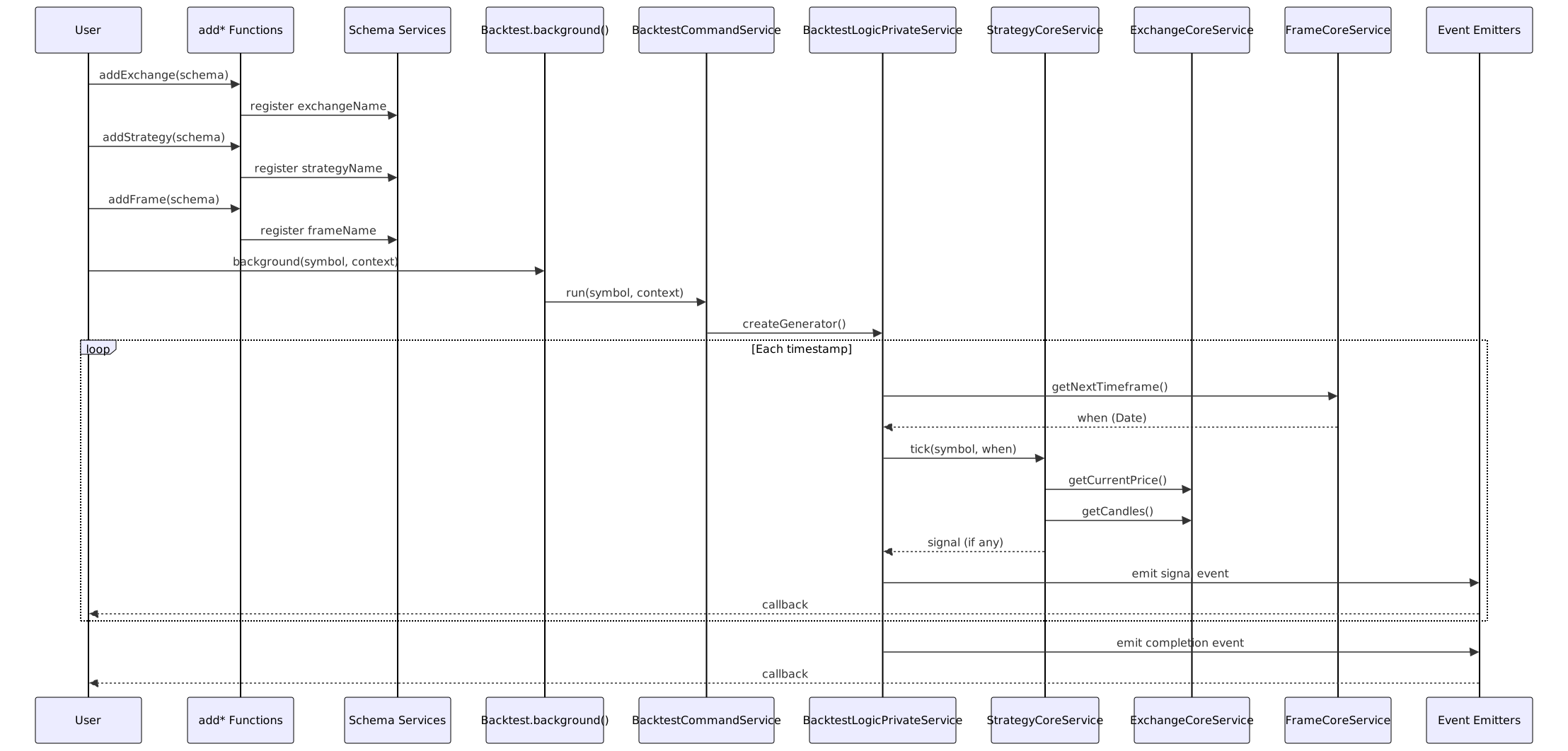
Execution Flow Diagram
This diagram shows how configuration components transition into execution:
Next Steps
After running your first backtest:
- Understanding Signals - Learn about trading signal lifecycle and state machine
- Setup Live Trading - Transition to real execution with crash protection
- Risk Management - Implement advanced portfolio validation rules
- AI Optimization - Generate strategies using large language models