Custom Persistence Backends
This page documents how to implement custom persistence backends for backtest-kit's crash recovery system. It covers the IPersistBase interface, adapter registration, and integration with external storage systems like Redis, MongoDB, or cloud storage.
For information about the persistence layer architecture and crash recovery mechanisms, see Persistence Layer. For details about the default file-based persistence implementation, see Persistence Utilities.
Overview
backtest-kit provides a pluggable persistence system that allows custom storage backends to replace the default file-based implementation. The system uses four domain-specific adapters:
| Adapter | Purpose | Data Type | Default Path |
|---|---|---|---|
PersistSignalAdapter |
Active pending signals | ISignalRow | null |
./dump/data/signal/ |
PersistRiskAdapter |
Active risk positions | Array<[string, IRiskActivePosition]> |
./dump/data/risk/ |
PersistScheduleAdapter |
Scheduled signals | IScheduledSignalRow | null |
./dump/data/schedule/ |
PersistPartialAdapter |
Partial profit/loss levels | Record<string, IPartialData> |
./dump/data/partial/ |
Each adapter accepts a custom constructor via use*Adapter() methods, enabling integration with any storage system that implements the IPersistBase interface.
Persistence System Architecture

Architecture: Each adapter uses a factory pattern with constructor type TPersistBaseCtor. Custom backends register by calling use*Adapter(CustomConstructor) which replaces the factory. Instances are memoized per entity name using memoize() from functools-kit.
IPersistBase Interface
Custom persistence backends must implement the IPersistBase<Entity> interface:
// From src/classes/Persist.ts
interface IPersistBase<Entity extends IEntity | null = IEntity> {
waitForInit(initial: boolean): Promise<void>;
readValue(entityId: EntityId): Promise<Entity>;
hasValue(entityId: EntityId): Promise<boolean>;
writeValue(entityId: EntityId, entity: Entity): Promise<void>;
}
Interface Contract
| Method | Parameters | Return Type | Purpose |
|---|---|---|---|
waitForInit |
initial: boolean |
Promise<void> |
Initialize storage, validate existing data |
readValue |
entityId: EntityId |
Promise<Entity> |
Retrieve entity by ID |
hasValue |
entityId: EntityId |
Promise<boolean> |
Check entity existence |
writeValue |
entityId, entity |
Promise<void> |
Persist entity atomically |
Entity Types
| Adapter | Entity Type | Key Format |
|---|---|---|
| Signal | ISignalRow | null |
symbol (e.g., "BTCUSDT") |
| Risk | Array<[string, IRiskActivePosition]> |
"positions" (constant) |
| Schedule | IScheduledSignalRow | null |
symbol (e.g., "BTCUSDT") |
| Partial | Record<string, IPartialData> |
"levels" (constant) |
Important: waitForInit() receives initial: boolean flag indicating first-time initialization. Use this to optimize connection pooling or skip expensive validation.
PersistBase Default Implementation
The default PersistBase class provides file-based storage with atomic writes:

Atomic Write Pattern
src/classes/Persist.ts:295-314 implements atomic writes via writeFileAtomic:
- Serialize entity to JSON string
- Write to temporary file:
{path}.tmp - Call
fsync()to ensure disk write - Rename temp file to final path (atomic operation)
This guarantees that files are never in a partially-written state, critical for crash recovery.
Self-Healing Validation
src/classes/Persist.ts:132-153 implements validation during waitForInit():
- Iterate all
.jsonfiles in directory - Attempt to read and parse each file
- If parsing fails, delete corrupted file
- Retry deletion up to 5 times with 1-second delays
This prevents corrupted files from blocking initialization after crashes.
Adapter Registration
Each domain-specific adapter exposes a use*Adapter() method accepting a custom constructor:
Signal Persistence
// From src/classes/Persist.ts
class PersistSignalUtils {
private PersistSignalFactory: TPersistBaseCtor<StrategyName, SignalData> = PersistBase;
public usePersistSignalAdapter(
Ctor: TPersistBaseCtor<StrategyName, SignalData>
): void {
this.PersistSignalFactory = Ctor;
}
}
export const PersistSignalAdapter = new PersistSignalUtils();
Memoization Key: src/classes/Persist.ts:518-519 uses ${symbol}:${strategyName} as cache key. Each symbol-strategy combination gets isolated storage instance.
Entity Name Format: src/classes/Persist.ts:522-524 constructs entity names as ${symbol}_${strategyName} and base directory as ./dump/data/signal/.
Risk Persistence
// From src/classes/Persist.ts
class PersistRiskUtils {
private PersistRiskFactory: TPersistBaseCtor<RiskName, RiskData> = PersistBase;
public usePersistRiskAdapter(
Ctor: TPersistBaseCtor<RiskName, RiskData>
): void {
this.PersistRiskFactory = Ctor;
}
}
export const PersistRiskAdapter = new PersistRiskUtils();
Memoization Key: src/classes/Persist.ts:651-652 uses ${riskName} as cache key. One instance per risk profile.
Storage Key: src/classes/Persist.ts:699 uses constant "positions" as entity ID for all risk data.
Schedule Persistence
// From src/classes/Persist.ts
class PersistScheduleUtils {
private PersistScheduleFactory: TPersistBaseCtor<StrategyName, ScheduleData> = PersistBase;
public usePersistScheduleAdapter(
Ctor: TPersistBaseCtor<StrategyName, ScheduleData>
): void {
this.PersistScheduleFactory = Ctor;
}
}
export const PersistScheduleAdapter = new PersistScheduleUtils();
Memoization Key: src/classes/Persist.ts:773-774 uses ${symbol}:${strategyName} as cache key.
Entity Name Format: src/classes/Persist.ts:776-778 constructs names as ${symbol}_${strategyName} with base directory ./dump/data/schedule/.
Partial Persistence
// From src/classes/Persist.ts
class PersistPartialUtils {
private PersistPartialFactory: TPersistBaseCtor<string, PartialData> = PersistBase;
public usePersistPartialAdapter(
Ctor: TPersistBaseCtor<string, PartialData>
): void {
this.PersistPartialFactory = Ctor;
}
}
export const PersistPartialAdapter = new PersistPartialUtils();
Memoization Key: src/classes/Persist.ts:899-900 uses ${symbol}:${strategyName} as cache key.
Storage Key: src/classes/Persist.ts:949 uses constant "levels" as entity ID for all partial data.
Implementation Guide
Step 1: Extend PersistBase
Custom backends must extend PersistBase and override core methods. Use makeExtendable() from functools-kit if needed for compatibility.
Example Structure (Redis):
// Conceptual example - do NOT copy verbatim
class RedisPersist extends PersistBase {
private redis: RedisClient;
constructor(entityName: string, baseDir: string) {
super(entityName, baseDir);
// Initialize Redis client
}
async waitForInit(initial: boolean): Promise<void> {
// Connect to Redis, handle initial flag
}
async readValue<T>(entityId: EntityId): Promise<T> {
// const value = await redis.get(key);
// return JSON.parse(value);
}
async writeValue<T>(entityId: EntityId, entity: T): Promise<void> {
// await redis.set(key, JSON.stringify(entity));
}
async hasValue(entityId: EntityId): Promise<boolean> {
// return await redis.exists(key);
}
}
Step 2: Key Construction
Construct Redis/MongoDB keys using entityName and entityId:
| Backend | Key Format Example |
|---|---|
| Redis | backtest-kit:signal:BTCUSDT_my-strategy:{entityId} |
| MongoDB | { collection: entityName, _id: entityId } |
| S3 | s3://bucket/{entityName}/{entityId}.json |
Step 3: Atomic Write Guarantee
Ensure atomic writes in distributed systems:
Redis: Use SET with NX flag or transactions
MongoDB: Use findOneAndUpdate with upsert
S3: Use object versioning or conditional writes
Step 4: Error Handling
src/classes/Persist.ts:258-271 shows error handling pattern:
- Catch
ENOENTerrors for missing entities - Throw descriptive errors with
getErrorMessage(error) - Log failures to
swarm.loggerService
Step 5: Register Adapter
Call registration before any live trading execution:
// Register for all domains
import {
PersistSignalAdapter,
PersistRiskAdapter,
PersistScheduleAdapter,
PersistPartialAdapter
} from "backtest-kit";
// Before Live.run() or Live.background()
PersistSignalAdapter.usePersistSignalAdapter(RedisPersist);
PersistRiskAdapter.usePersistRiskAdapter(RedisPersist);
PersistScheduleAdapter.usePersistScheduleAdapter(RedisPersist);
PersistPartialAdapter.usePersistPartialAdapter(RedisPersist);
Data Flow and Lifecycle
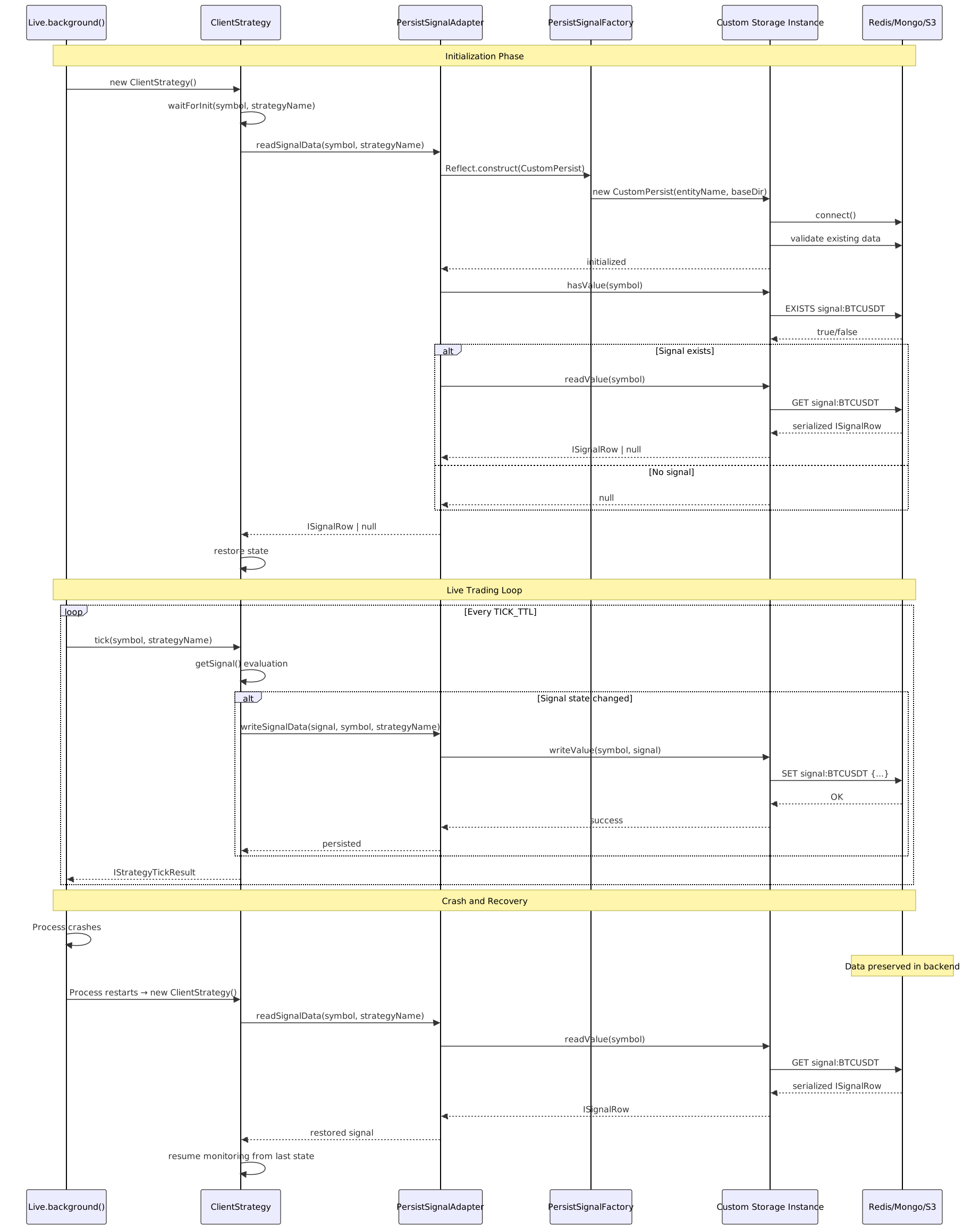
Lifecycle Guarantees:
- Initialization:
waitForInit()called exactly once per storage instance viasingleshot()pattern src/classes/Persist.ts:228-230 - Write Frequency: Signal persistence occurs on every state change src/client/ClientStrategy.ts:500-700
- Read Frequency: State loaded once during initialization, never re-read
- Cleanup: No explicit cleanup - storage instances remain memoized
Integration Patterns
Pattern 1: Single Backend for All Domains
// Use same Redis instance for all adapters
class RedisPersist extends PersistBase {
private static client: RedisClient | null = null;
constructor(entityName: string, baseDir: string) {
super(entityName, baseDir);
if (!RedisPersist.client) {
RedisPersist.client = new RedisClient(config);
}
}
async waitForInit(initial: boolean): Promise<void> {
if (initial) {
await RedisPersist.client!.connect();
}
}
}
// Register for all domains
PersistSignalAdapter.usePersistSignalAdapter(RedisPersist);
PersistRiskAdapter.usePersistRiskAdapter(RedisPersist);
PersistScheduleAdapter.usePersistScheduleAdapter(RedisPersist);
PersistPartialAdapter.usePersistPartialAdapter(RedisPersist);
Benefit: Connection pooling across all adapters reduces overhead.
Pattern 2: Namespace Isolation
// Separate Redis databases per domain
class SignalRedisPersist extends PersistBase {
constructor(entityName: string, baseDir: string) {
super(entityName, baseDir);
this.redis = new RedisClient({ db: 0 }); // Signals
}
}
class RiskRedisPersist extends PersistBase {
constructor(entityName: string, baseDir: string) {
super(entityName, baseDir);
this.redis = new RedisClient({ db: 1 }); // Risk
}
}
PersistSignalAdapter.usePersistSignalAdapter(SignalRedisPersist);
PersistRiskAdapter.usePersistRiskAdapter(RiskRedisPersist);
Benefit: Domain isolation prevents key collisions and simplifies debugging.
Pattern 3: Hybrid Storage
// Critical data in Redis, analytics in S3
PersistSignalAdapter.usePersistSignalAdapter(RedisPersist);
PersistRiskAdapter.usePersistRiskAdapter(RedisPersist);
PersistScheduleAdapter.usePersistScheduleAdapter(RedisPersist);
PersistPartialAdapter.usePersistPartialAdapter(S3Persist); // Analytics
Benefit: Optimize for read/write patterns - low-latency Redis for hot data, cost-effective S3 for cold analytics.
Best Practices
Performance Considerations
| Consideration | Recommendation | Rationale |
|---|---|---|
| Connection Pooling | Share client instances across memoized storage | src/classes/Persist.ts:518-525 creates multiple instances per symbol-strategy |
| Serialization | Pre-serialize JSON outside lock | Write operations are synchronous in default impl |
| Batch Writes | Not applicable | Each domain writes independently per state change |
| Read Caching | Unnecessary | State loaded once during waitForInit() |
Error Handling
Transient Failures: src/classes/Persist.ts:155-177 implements retry logic with exponential backoff for file deletion. Apply similar pattern for network operations.
Validation Failures: src/classes/Persist.ts:138-152 auto-deletes corrupted files. Custom backends should either:
- Return
nullfor corrupted data (graceful degradation) - Delete corrupted keys (self-healing)
- Throw errors for manual intervention
Testing
Unit Test Pattern:
describe("CustomPersist", () => {
it("should write and read entity atomically", async () => {
const persist = new CustomPersist("test-entity", "./test-data");
await persist.waitForInit(true);
const entity = { id: "abc", data: "value" };
await persist.writeValue("key1", entity);
const result = await persist.readValue("key1");
expect(result).toEqual(entity);
});
});
Integration Test Pattern:
it("should survive process restart", async () => {
PersistSignalAdapter.usePersistSignalAdapter(CustomPersist);
// Write signal
await PersistSignalAdapter.writeSignalData(signal, "BTCUSDT", "my-strategy");
// Simulate restart - clear memoized instances
// Re-initialize
const restored = await PersistSignalAdapter.readSignalData("BTCUSDT", "my-strategy");
expect(restored).toEqual(signal);
});
Security
Credential Management: Never hardcode credentials. Use environment variables or secret managers:
class SecureRedisPersist extends PersistBase {
constructor(entityName: string, baseDir: string) {
super(entityName, baseDir);
this.redis = new RedisClient({
host: process.env.REDIS_HOST,
password: process.env.REDIS_PASSWORD,
tls: process.env.NODE_ENV === "production"
});
}
}
Data Encryption: Encrypt sensitive signal data before persistence:
async writeValue<T>(entityId: EntityId, entity: T): Promise<void> {
const serialized = JSON.stringify(entity);
const encrypted = encrypt(serialized, this.encryptionKey);
await this.redis.set(this.getKey(entityId), encrypted);
}
Troubleshooting
Common Issues
Issue: Memoized instances not cleared after registration
Cause: src/classes/Persist.ts:518-525 memoization persists across registrations
Solution: Clear memoized caches or restart process after use*Adapter() calls
Issue: waitForInit() called multiple times
Cause: src/classes/Persist.ts:228-230 uses singleshot() but storage instance recreated
Solution: Ensure connection pooling in constructor, not in waitForInit()
Issue: Data not persisted in live mode
Cause: src/client/ClientPartial.ts:214-218 skips persistence in backtest mode
Solution: Verify backtest flag is false in live execution context
Issue: Key collisions across symbols
Cause: Incorrect memoization key format
Solution: Follow exact key format from src/classes/Persist.ts:519: ${symbol}:${strategyName}
Related Interfaces
See Persistence Layer for crash recovery architecture and atomic write guarantees.
See Persistence Utilities for public API documentation of PersistSignalAdapter, PersistRiskAdapter, PersistScheduleAdapter, and PersistPartialAdapter.
See Live Trading API for integration with Live.background() and crash recovery workflow.