Error Handling
This page documents the error handling infrastructure in backtest-kit, including error categorization, emission, propagation, and recovery patterns. The system implements a multi-tier error handling architecture that distinguishes between recoverable errors, fatal errors, and validation failures.
For logging system configuration, see Logging System. For persistence error handling, see Persistence Layer.
Error Categorization
The system categorizes errors into three distinct types, each with different handling semantics:
| Error Type | Emitter | Listener | Execution Behavior | Use Cases |
|---|---|---|---|---|
| Recoverable | errorEmitter |
listenError() |
Execution continues | API timeouts, network failures, non-critical callback errors |
| Fatal | exitEmitter |
listenExit() |
Execution terminates | Unrecoverable infrastructure failures, critical validation failures |
| Validation | validationSubject |
listenValidation() |
Logged, execution continues | Risk validation function errors, signal validation warnings |
Recoverable Errors are caught during background execution and emitted to errorEmitter. The system logs the error and continues operation. These typically occur during:
- Exchange API calls (
getCandles,formatPrice,formatQuantity) - Strategy callback execution (
onOpen,onClose,onActive) - User listener callbacks (
listenSignal,listenDoneBacktest)
Fatal Errors are emitted to exitEmitter when the system encounters unrecoverable failures. Background execution methods (Backtest.background(), Live.background(), Walker.background()) terminate when fatal errors occur.
Validation Errors are emitted to validationSubject when risk validation functions throw exceptions. These are logged for debugging but do not interrupt execution, allowing the signal to be rejected gracefully.
Error Emitters
The system defines three Subject-based error emitters in the global configuration:
errorEmitter
Emits recoverable errors caught during background execution. Used by Backtest.background(), Live.background(), and Walker.background() to report non-critical failures.
// src/config/emitters.ts:32-35
export const errorEmitter = new Subject<Error>();
Emission Points:
- Exchange API failures during retry exhaustion
- Strategy callback exceptions
- User listener callback exceptions
- Non-critical infrastructure failures
exitEmitter
Emits fatal errors that require process termination. Unlike errorEmitter, these errors stop current execution.
// src/config/emitters.ts:37-42
export const exitEmitter = new Subject<Error>();
Emission Points:
- Unrecoverable exchange integration failures
- Critical validation failures
- Background execution method crashes
validationSubject
Emits errors thrown by risk validation functions during checkSignal() execution. These are separated from errorEmitter to enable specialized monitoring of risk management failures.
// src/config/emitters.ts:105-108
export const validationSubject = new Subject<Error>();
Emission Points:
-
Risk validation function exceptions (
IRiskSchema.validation) -
Signal validation rule violations (30+ validation rules)
Error Flow Architecture

Error Listeners
The system provides three listener functions for subscribing to error events. All listeners use queued callback processing to ensure sequential execution.
listenError()
Subscribes to recoverable execution errors with queued async processing.
// Example: Monitor recoverable errors
listenError((error) => {
console.error("Recoverable error (execution continues):", error.message);
// Log to monitoring service
if (error.message.includes("EXCHANGE_API_ERROR")) {
monitoringService.alert("Exchange API failure", error);
}
// Retry logic for specific errors
if (error.message.includes("Network timeout")) {
scheduleRetry();
}
});
Callback Signature:
function listenError(fn: (error: Error) => void): () => void
Returns: Unsubscribe function to stop listening
Processing: Callbacks are processed sequentially using queued() wrapper, preventing concurrent execution even with async callbacks.
listenExit()
Subscribes to fatal execution errors that terminate the current process.
// Example: Handle fatal errors
listenExit((error) => {
console.error("Fatal error (execution terminated):", error.message);
// Cleanup resources
closeConnections();
// Send critical alert
alertingService.critical("Process terminated", error);
// Optionally restart
if (shouldAutoRestart(error)) {
process.exit(1); // Let process manager restart
}
});
Callback Signature:
function listenExit(fn: (error: Error) => void): () => void
Returns: Unsubscribe function to stop listening
Use Cases: Process monitoring, automatic restart logic, critical alerting, resource cleanup
listenValidation()
Subscribes to risk validation errors for debugging and monitoring validation failures.
// Example: Monitor validation failures
listenValidation((error) => {
console.error("Risk validation error:", error.message);
// Extract validation details
const isRiskLimit = error.message.includes("maxConcurrentPositions");
const isSignalInvalid = error.message.includes("Invalid signal");
if (isRiskLimit) {
metrics.increment("validation.risk_limit_hit");
} else if (isSignalInvalid) {
metrics.increment("validation.signal_rejected");
}
// Debug validation logic
debugLogger.log("Validation error details:", error.stack);
});
Callback Signature:
function listenValidation(fn: (error: Error) => void): () => void
Returns: Unsubscribe function to stop listening
Use Cases: Validation debugging, risk management monitoring, signal rejection tracking
Error Source Mapping

Queued Error Processing
All error listeners use the queued() wrapper from functools-kit to ensure sequential, ordered processing of error events. This prevents race conditions and ensures errors are handled in the order they occur.
Sequential Processing Guarantee
// Implementation pattern from src/function/event.ts:244-246
export function listenError(fn: (error: Error) => void) {
backtest.loggerService.log(LISTEN_ERROR_METHOD_NAME);
return errorEmitter.subscribe(queued(async (error) => fn(error)));
}
Key Properties:
- Order Preservation: Errors are processed in emission order, even if callbacks are async
- No Concurrency: Only one error callback executes at a time per listener
- Blocking Queue: If callback is slow, subsequent errors queue until completion
- Async Support: Callbacks can be async; queue waits for Promise resolution
Example: Queued vs Concurrent
// WITHOUT queued (WRONG): Concurrent execution
errorEmitter.subscribe(async (error) => {
await logToDatabase(error); // Multiple executions overlap
// Race condition possible
});
// WITH queued (CORRECT): Sequential execution
errorEmitter.subscribe(queued(async (error) => {
await logToDatabase(error); // Waits for previous to complete
// Order guaranteed
}));
Benefits:
-
Database Safety: Sequential writes prevent race conditions
-
Log Ordering: Errors appear in chronological order in logs
-
Resource Protection: Prevents concurrent access to shared resources
-
Debugging: Easier to trace error sequences
Error Recovery Patterns
Different error types require different recovery strategies. The system provides patterns for handling each error category.
Pattern 1: Retry on Recoverable Errors
// Exchange API failure with retry logic
let retryCount = 0;
const MAX_RETRIES = 3;
listenError((error) => {
if (error.message.includes("EXCHANGE_API_ERROR")) {
retryCount++;
if (retryCount < MAX_RETRIES) {
console.log(`Retry ${retryCount}/${MAX_RETRIES}...`);
// Framework will retry automatically via CC_GET_CANDLES_RETRY_COUNT
} else {
console.error("Max retries exhausted, skipping signal");
retryCount = 0;
}
}
});
Pattern 2: Graceful Degradation on Validation Errors
// Monitor validation failures without interrupting execution
const validationStats = {
riskLimitHits: 0,
invalidSignals: 0,
totalErrors: 0
};
listenValidation((error) => {
validationStats.totalErrors++;
if (error.message.includes("maxConcurrentPositions")) {
validationStats.riskLimitHits++;
// Risk limit hit - normal operation, no action needed
} else if (error.message.includes("Invalid signal")) {
validationStats.invalidSignals++;
// Signal rejected by validation - expected behavior
} else {
// Unexpected validation error - alert
console.error("Unexpected validation error:", error.message);
}
});
Pattern 3: Crash Recovery on Fatal Errors
// Process restart on fatal error
listenExit((error) => {
// Log critical error
fs.appendFileSync("fatal_errors.log",
`${new Date().toISOString()}: ${error.message}\n${error.stack}\n`
);
// Cleanup persistence state
PersistSignalAdapter.removeValue("BTCUSDT", "active_signal");
PersistRiskAdapter.removeValue("BTCUSDT", "active_positions");
// Alert monitoring
sendAlert({
level: "critical",
message: "Fatal error - process terminating",
error: error.message
});
// Exit for process manager restart
process.exit(1);
});
Pattern 4: Callback Error Isolation
// Prevent user callback errors from crashing execution
listenSignal((result) => {
try {
// User business logic
if (result.action === "closed") {
updateDatabase(result);
sendNotification(result);
}
} catch (error) {
// Errors here emit to errorEmitter
console.error("User callback error:", error);
// Framework continues execution
}
});
Error Testing Patterns
The test suite demonstrates comprehensive error handling verification using the defend test pattern:
Exchange API Failure Test
// test/e2e/defend.test.mjs:1664-1743
addExchange({
exchangeName: "binance-defend-exchange-error",
getCandles: async () => {
// Simulate infrastructure failure
throw new Error("EXCHANGE_API_ERROR: Network timeout - unable to fetch candles");
}
});
let errorCaught = null;
listenError((error) => {
errorCaught = error;
});
// Verify error was caught and emitted
if (!errorCaught) {
fail("Exchange error not caught");
}
Listener Callback Error Test
// test/e2e/defend.test.mjs:1754-1859
let errorCaught = null;
listenError((error) => {
errorCaught = error;
});
// Callback that throws error
listenSignalBacktest((result) => {
throw new Error("LISTENER_ERROR: User callback crashed");
});
// Verify error was caught and execution continued
if (!errorCaught || !errorCaught.message.includes("LISTENER_ERROR")) {
fail("Listener error not caught");
}
Test Coverage:
| Error Type | Test File | Lines | Verification |
|---|---|---|---|
| Exchange API failure | test/e2e/defend.test.mjs |
1664-1743 | errorEmitter receives error |
| Listener callback error | test/e2e/defend.test.mjs |
1754-1859 | errorEmitter receives error |
| Invalid signal validation | test/e2e/defend.test.mjs |
545-642 | Signal rejected, no emission |
| Risk validation failure | test/spec/risk.test.mjs |
N/A | validationSubject receives error |
- test/e2e/defend.test.mjs:1664-1743
- test/e2e/defend.test.mjs:1754-1859
- test/e2e/defend.test.mjs:545-642
Integration with Background Execution
Background execution methods (Backtest.background(), Live.background(), Walker.background()) integrate with the error system by catching exceptions and routing them to appropriate emitters.
Error Handling Flow in Background Methods
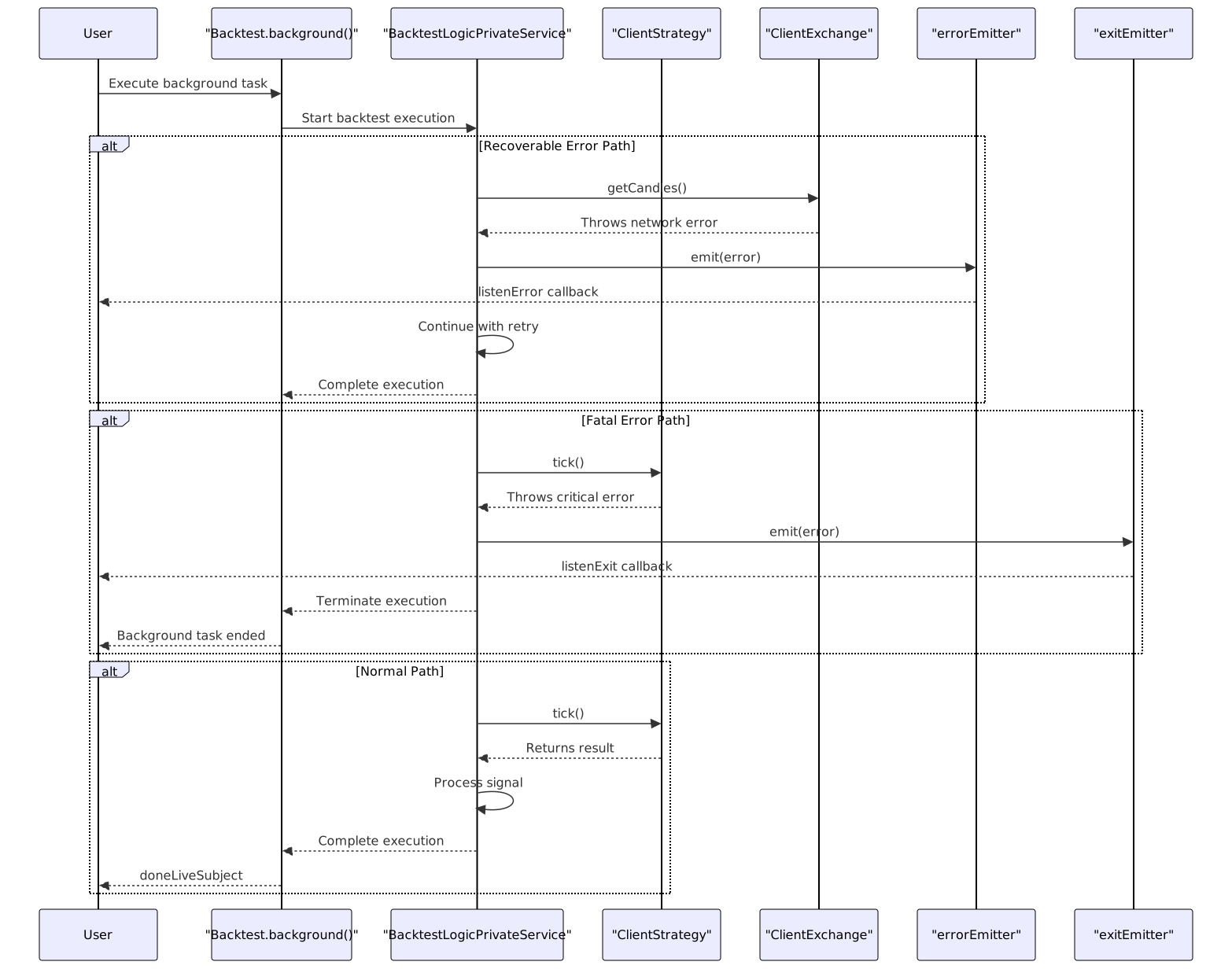
Error Boundaries:
-
Background methods establish error boundaries around execution
-
Recoverable errors emit to
errorEmitter, execution continues -
Fatal errors emit to
exitEmitter, background task terminates -
User callbacks wrapped in try-catch to prevent cascade failures
Best Practices
1. Always Subscribe to Error Listeners
// GOOD: Monitor all error types
listenError((error) => {
logger.error("Recoverable error:", error);
});
listenExit((error) => {
logger.critical("Fatal error:", error);
cleanup();
});
listenValidation((error) => {
logger.debug("Validation error:", error);
});
2. Distinguish Error Types in Handlers
listenError((error) => {
const message = error.message;
if (message.includes("EXCHANGE_API_ERROR")) {
handleExchangeError(error);
} else if (message.includes("LISTENER_ERROR")) {
handleCallbackError(error);
} else if (message.includes("Network timeout")) {
handleNetworkError(error);
} else {
handleGenericError(error);
}
});
3. Implement Graceful Degradation
let consecutiveErrors = 0;
listenError((error) => {
consecutiveErrors++;
if (consecutiveErrors > 10) {
// Too many errors - switch to safe mode
console.warn("Entering safe mode due to errors");
disableNonCriticalFeatures();
}
});
listenSignal((result) => {
if (result.action === "closed") {
// Reset error count on successful operation
consecutiveErrors = 0;
}
});
4. Log with Context
listenError((error) => {
logger.error("Error during execution", {
error: error.message,
stack: error.stack,
timestamp: new Date().toISOString(),
mode: getMode(), // backtest or live
symbol: getCurrentSymbol(),
strategy: getCurrentStrategy()
});
});
5. Clean Up on Fatal Errors
listenExit(async (error) => {
// Log critical error
await logger.critical("Fatal error", error);
// Close all connections
await closeExchangeConnections();
await closeDatabaseConnections();
// Clear persistence state
await clearCrashRecoveryState();
// Send alerts
await sendCriticalAlert(error);
// Allow async operations to complete
await sleep(1000);
// Exit for restart
process.exit(1);
});