Validation Services
Purpose and Scope
Validation Services provide schema validation and runtime checks for all component types in the framework. These services ensure that components are correctly configured at registration time and that runtime data (signals, prices, risk parameters) meets safety constraints before execution. Validation Services act as gatekeepers between the public API and the execution engine, preventing invalid configurations from causing runtime errors or financial losses.
For information about how validated schemas are stored and retrieved, see Schema Services. For details on how validation results flow into execution, see Global Services.
Architecture Overview
Validation Services in the DI System

Validation Flow: Registration to Execution

Validation Service Types
The framework provides six validation service classes, one for each component type. All validation services follow a common pattern: they validate schemas at registration time, memoize validation results, and provide a list() method for retrieving registered schemas.
Service Responsibilities Table
| Service Class | Component Type | Primary Responsibilities | DI Symbol |
|---|---|---|---|
StrategyValidationService |
Strategy | Signal generation validation, interval checks, risk/sizing references | TYPES.strategyValidationService |
ExchangeValidationService |
Exchange | Market data interface validation, formatting function checks | TYPES.exchangeValidationService |
FrameValidationService |
Frame | Timeframe configuration validation, date range checks | TYPES.frameValidationService |
RiskValidationService |
Risk | Position limit validation, custom validation function checks | TYPES.riskValidationService |
SizingValidationService |
Sizing | Position sizing method validation, parameter range checks | TYPES.sizingValidationService |
WalkerValidationService |
Walker | Strategy comparison validation, metric selection checks | TYPES.walkerValidationService |
Common Service Interface
All validation services implement a consistent interface pattern:
interface IValidationService<TSchema> {
// Store and validate schema
addComponent(name: string, schema: TSchema): void;
// Retrieve all registered schemas
list(): Promise<TSchema[]>;
// Internal validation logic (memoized)
_validateSchema(schema: TSchema): ValidationResult;
}
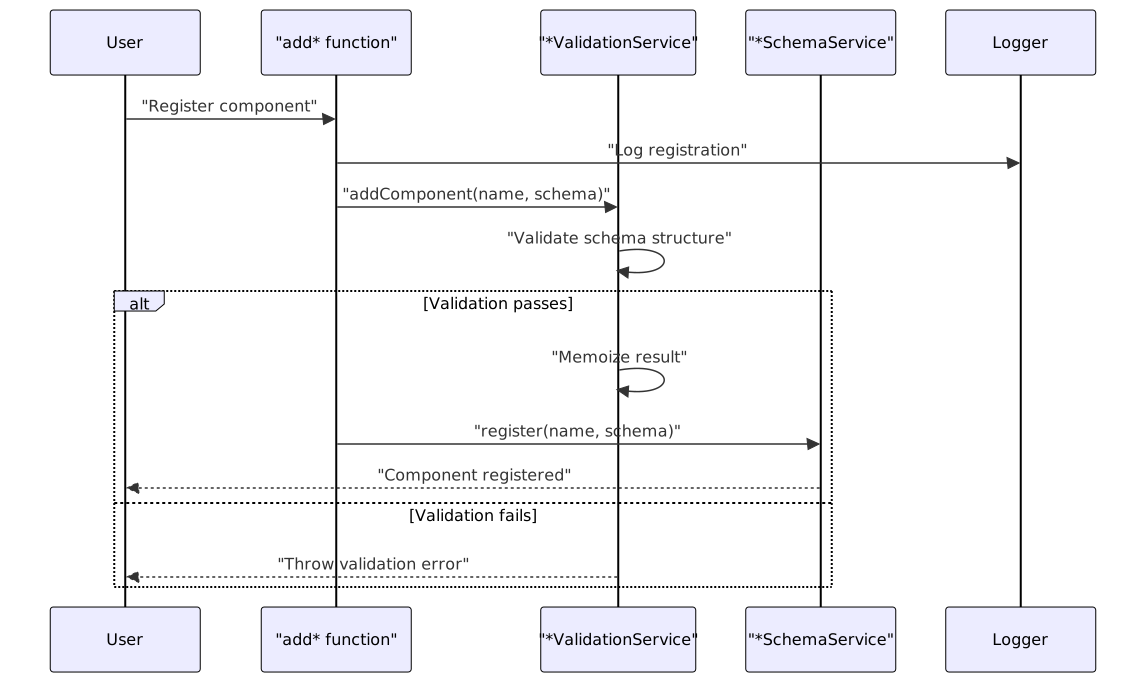
The addComponent method (named addStrategy, addExchange, etc.) is called by the corresponding add* functions in the public API. Validation results are memoized to avoid repeated validation of the same schema.
Schema Validation
Registration-Time Validation
Schema validation occurs when a component is registered via an add* function. The validation flow follows this sequence:
Validation Checks by Component Type
Each validation service performs component-specific checks:
Strategy Validation
strategyNameis non-empty stringintervalmatchesFrameIntervalenum valuesgetSignalis an async functionriskNamereference exists (if specified)sizingNamereference exists (if specified)callbacksstructure is valid (if specified)
Exchange Validation
exchangeNameis non-empty stringgetCandlesis an async function returning candle arrayformatPriceis an async functionformatQuantityis an async functioncallbacksstructure is valid (if specified)
Frame Validation
frameNameis non-empty stringintervalmatchesFrameIntervalenum valuesstartDateis valid Date objectendDateis valid Date objectstartDate < endDatecallbacksstructure is valid (if specified)
Risk Validation
riskNameis non-empty stringmaxConcurrentPositionsis positive integer (if specified)validationsarray contains valid functions (if specified)callbacksstructure is valid (if specified)
Sizing Validation
sizingNameis non-empty stringmethodis one of:"fixed-percentage","kelly-criterion","atr-based"- Method-specific parameters are valid (e.g.,
riskPercentage,kellyMultiplier) callbacksstructure is valid (if specified)
Walker Validation
walkerNameis non-empty stringexchangeNamereference existsframeNamereference existsstrategiesis non-empty array of strategy names- All referenced strategies exist
metricis valid metric name (if specified)callbacksstructure is valid (if specified)
Memoization Pattern
Validation services use memoization to cache validation results. Once a schema is validated, subsequent calls with the same schema name return the cached result without re-running validation logic. This optimization is critical for performance during execution when validation services may be called frequently.
Signal Validation
VALIDATE_SIGNAL_FN: Runtime Signal Checks
Signal validation occurs at runtime when a strategy generates a signal via getSignal(). The validation function VALIDATE_SIGNAL_FN in src/client/ClientStrategy.ts:41-261 performs comprehensive checks to ensure the signal is financially sound and meets safety constraints.
The function is invoked within GET_SIGNAL_FN at src/client/ClientStrategy.ts:263-396 after signal creation but before the signal is returned for execution. This ensures that invalid signals are rejected immediately without entering the execution pipeline.
Runtime Signal Validation Flow

Price Validation Checks
The framework validates all price fields to prevent impossible or dangerous trades. These checks occur in VALIDATE_SIGNAL_FN at src/client/ClientStrategy.ts:64-103:
| Check | Condition | Error Message Location | Purpose |
|---|---|---|---|
| Finite Numbers | isFinite(currentPrice), isFinite(priceOpen), isFinite(priceTakeProfit), isFinite(priceStopLoss) |
src/client/ClientStrategy.ts:65-89 | Prevent NaN or Infinity values that cause calculation explosions |
| Positive Prices | currentPrice > 0, priceOpen > 0, priceTakeProfit > 0, priceStopLoss > 0 |
src/client/ClientStrategy.ts:70-102 | Prevent negative or zero prices that indicate data corruption |
| Required Fields | id !== '', exchangeName !== '', strategyName !== '', symbol !== '' |
src/client/ClientStrategy.ts:45-62 | Ensure signal has all required metadata for tracking |
Example: NaN Price Rejection
// This signal will be rejected at validation
{
position: "long",
priceOpen: NaN, // Invalid: causes "priceOpen must be a finite number" error
priceTakeProfit: 43000,
priceStopLoss: 41000,
minuteEstimatedTime: 60
}
Price Validation Checks
The framework validates all price fields to prevent impossible or dangerous trades:
| Check | Condition | Purpose |
|---|---|---|
| Positive Prices | priceOpen > 0, priceTakeProfit > 0, priceStopLoss > 0 |
Prevent negative or zero prices |
| Finite Numbers | isFinite(priceOpen), isFinite(priceTakeProfit), isFinite(priceStopLoss) |
Prevent NaN or Infinity values |
| Non-NaN | !isNaN(priceOpen), !isNaN(priceTakeProfit), !isNaN(priceStopLoss) |
Prevent calculation explosions |
Example: Negative Price Rejection
// This signal will be rejected at validation
{
position: "long",
priceOpen: -42000, // Invalid: negative price
priceTakeProfit: 43000,
priceStopLoss: 41000,
minuteEstimatedTime: 60
}
TP/SL Logic Validation
The framework enforces position-specific logic for Take Profit and Stop Loss prices. These checks occur at src/client/ClientStrategy.ts:104-222 and implement different rules for LONG vs SHORT positions:
LONG Position Logic (src/client/ClientStrategy.ts:105-162):
- Take Profit must be above entry:
priceTakeProfit > priceOpen(line 107-109) - Stop Loss must be below entry:
priceStopLoss < priceOpen(line 111-114) - For immediate signals (not scheduled):
currentPricemust not have already hit TP/SL (line 119-134)
SHORT Position Logic (src/client/ClientStrategy.ts:165-222):
- Take Profit must be below entry:
priceTakeProfit < priceOpen(line 166-169) - Stop Loss must be above entry:
priceStopLoss > priceOpen(line 171-174) - For immediate signals (not scheduled):
currentPricemust not have already hit TP/SL (line 179-194)
Edge Case Protection: Immediate TP/SL Hit
The validation includes critical edge case checks at src/client/ClientStrategy.ts:119-134 (LONG) and src/client/ClientStrategy.ts:179-194 (SHORT):
// LONG edge case check (line 119-134)
if (!isScheduled) {
// Signal would immediately close at SL
if (isFinite(currentPrice) && currentPrice < signal.priceStopLoss) {
errors.push(
`Long: currentPrice (${currentPrice}) < priceStopLoss (${signal.priceStopLoss}). ` +
`Signal would be immediately cancelled. This signal is invalid.`
);
}
// Profit opportunity already passed
if (isFinite(currentPrice) && currentPrice > signal.priceTakeProfit) {
errors.push(
`Long: currentPrice (${currentPrice}) > priceTakeProfit (${signal.priceTakeProfit}). ` +
`Signal is invalid - the profit opportunity has already passed.`
);
}
}
Example: Invalid LONG Signal
// This signal will be rejected at validation
{
position: "long",
priceOpen: 41000,
priceTakeProfit: 40000, // Invalid: TP below priceOpen for LONG
priceStopLoss: 39000,
minuteEstimatedTime: 60
}
// Error: "Long: priceTakeProfit (40000) must be > priceOpen (41000)"
Example: Invalid SHORT Signal
// This signal will be rejected at validation
{
position: "short",
priceOpen: 43000,
priceTakeProfit: 44000, // Invalid: TP above priceOpen for SHORT
priceStopLoss: 45000,
minuteEstimatedTime: 60
}
// Error: "Short: priceTakeProfit (44000) must be < priceOpen (43000)"
Distance Validation
The framework validates minimum and maximum distances for Take Profit and Stop Loss to ensure trades are profitable after fees and risk is bounded. These checks use GLOBAL_CONFIG parameters defined in types.d.ts:5-72:
| Parameter | Default Value | Validation Location | Purpose |
|---|---|---|---|
CC_MIN_TAKEPROFIT_DISTANCE_PERCENT |
0.3% | src/client/ClientStrategy.ts:138-148 (LONG) src/client/ClientStrategy.ts:198-208 (SHORT) |
Ensure TP distance covers trading fees (2×0.1% = 0.2%) plus minimum profit margin |
CC_MAX_STOPLOSS_DISTANCE_PERCENT |
20% | src/client/ClientStrategy.ts:151-161 (LONG) src/client/ClientStrategy.ts:211-221 (SHORT) |
Prevent catastrophic losses (one signal cannot lose >20% of position) |
LONG Distance Calculation:
// Take Profit distance validation (line 138-148)
const tpDistancePercent =
((signal.priceTakeProfit - signal.priceOpen) / signal.priceOpen) * 100;
if (tpDistancePercent < GLOBAL_CONFIG.CC_MIN_TAKEPROFIT_DISTANCE_PERCENT) {
errors.push(
`Long: TakeProfit too close to priceOpen (${tpDistancePercent.toFixed(3)}%). ` +
`Minimum distance: ${GLOBAL_CONFIG.CC_MIN_TAKEPROFIT_DISTANCE_PERCENT}% to cover trading fees.`
);
}
// Stop Loss distance validation (line 151-161)
const slDistancePercent =
((signal.priceOpen - signal.priceStopLoss) / signal.priceOpen) * 100;
if (slDistancePercent > GLOBAL_CONFIG.CC_MAX_STOPLOSS_DISTANCE_PERCENT) {
errors.push(
`Long: StopLoss too far from priceOpen (${slDistancePercent.toFixed(3)}%). ` +
`Maximum distance: ${GLOBAL_CONFIG.CC_MAX_STOPLOSS_DISTANCE_PERCENT}% to protect capital.`
);
}
SHORT Distance Calculation:
// Take Profit distance validation (line 198-208)
const tpDistancePercent =
((signal.priceOpen - signal.priceTakeProfit) / signal.priceOpen) * 100;
// Stop Loss distance validation (line 211-221)
const slDistancePercent =
((signal.priceStopLoss - signal.priceOpen) / signal.priceOpen) * 100;
Example: Micro-Profit Rejection
// This signal will be rejected at validation
{
position: "long",
priceOpen: 42000,
priceTakeProfit: 42010, // Only 0.024% profit - fees will eat profit
priceStopLoss: 41000,
minuteEstimatedTime: 60
}
// Error: "Long: TakeProfit too close to priceOpen (0.024%).
// Minimum distance: 0.3% to cover trading fees."
// Net PNL after fees: 0.024% - 0.2% = -0.176% (loss!)
Example: Extreme Stop Loss Rejection
// This signal will be rejected at validation
{
position: "long",
priceOpen: 42000,
priceTakeProfit: 43000,
priceStopLoss: 20000, // -52% loss - catastrophic risk!
minuteEstimatedTime: 60
}
// Error: "Long: StopLoss too far from priceOpen (52.381%).
// Maximum distance: 20% to protect capital."
Lifetime Validation
The framework validates signal lifetime to prevent "eternal signals" that block risk limits indefinitely. These checks occur at src/client/ClientStrategy.ts:224-247:
| Parameter | Default Value | Validation Location | Purpose |
|---|---|---|---|
CC_MAX_SIGNAL_LIFETIME_MINUTES |
1440 (1 day) | src/client/ClientStrategy.ts:237-246 | Prevent signals from blocking positions for weeks/months |
Lifetime Validation Logic:
// Basic checks (line 225-234)
if (signal.minuteEstimatedTime <= 0) {
errors.push(`minuteEstimatedTime must be positive, got ${signal.minuteEstimatedTime}`);
}
if (!Number.isInteger(signal.minuteEstimatedTime)) {
errors.push(`minuteEstimatedTime must be an integer (whole number), got ${signal.minuteEstimatedTime}`);
}
// Maximum lifetime check (line 237-246)
if (GLOBAL_CONFIG.CC_MAX_SIGNAL_LIFETIME_MINUTES) {
if (signal.minuteEstimatedTime > GLOBAL_CONFIG.CC_MAX_SIGNAL_LIFETIME_MINUTES) {
const days = (signal.minuteEstimatedTime / 60 / 24).toFixed(1);
const maxDays = (GLOBAL_CONFIG.CC_MAX_SIGNAL_LIFETIME_MINUTES / 60 / 24).toFixed(0);
errors.push(
`minuteEstimatedTime too large (${signal.minuteEstimatedTime} minutes = ${days} days). ` +
`Maximum: ${GLOBAL_CONFIG.CC_MAX_SIGNAL_LIFETIME_MINUTES} minutes (${maxDays} days) to prevent strategy deadlock. ` +
`Eternal signals block risk limits and prevent new trades.`
);
}
}
Example: Excessive Lifetime Rejection
// This signal will be rejected at validation
{
position: "long",
priceOpen: 42000,
priceTakeProfit: 43000,
priceStopLoss: 41000,
minuteEstimatedTime: 50000 // >34 days - strategy deadlock risk!
}
// Error: "minuteEstimatedTime too large (50000 minutes = 34.7 days).
// Maximum: 1440 minutes (1 days) to prevent strategy deadlock.
// Eternal signals block risk limits and prevent new trades."
Global Configuration Parameters
Validation behavior is controlled by global configuration parameters that can be modified at runtime using setConfig():
Configuration Parameters Table
| Parameter | Type | Default | Type Definition | Description |
|---|---|---|---|---|
CC_MIN_TAKEPROFIT_DISTANCE_PERCENT |
number |
0.3 | types.d.ts:20-22 | Minimum TP distance from priceOpen (percentage). Must be greater than trading fees (2×0.1% = 0.2%) to ensure profitable trades. |
CC_MAX_STOPLOSS_DISTANCE_PERCENT |
number |
20 | types.d.ts:23-27 | Maximum SL distance from priceOpen (percentage). Prevents catastrophic losses from extreme StopLoss values. One signal cannot lose more than 20% of position. |
CC_MAX_SIGNAL_LIFETIME_MINUTES |
number |
1440 | types.d.ts:29-32 | Maximum signal lifetime in minutes. Prevents eternal signals that block risk limits for weeks/months. Default: 1440 minutes = 1 day. |
CC_SCHEDULE_AWAIT_MINUTES |
number |
120 | types.d.ts:7-10 | Time to wait for scheduled signal to activate (in minutes). Scheduled signals that don't reach priceOpen within this time are cancelled. |
CC_AVG_PRICE_CANDLES_COUNT |
number |
5 | types.d.ts:12-14 | Number of candles to use for average price calculation (VWAP). Default: 5 candles = last 5 minutes when using 1m interval. |
CC_GET_CANDLES_RETRY_COUNT |
number |
3 | types.d.ts:35-37 | Number of retries for getCandles() function when exchange API fails. |
CC_GET_CANDLES_RETRY_DELAY_MS |
number |
5000 | types.d.ts:38-42 | Delay between retries for getCandles() function in milliseconds. Default: 5000ms = 5 seconds. |
Example: Customizing Validation Parameters
import { setConfig } from "backtest-kit";
// Stricter validation for high-leverage trading
setConfig({
CC_MIN_TAKEPROFIT_DISTANCE_PERCENT: 0.5, // Require 0.5% minimum TP
CC_MAX_STOPLOSS_DISTANCE_PERCENT: 10, // Limit SL to 10% max (tighter risk)
CC_MAX_SIGNAL_LIFETIME_MINUTES: 720, // Limit signals to 12 hours
CC_SCHEDULE_AWAIT_MINUTES: 60, // Cancel scheduled signals after 1 hour
});
The setConfig() function is defined in the public API and updates GLOBAL_CONFIG values. These parameters are then accessed by VALIDATE_SIGNAL_FN during signal validation at src/client/ClientStrategy.ts:138, src/client/ClientStrategy.ts:151, src/client/ClientStrategy.ts:237.
Common Patterns
Pattern 1: Validation at Registration
All add* functions follow the same pattern:
- Log the registration attempt
- Call the validation service's
addComponentmethod - Call the schema service's
registermethod
// Pattern from src/function/add.ts:50-62
export function addStrategy(strategySchema: IStrategySchema) {
backtest.loggerService.info(ADD_STRATEGY_METHOD_NAME, {
strategySchema,
});
backtest.strategyValidationService.addStrategy(
strategySchema.strategyName,
strategySchema
);
backtest.strategySchemaService.register(
strategySchema.strategyName,
strategySchema
);
}
This two-phase approach ensures that invalid schemas are rejected before being stored, preventing runtime errors later in the execution pipeline.
Pattern 2: Validation Result Memoization
Validation services memoize validation results to avoid redundant checks. Once a schema is validated, subsequent references to the same component name use the cached validation result. This is critical for performance during execution when components may be referenced hundreds or thousands of times.
Pattern 3: Listing Registered Schemas
All validation services provide a list() method that returns an array of all registered schemas. This is used for debugging, documentation generation, and building dynamic UIs:
// Pattern from src/function/list.ts:41-44
export async function listExchanges(): Promise<IExchangeSchema[]> {
backtest.loggerService.log(LIST_EXCHANGES_METHOD_NAME);
return await backtest.exchangeValidationService.list();
}
Pattern 4: Reference Validation
Some validation services check that referenced components exist. For example, WalkerValidationService validates that all strategy names in the strategies array exist, and that the exchangeName and frameName references are valid.
This cross-component validation ensures that the execution engine never attempts to use non-existent components, preventing runtime errors.
Error Handling
Validation Errors
When validation fails, the validation service throws an error immediately. This error propagates back to the caller (typically the add* function), which then propagates to the user. Validation errors are synchronous and deterministic - they occur at registration time, not at execution time.
Example Error Scenarios:
- Invalid Schema Structure: Missing required fields or invalid types
- Reference Errors: Referenced components don't exist (e.g.,
riskNamenot registered) - Constraint Violations: Values outside valid ranges (e.g., negative
maxConcurrentPositions) - Runtime Signal Validation: Invalid signal prices, TP/SL logic, or lifetime
Signal Rejection vs. Validation Errors
It's important to distinguish between two types of validation failures:
| Type | Timing | Behavior | Implementation | Example |
|---|---|---|---|---|
| Schema Validation Error | Registration time | Throws exception, prevents component registration | Direct throw in add* functions |
Missing strategyName field |
| Signal Rejection | Runtime (during execution) | Returns null, wrapped in trycatch() |
src/client/ClientStrategy.ts:263-396 | TP/SL distances too close |
Signal Rejection Flow:
Signal rejections use trycatch() from functools-kit at src/client/ClientStrategy.ts:263 to catch validation errors:
const GET_SIGNAL_FN = trycatch(
async (self: ClientStrategy): Promise<ISignalRow | IScheduledSignalRow | null> => {
// ... signal generation and validation ...
VALIDATE_SIGNAL_FN(signalRow, currentPrice, false);
return signalRow;
},
{
defaultValue: null, // Return null on validation failure
fallback: (error) => {
backtest.loggerService.warn("ClientStrategy exception thrown", {
error: errorData(error),
message: getErrorMessage(error),
});
errorEmitter.next(error); // Emit to errorEmitter for monitoring
},
}
);
This pattern ensures that:
- Invalid signals return
nullinstead of throwing exceptions - Validation errors are logged via
LoggerService - Error events are emitted to
errorEmitterfor external monitoring - Execution continues normally (strategy remains in
idlestate)
Schema validation errors, in contrast, throw immediately at registration time and prevent the component from being stored in the schema service.
Integration with Other Services
Validation → Schema Storage Flow

After a schema passes validation:
- It's stored in the corresponding
*SchemaService(see Schema Services) - During execution,
*ConnectionServiceretrieves it (see Connection Services) *ConnectionServicecreates a memoizedClient*instance- The
Client*instance uses the validated schema for all operations
This ensures that only validated schemas reach the execution engine.
Validation Service DI Bindings
All validation services are registered in the DI container as singletons:
// From src/lib/core/provide.ts:102-109
{
provide(TYPES.exchangeValidationService, () => new ExchangeValidationService());
provide(TYPES.strategyValidationService, () => new StrategyValidationService());
provide(TYPES.frameValidationService, () => new FrameValidationService());
provide(TYPES.walkerValidationService, () => new WalkerValidationService());
provide(TYPES.sizingValidationService, () => new SizingValidationService());
provide(TYPES.riskValidationService, () => new RiskValidationService());
}
The singleton pattern ensures that validation results and registered schemas are shared across the entire application lifecycle.