ClientRisk
Purpose and Scope
ClientRisk is the core implementation of the IRisk interface responsible for signal validation and position tracking within the backtest-kit framework. This class executes user-defined validation rules, enforces risk management policies, and maintains active position counts across trading strategies.
This document covers the internal implementation of ClientRisk and how it integrates with the signal lifecycle. For information about:
- Defining risk schemas via
addRisk(), see Risk Schemas - The broader risk management system, see Risk Management
- Position tracking mechanisms, see Position Tracking
IRisk Interface Contract
ClientRisk implements the IRisk interface, which defines three core methods for risk management:
| Method | Purpose | When Called |
|---|---|---|
checkSignal |
Validates pending signal against risk rules | Before opening position (immediate or scheduled) |
addSignal |
Tracks new active position | After signal validation passes |
removeSignal |
Removes position from tracking | When signal closes (TP/SL/timeout) |

Risk Schema Execution Model
ClientRisk wraps user-defined risk schemas registered via addRisk(). Each schema contains an array of validation rules that are executed sequentially:

Signal Validation Flow (checkSignal)
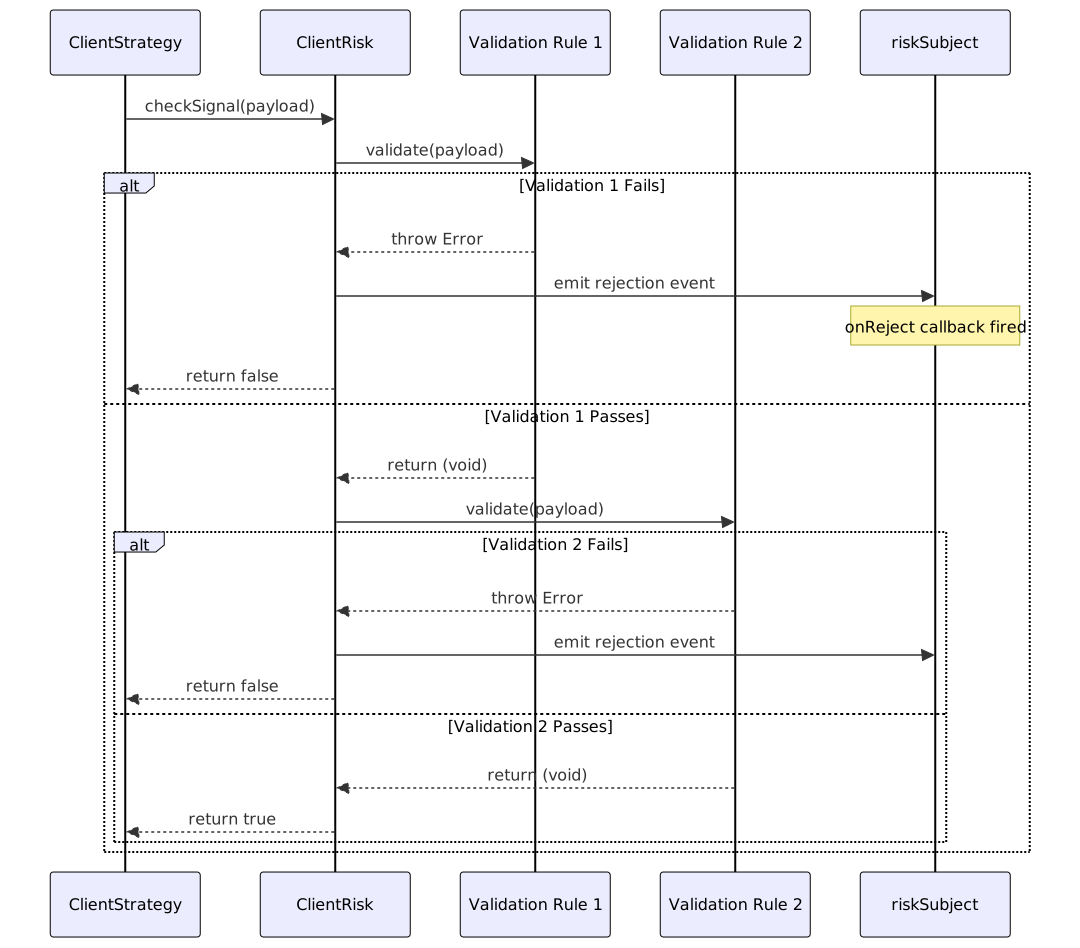
The checkSignal method is the primary entry point for risk validation. It receives a validation payload and executes all registered validation rules:
Validation Payload Structure
interface ICheckSignalPayload {
pendingSignal: ISignalDto; // Signal to validate
symbol: string; // Trading pair (e.g., "BTCUSDT")
strategyName: StrategyName; // Strategy identifier
exchangeName: ExchangeName; // Exchange identifier
currentPrice: number; // Current VWAP price
timestamp: number; // Unix timestamp (ms)
}
Validation Execution Sequence
Validation Rule Examples
Risk schemas define validation functions that throw errors on failure. Common validation patterns include:
Distance Validation
Ensures take profit and stop loss are sufficiently distant from entry price to avoid micro-profits and instant stop-outs:
// Example: Minimum TP distance validation
{
validate: ({ pendingSignal, currentPrice }) => {
const { priceOpen = currentPrice, priceTakeProfit, position } = pendingSignal;
const tpDistance = position === "long"
? ((priceTakeProfit - priceOpen) / priceOpen) * 100
: ((priceOpen - priceTakeProfit) / priceOpen) * 100;
if (tpDistance < 1) {
throw new Error(`TP distance ${tpDistance.toFixed(2)}% < 1%`);
}
},
note: "TP distance must be at least 1%"
}
Risk-Reward Ratio Validation
Ensures favorable risk-reward ratio:
// Example: Minimum 1:2 RR ratio validation
{
validate: ({ pendingSignal, currentPrice }) => {
const { priceOpen = currentPrice, priceTakeProfit, priceStopLoss, position } = pendingSignal;
const reward = position === "long"
? priceTakeProfit - priceOpen
: priceOpen - priceTakeProfit;
const risk = position === "long"
? priceOpen - priceStopLoss
: priceStopLoss - priceOpen;
const rrRatio = reward / risk;
if (rrRatio < 2) {
throw new Error(`RR ratio ${rrRatio.toFixed(2)} < 2:1`);
}
},
note: "Risk-Reward ratio must be at least 1:2"
}
Position Tracking (addSignal / removeSignal)
ClientRisk maintains active position counts per symbol-strategy pair to enforce concurrent position limits:

Position Tracking Methods
| Method | Signature | Purpose |
|---|---|---|
addSignal |
(symbol: string, ctx: {strategyName, riskName}) => Promise<void> |
Increments position counter for symbol-strategy pair |
removeSignal |
(symbol: string, ctx: {strategyName, riskName}) => Promise<void> |
Decrements position counter when signal closes |
Integration Points

Fail-Fast Validation Pattern
ClientRisk implements a fail-fast validation pattern where the first validation failure immediately stops execution:

This pattern ensures:
- Early termination on first rule violation
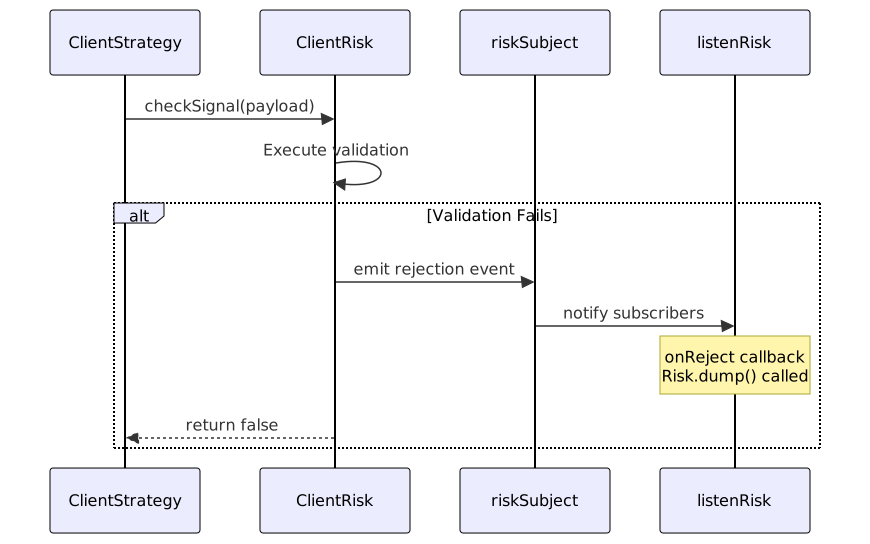
- Single rejection event emitted per validation attempt
- Diagnostic information via
notefield in validation rule - Optional callbacks via
onRejectfor custom handling
NOOP Risk Implementation
When a strategy has no riskName configured, ClientRisk is replaced with a no-op implementation that always passes validation:
const NOOP_RISK: IRisk = {
checkSignal: () => Promise.resolve(true),
addSignal: () => Promise.resolve(),
removeSignal: () => Promise.resolve(),
}
This allows strategies to operate without risk management while maintaining the same interface contract.
Integration with RiskConnectionService
ClientRisk instances are managed by RiskConnectionService, which provides routing and memoization:

The connection service ensures:
- One instance per risk profile via memoization
- Efficient routing based on
riskNamestring - Fallback to NOOP when no risk profile assigned
Risk Event Emission
When validation fails, ClientRisk emits rejection events through the riskSubject event emitter:
Risk Event Structure
interface IRiskEvent {
symbol: string;
strategyName: StrategyName;
exchangeName: ExchangeName;
pendingSignal: ISignalDto;
currentPrice: number;
timestamp: number;
rejectionReason: string; // Error message from validation
validationNote: string; // "note" field from validation rule
}
Summary
ClientRisk serves as the gatekeeper for signal execution, enforcing user-defined risk policies before positions are opened. Key characteristics:
| Aspect | Implementation |
|---|---|
| Interface | Implements IRisk with three methods |
| Validation Model | Sequential execution with fail-fast pattern |
| Position Tracking | Maintains active position counts per symbol-strategy |
| Integration | Called by ClientStrategy during signal lifecycle |
| Event System | Emits rejection events through riskSubject |
| Flexibility | Supports custom validation logic via schemas |
| Fallback | NOOP implementation when no risk profile assigned |
The separation of ClientRisk from dependency injection allows risk logic to be pure, testable, and reusable across different execution contexts (backtest, live, walker).