ClientRisk
This page documents the ClientRisk class, which implements portfolio-level risk management by tracking active positions across strategies and executing custom validation logic. For information about the risk schema registration and validation services, see Risk Schemas and Risk Management. For information about risk validation services in the service layer, see Validation Services.
Purpose and Scope
ClientRisk is a client class that provides portfolio-level risk management without dependency injection. It tracks active positions across multiple strategies sharing the same risk profile, executes custom validation functions, and provides crash-safe persistence of position state. The class is instantiated once per riskName and used by multiple ClientStrategy instances to ensure consistent risk limits across the portfolio.
Core Responsibilities
ClientRisk implements the IRisk interface and provides three primary operations:
| Method | Purpose | Called By |
|---|---|---|
checkSignal(params) |
Validates if a new position should be allowed based on custom validations | ClientStrategy before signal creation |
addSignal(symbol, context) |
Registers a newly opened position | StrategyConnectionService after signal opens |
removeSignal(symbol, context) |
Removes a closed position | StrategyConnectionService after signal closes |
All operations are asynchronous and support persistence for crash recovery in live trading mode.
Architecture Overview

Key Integration Points:
RiskConnectionServicecreates and memoizesClientRiskinstances (one perriskName)ClientStrategycalls risk checks before generating new signalsPersistRiskAdapterprovides crash-safe persistence for live mode- Multiple strategies can share the same
ClientRiskinstance for cross-strategy limits
Position Tracking Mechanism
Active Position Storage
ClientRisk maintains a Map of active positions with a composite key pattern:
// Key pattern: strategyName:symbol
const GET_KEY_FN = (strategyName: string, symbol: string) => `${strategyName}:${symbol}`;
Each entry stores:
interface IRiskActivePosition {
signal: ISignalRow; // Signal details (null for tracking-only)
strategyName: string; // Strategy owning the position
exchangeName: string; // Exchange name
openTimestamp: number; // When position was opened
}
Lazy Initialization Pattern
The _activePositions field uses a special initialization pattern:

Implementation Details:
| State | Type | Meaning |
|---|---|---|
POSITION_NEED_FETCH |
Symbol |
Initial state, positions not yet loaded |
Map<string, IRiskActivePosition> |
Map |
Initialized state with position data |
The waitForInit method uses singleshot pattern to ensure initialization happens exactly once:
private waitForInit = singleshot(async () => await WAIT_FOR_INIT_FN(this));
Risk Validation Flow
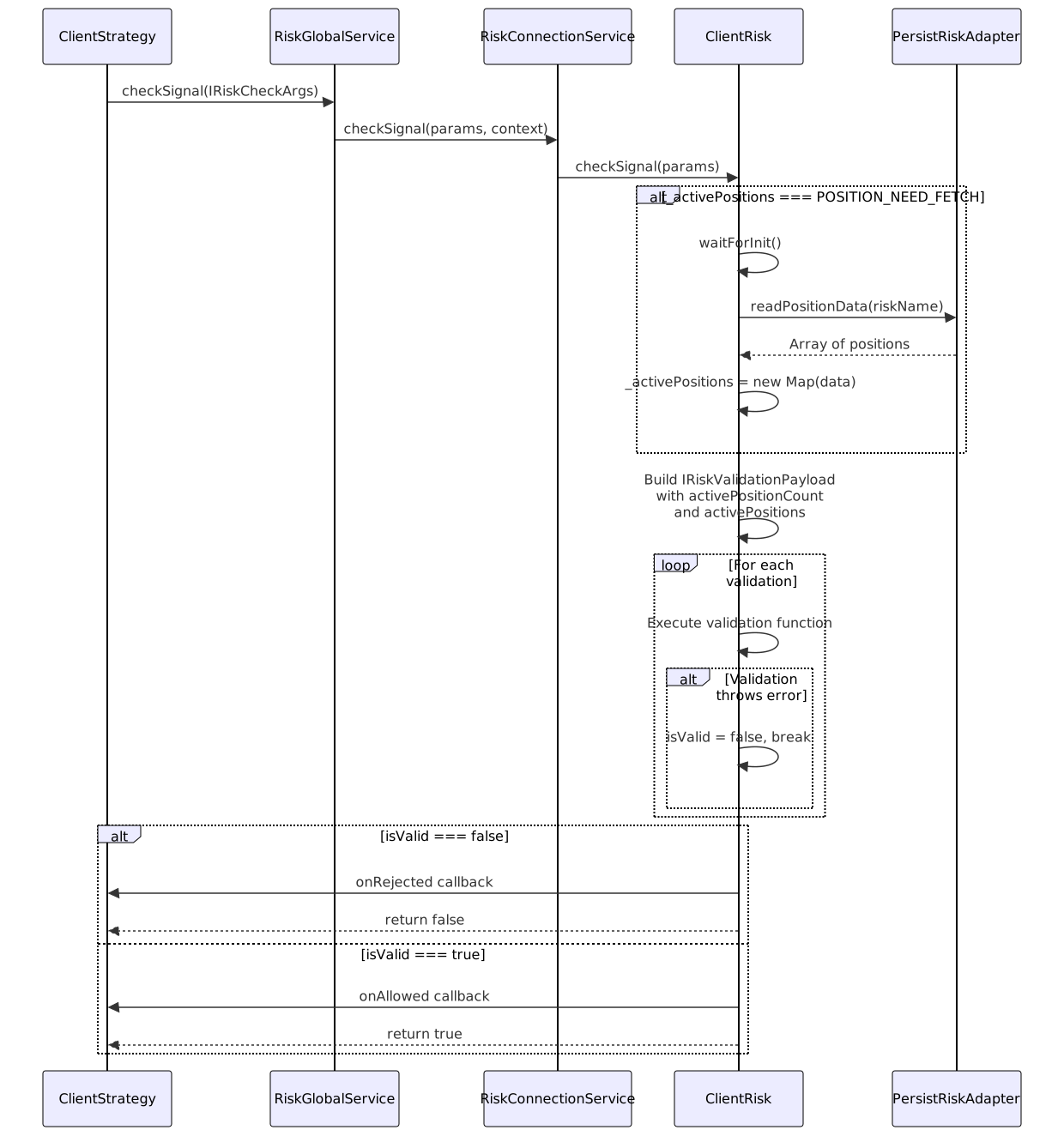
Signal Check Process
Validation Execution
Custom validations receive IRiskValidationPayload with complete portfolio state:
| Field | Source | Purpose |
|---|---|---|
symbol |
IRiskCheckArgs |
Trading pair being validated |
strategyName |
IRiskCheckArgs |
Strategy requesting position |
exchangeName |
IRiskCheckArgs |
Exchange for position |
currentPrice |
IRiskCheckArgs |
Current VWAP price |
timestamp |
IRiskCheckArgs |
Current timestamp |
activePositionCount |
ClientRisk |
Number of active positions |
activePositions |
ClientRisk |
Full list of active positions |
Validation Function Wrapper:
The DO_VALIDATION_FN wrapper provides error handling:
const DO_VALIDATION_FN = trycatch(
async (validation: IRiskValidationFn, params: IRiskValidationPayload) => {
await validation(params);
return true; // Validation passed
},
{
defaultValue: false, // Validation failed
fallback: (error) => {
// Log error and emit to validationSubject
}
}
);
Position Management
Adding Positions

Key Pattern Ensures Uniqueness:
- Each strategy can have one position per symbol
- Different strategies can have positions in the same symbol
- Example:
"strategy1:BTCUSDT"and"strategy2:BTCUSDT"are separate positions
Removing Positions

Persistence and Crash Recovery
Persistence Architecture

Data Format:
Positions are converted between Map and Array for serialization:
// Writing: Map -> Array
await PersistRiskAdapter.writePositionData(
Array.from(<RiskMap>this._activePositions),
this.params.riskName
);
// Reading: Array -> Map
const persistedPositions = await PersistRiskAdapter.readPositionData(riskName);
this._activePositions = new Map(persistedPositions);
Crash Recovery Process
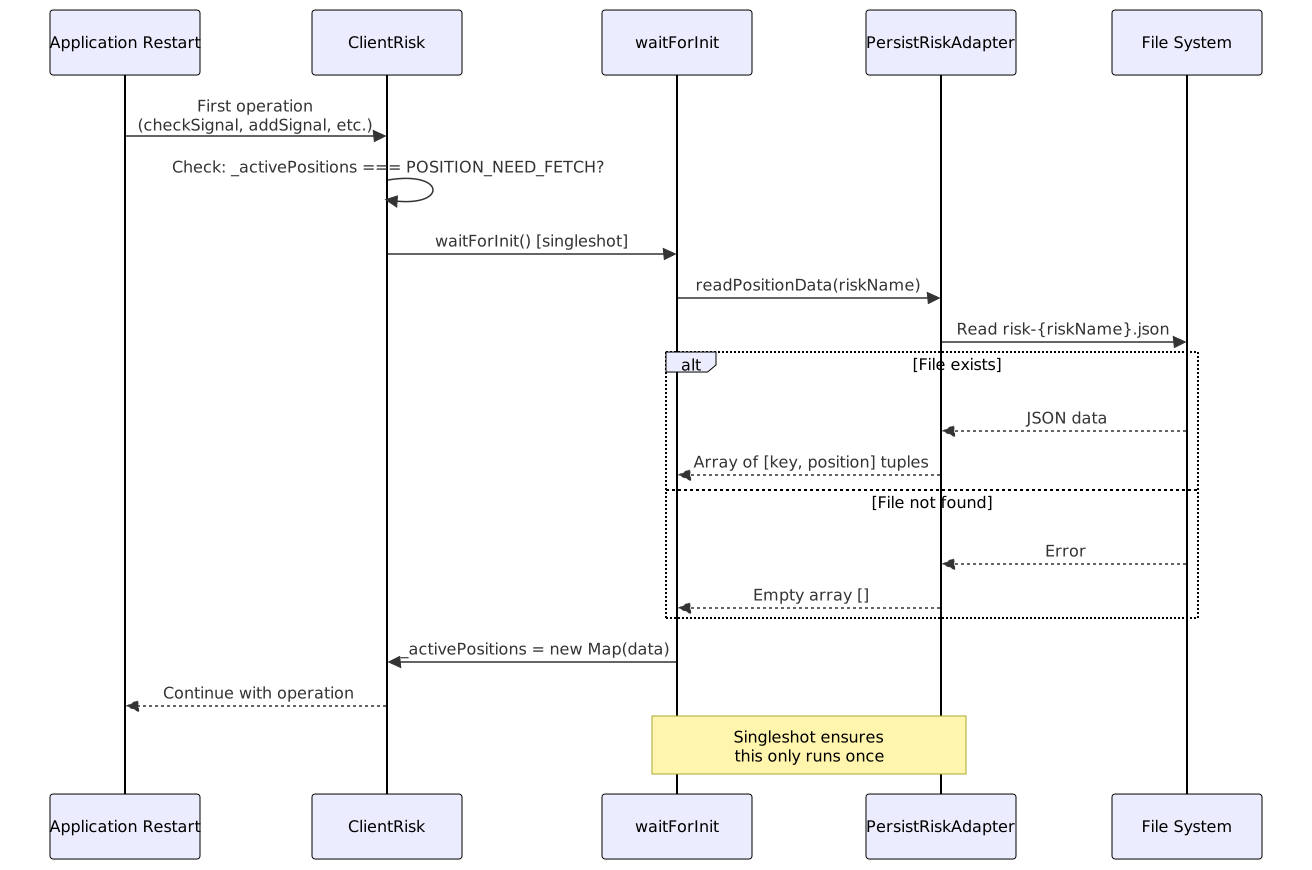
Isolation by Risk Name:
Each riskName has isolated persistence:
| Risk Name | File Path | Isolated State |
|---|---|---|
"conservative" |
risk-conservative.json |
Separate Map |
"aggressive" |
risk-aggressive.json |
Separate Map |
"moderate" |
risk-moderate.json |
Separate Map |
Data Flow Diagram

Payload Construction:
The checkSignal method constructs the validation payload by combining:
- Passthrough arguments from
IRiskCheckArgs(symbol, strategyName, exchangeName, currentPrice, timestamp) - Portfolio state from
_activePositionsMap (activePositionCount, activePositions array)
Key Implementation Details
Memoization in RiskConnectionService
ClientRisk instances are created once per riskName and cached:
public getRisk = memoize(
([riskName]) => `${riskName}`,
(riskName: RiskName) => {
const schema = this.riskSchemaService.get(riskName);
return new ClientRisk({
...schema,
logger: this.loggerService,
});
}
);
Implications:
- Multiple strategies sharing a
riskNameuse the sameClientRiskinstance - Position tracking is shared across all strategies with the same risk profile
- Validation state is consistent for all strategies in the risk group
Validation Function Types
Two validation formats are supported:
Object Format:
{
validate: (payload: IRiskValidationPayload) => {
if (payload.activePositionCount >= 5) {
throw new Error("Max 5 positions");
}
},
note: "Limit to 5 concurrent positions"
}
Function Format:
(payload: IRiskValidationPayload) => {
if (payload.activePositionCount >= 5) {
throw new Error("Max 5 positions");
}
}
Both are normalized during execution:
for (const validation of this.params.validations) {
await DO_VALIDATION_FN(
typeof validation === "function"
? validation
: validation.validate,
payload
);
}
Error Handling Strategy
Validation Errors:
- Validation functions throw errors to reject signals
DO_VALIDATION_FNwrapper catches errors and returnsfalse- Errors are logged and emitted to
validationSubject - First validation failure short-circuits remaining validations
Persistence Errors:
- Read failures during initialization return empty array (no crash)
- Write failures propagate to caller (operation fails, state remains consistent)
Position Key Uniqueness
The composite key pattern ensures:
| Component | Purpose |
|---|---|
strategyName |
Allows multiple strategies to track the same symbol |
: separator |
Delimiter between components |
symbol |
Trading pair identifier |
Example Keys:
"momentum-1m:BTCUSDT"
"mean-reversion:BTCUSDT"
"momentum-1m:ETHUSDT"
This allows:
momentum-1mandmean-reversionto both holdBTCUSDTpositions- Each strategy-symbol combination counted separately
- Risk limits applied to total across all keys