Exchange Schemas
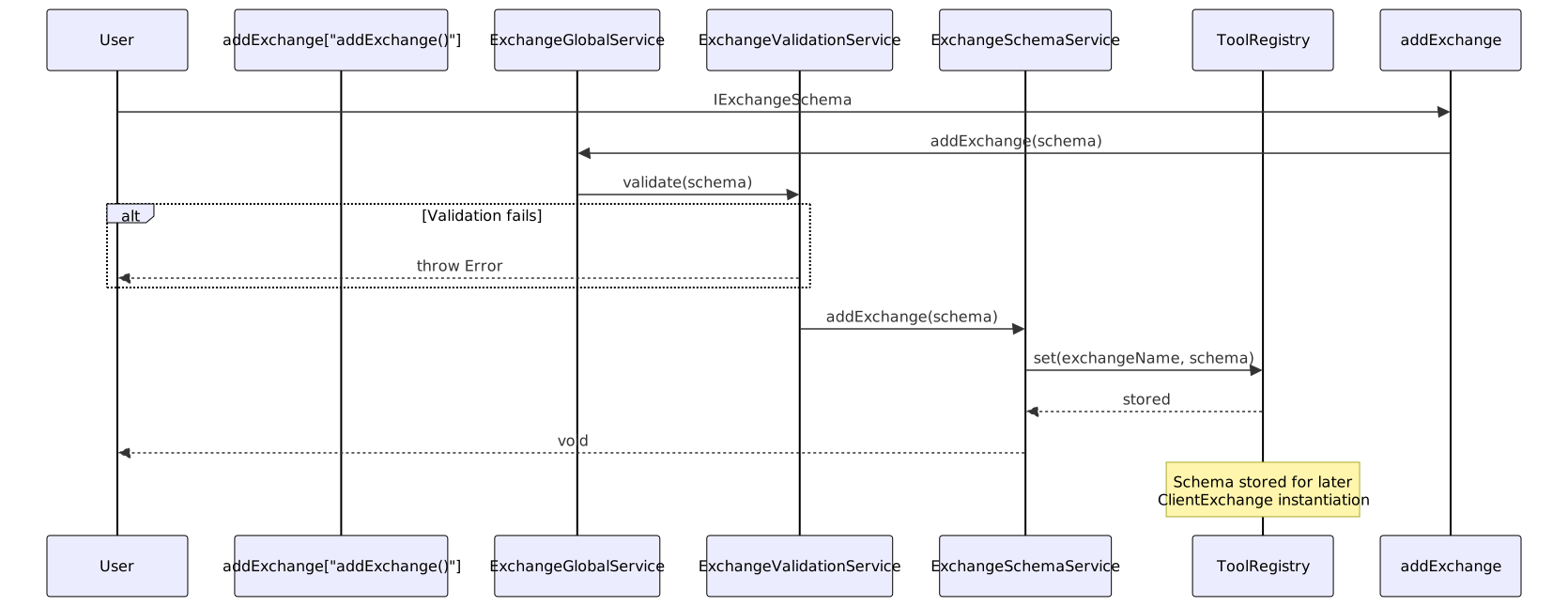
Exchange schemas define market data sources for backtesting and live trading. An exchange provides historical candle data (OHLCV) and formatting functions for prices and quantities. Exchanges are registered via addExchange() and instantiated as ClientExchange instances by the connection service layer.
For information about strategy schemas that consume exchange data, see Strategy Schemas. For frame schemas that define backtest time ranges, see Frame Schemas.
Interface Definition
The IExchangeSchema interface specifies the contract for all exchange implementations. It consists of three core functions and optional lifecycle callbacks.

Required Fields
exchangeName
Unique identifier for the exchange. Used throughout the system to reference this exchange configuration via dependency injection.
| Property | Type | Description |
|---|---|---|
exchangeName |
ExchangeName (string) |
Unique exchange identifier |
note |
string? |
Optional developer documentation |
getCandles Function
Fetches historical OHLCV candle data from the exchange data source (API, database, or custom provider).
Signature:
getCandles: (
symbol: string, // Trading pair (e.g., "BTCUSDT")
interval: CandleInterval, // Candle time interval
since: Date, // Start date for data fetch
limit: number // Maximum candles to return
) => Promise<ICandleData[]>
Returns: Array of ICandleData objects sorted by timestamp ascending.
Temporal Isolation: The since parameter is automatically determined by ExecutionContextService.context.when to prevent look-ahead bias during backtesting. Strategies cannot access future data.
formatPrice Function
Formats price values according to exchange precision rules (e.g., 2 decimal places for USDT pairs).
Signature:
formatPrice: (
symbol: string, // Trading pair
price: number // Raw price value
) => Promise<string> // Formatted price string
formatQuantity Function
Formats quantity/amount values according to exchange precision rules (e.g., 8 decimal places for BTC).
Signature:
formatQuantity: (
symbol: string, // Trading pair
quantity: number // Raw quantity value
) => Promise<string> // Formatted quantity string
Candle Data Structure
Each candle represents aggregated trading data for a specific time interval.

| Field | Type | Description |
|---|---|---|
timestamp |
number |
Unix timestamp in milliseconds when candle opened |
open |
number |
Opening price at candle start |
high |
number |
Highest price during candle period |
low |
number |
Lowest price during candle period |
close |
number |
Closing price at candle end |
volume |
number |
Trading volume during candle period |
VWAP Formula: The system uses the last 5 1-minute candles to calculate Volume Weighted Average Price for realistic entry/exit pricing:
Typical Price = (High + Low + Close) / 3
VWAP = Σ(Typical Price × Volume) / Σ(Volume)
Registration Flow
Exchange schemas are registered via addExchange() and stored in ExchangeSchemaService using the ToolRegistry pattern.
Exchange Instance Lifecycle
ExchangeConnectionService creates and memoizes ClientExchange instances using a composite key strategy.

Memoization Key: ${symbol}:${exchangeName}:${backtest}
This ensures separate exchange instances for:
- Different symbols (e.g., BTCUSDT vs ETHUSDT)
- Different exchanges (e.g., binance vs coinbase)
- Different execution modes (backtest vs live)
Candle Data Flow
Exchange candles flow through multiple layers before reaching strategies.
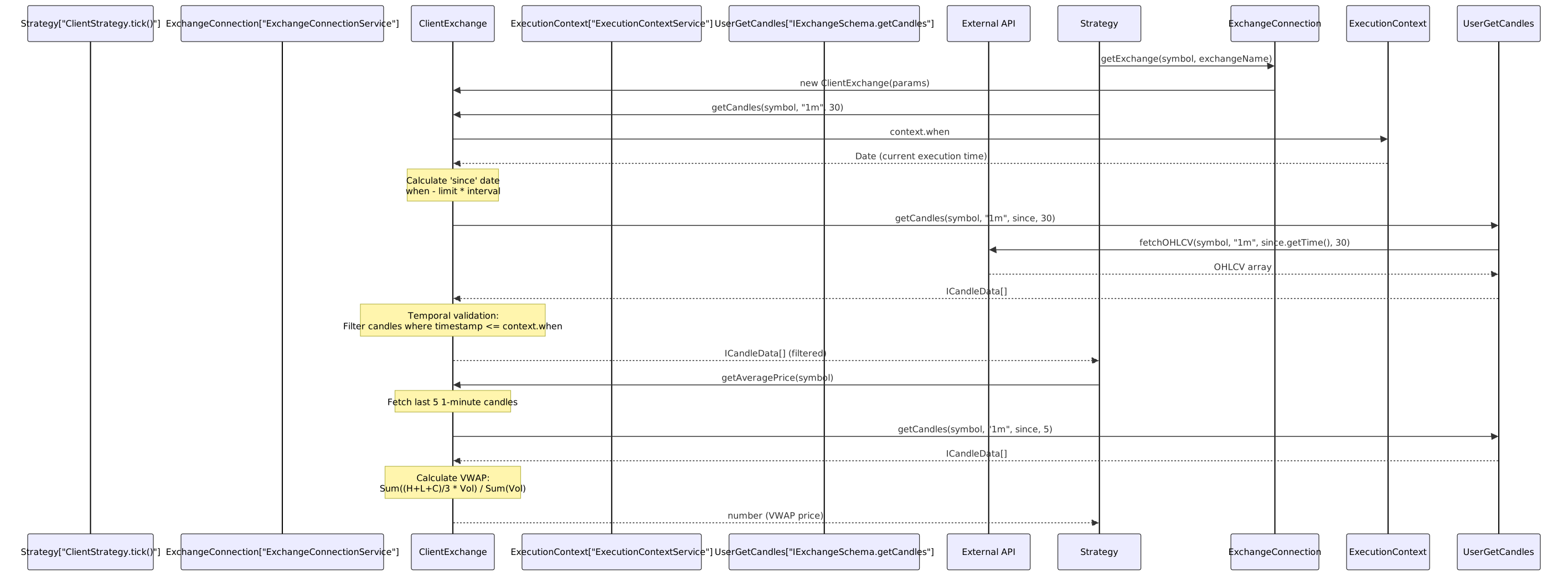
Temporal Isolation: ClientExchange automatically filters candles to ensure candle.timestamp <= ExecutionContextService.context.when. This prevents look-ahead bias in backtesting.
Callbacks
Optional lifecycle callbacks for monitoring candle data fetching.
onCandleData
Invoked after candle data is successfully fetched from the exchange. Useful for logging, caching, or debugging.
callbacks: {
onCandleData: (
symbol: string, // Trading pair
interval: CandleInterval, // Candle interval
since: Date, // Start date requested
limit: number, // Limit requested
data: ICandleData[] // Fetched candles
) => void
}
Integration Example
Typical exchange schema using CCXT for Binance data:
import ccxt from "ccxt";
import { addExchange } from "backtest-kit";
addExchange({
exchangeName: "binance",
note: "Binance exchange via CCXT",
getCandles: async (symbol, interval, since, limit) => {
const exchange = new ccxt.binance();
const ohlcv = await exchange.fetchOHLCV(
symbol,
interval,
since.getTime(),
limit
);
return ohlcv.map(([timestamp, open, high, low, close, volume]) => ({
timestamp,
open,
high,
low,
close,
volume
}));
},
formatPrice: async (symbol, price) => {
// USDT pairs: 2 decimals
return price.toFixed(2);
},
formatQuantity: async (symbol, quantity) => {
// BTC: 8 decimals
return quantity.toFixed(8);
},
callbacks: {
onCandleData: (symbol, interval, since, limit, data) => {
console.log(`Fetched ${data.length} ${interval} candles for ${symbol}`);
}
}
});
Validation Rules
ExchangeValidationService enforces the following constraints during registration:
| Rule | Description |
|---|---|
| Unique Name | exchangeName must be unique across all registered exchanges |
| Required Functions | getCandles, formatPrice, formatQuantity must be provided |
| Valid Return Types | getCandles must return Promise<ICandleData[]> |
| Valid Intervals | All CandleInterval values must be supported |
ClientExchange Implementation
The ClientExchange class implements the IExchange interface and provides additional functionality:

Additional Methods:
getNextCandles
Fetches future candles for backtest fast-forwarding. Only used in backtest mode.
getNextCandles: (
symbol: string,
interval: CandleInterval,
limit: number
) => Promise<ICandleData[]>
Calculates since as context.when + (interval duration) to fetch candles starting after the current execution time.
getAveragePrice
Calculates VWAP from the last 5 1-minute candles. This is the price used for all signal entry/exit calculations to provide realistic execution pricing.
getAveragePrice: (symbol: string) => Promise<number>
Formula Implementation:
const candles = await this.getCandles(symbol, "1m", 5);
const totalValue = candles.reduce((sum, c) => {
const typicalPrice = (c.high + c.low + c.close) / 3;
return sum + (typicalPrice * c.volume);
}, 0);
const totalVolume = candles.reduce((sum, c) => sum + c.volume, 0);
return totalValue / totalVolume;
Temporal Isolation
ClientExchange enforces temporal isolation to prevent look-ahead bias during backtesting.

Implementation: src/client/ClientExchange.ts:70-120
This ensures that strategies only see historical data up to the current backtest timestamp, preventing look-ahead bias and ensuring realistic strategy testing.
Public API Functions
Helper functions for accessing exchange functionality from user code:
getCandles
import { getCandles } from "backtest-kit";
const candles = await getCandles("BTCUSDT", "1m", 30);
Retrieves candles using the current execution context (symbol, exchange, timestamp).
getAveragePrice
import { getAveragePrice } from "backtest-kit";
const vwapPrice = await getAveragePrice("BTCUSDT");
Calculates VWAP from the last 5 1-minute candles.
formatPrice / formatQuantity
import { formatPrice, formatQuantity } from "backtest-kit";
const priceStr = await formatPrice("BTCUSDT", 50000.123); // "50000.12"
const qtyStr = await formatQuantity("BTCUSDT", 0.123456789); // "0.12345679"
Formats values according to exchange precision rules.